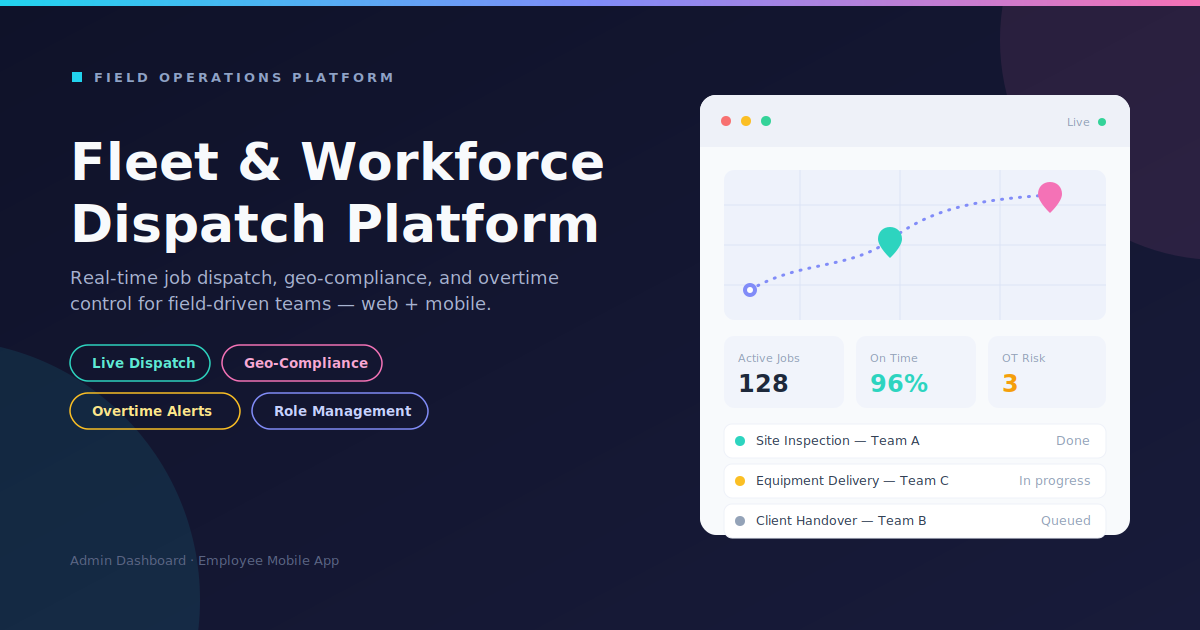
Fleet & Workforce Dispatch Platform

A centralized system built for field-driven businesses — replacing spreadsheets and scattered check-ins with one real-time operational layer for dispatch, workforce tracking, and compliance.
Overview
Field service businesses run on constantly moving teams, equipment, and job sites. Without a unified system, operations teams end up relying on spreadsheets, scattered check-ins, and after-the-fact reporting — which makes accountability, safety compliance, and overtime cost control difficult to manage at scale.
This platform was built to solve that: a real-time operational command center for dispatch and workforce management, paired with a simple, guided mobile experience for field employees.
The system is delivered as two connected products:
Web-based Admin Dashboard — for operations, dispatch, and management teams
Employee Mobile App — for field teams to check in, execute jobs, and stay compliant
Key Capabilities
Centralized Dispatch & Job Operations
Create and assign jobs to teams or individual employees across multiple sites
Monitor job progress and execution status in real time
Jobs flow directly to the employee's mobile app — no manual follow-up needed
Choose, at the point of job creation, exactly which team member is authorized to mark a task complete, keeping accountability precise even within larger crews
Field-Ready Mobile App
Secure login, assigned job & schedule visibility
Geo-tagged check-in / check-out at job sites
Automatic location tracking during work hours
Built-in mileage tracker with work/personal trip tagging — usable for tax rebates or client billing
Instant feedback when an action triggers a compliance alert
Location & Geo-Compliance
Configurable geo-fences per job site
Real-time detection of check-ins from unauthorized locations, early departures, or route deviations
Live map view of workforce distribution and activity
Attendance, Overtime & Cost Control
Automatic, location-verified attendance tied to specific jobs (not generic clock-ins)
Predictive overtime monitoring at the employee, team, and organizational level
Cost impact visibility before overtime thresholds are breached, not after
Role-Based Access & Sub-Admin Management
Create sub-admin accounts with defined access and responsibilities
Track sub-admin activity — see exactly what actions were, or weren't, performed
Configure an inactivity window that automatically deactivates dormant accounts, keeping access control tight without manual audits
Alerts, Exceptions & Reporting
Automated detection of anomalies: late arrivals, early exits, unauthorized stops, geo-fence violations, overtime risk
Prioritized, contextual alerts so supervisors act on what matters, not noise
Exportable reports for payroll validation, audits, and management review
Built to Scale
Integration-ready architecture for future connectivity with payroll, accounting, ERP, and HR systems
Rule-based automation layer for alerts, notifications, and thresholds
The Approach
The platform was designed around how work actually happens on the ground, not just how it's reported:
Planning & Setup — employees, teams, roles, job sites, pay rules, and compliance thresholds configured centrally
Dispatch — jobs created and assigned, delivered instantly to the mobile app
Field Execution — check-ins, time tracking, and location capture happen naturally as part of the workday
Live Monitoring — operations teams get instant visibility into attendance, overtime risk, and job progress
Exception Handling — alerts surface automatically, so supervisors intervene early
Reporting — verified hours feed directly into payroll and compliance workflows
Who It's For
This kind of platform fits any business that dispatches teams into the field and needs to trust the data that comes back — energy services, facilities maintenance, utilities, logistics, security, and similar field-driven operations. The common thread is teams and equipment that move constantly, and a management layer that needs to keep up without adding friction for the people doing the work.
Outcome
By replacing fragmented tools and manual tracking with a single operational layer, the platform gives operations teams real-time control instead of reactive firefighting — while keeping the field experience simple enough that adoption doesn't require training overhead.
The result is a system where dispatch, attendance, compliance, and cost visibility all originate from the same source of truth, so there's no reconciliation between spreadsheets, messaging threads, and after-the-fact reports. Supervisors see issues as they happen, not days later during payroll review — and field employees get a tool that fits into their actual workday instead of adding a second job of reporting on the first one.
1reading now
Get an email when Akash publishes