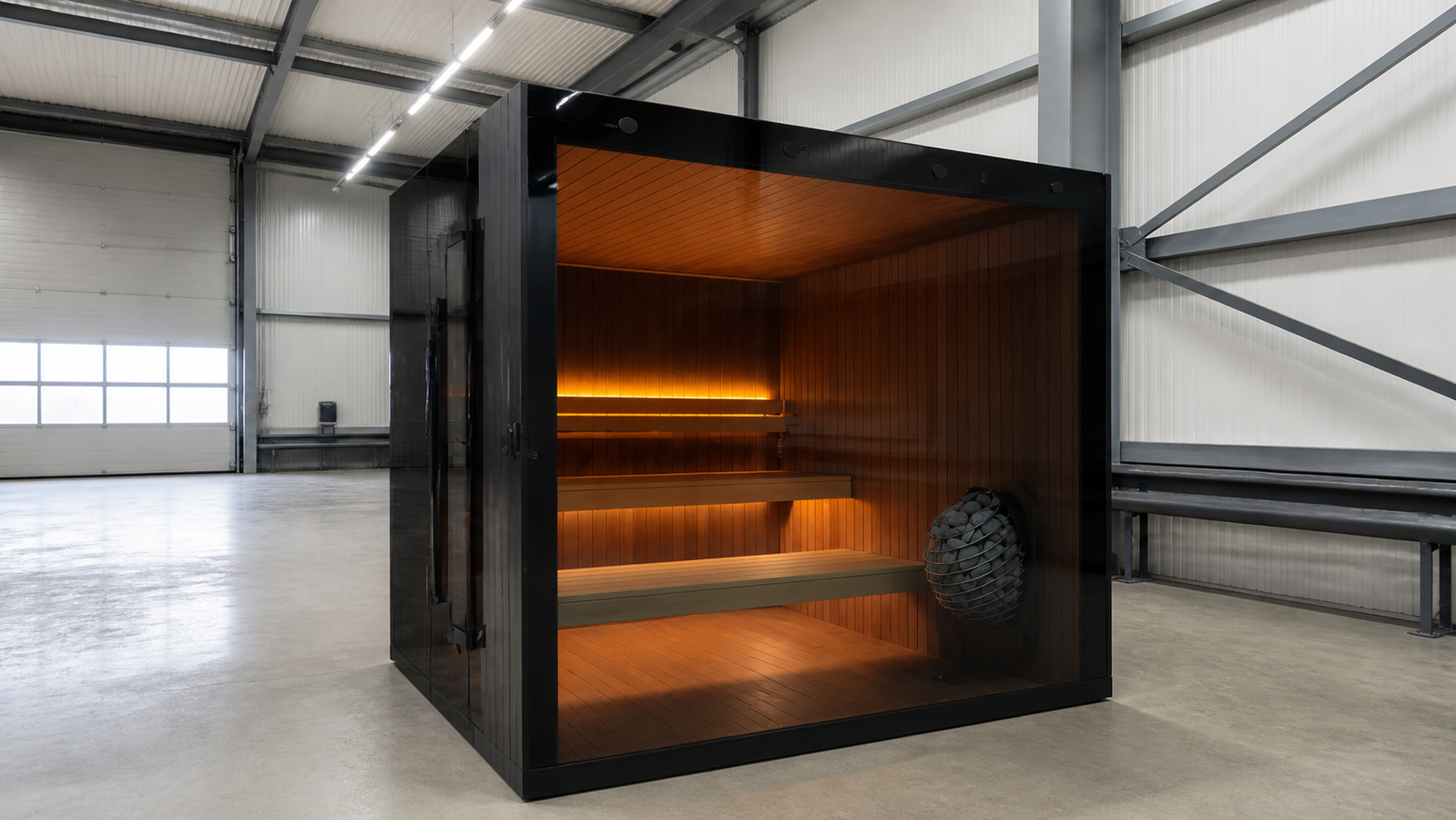
What Should You Ask to See on a Sauna Factory Visit?

Key Takeaways
On a sauna factory visit, ask to see eight things, starting with a sauna being built that day.
A display unit shows the finish. A part-built unit shows what the finish will hide.
Ask for a completed pre-shipment inspection record with the customer's name removed, never a blank template.
For consumer products in its scope, Article 9 of Regulation (EU) 2023/988 requires technical documentation kept for 10 years.
EU Deforestation Regulation duties start on 30 December 2026. Micro and small operators get 30 June 2027 only for products the Timber Regulation didn't list.
For a remote visit, keep the same eight stops and choose the unit yourself on a live call.
A factory visit earns its travel cost only if you choose the route before you arrive. We assemble and check every sauna in our 2,000 m² workshop in Klaipėda before it ships, so we know which corners hold evidence. Here are eight things to ask to see, and what each one proves.
What Should You Ask to See on a Sauna Factory Visit?
On a sauna factory visit, ask to see eight things. Start with a sauna being built that day and the timber store behind it. Then the assembly area where units are checked before dispatch, the electrical preparation, and the packing. Finish in the office: a completed inspection record, the technical file for your model, and the person who answers technical questions after the sale. A showroom proves a supplier can finish one sauna. These eight stops show whether the same care reaches every unit.
What should you check in public registers before you travel?
Two public checks take minutes.
The first is the business register of the supplier's country. In Lithuania, for example, the State Enterprise Centre of Registers runs a public search of the Register of Legal Entities by company name or code. Write down the legal name and the registered address.
The second is the European Commission's VIES service. It checks a VAT number in real time against the database of the member state that issued it. It says nothing about a workshop.
A registered office can sit in a different town from the production site. Ask for the reason, and for the production address.
For the invoice and bank checks, read How Do You Verify a Sauna Factory Before a Deposit?
What does each of the eight stops prove?
Ask to see | What it proves | Bad sign |
|---|---|---|
1. A sauna being built today, with a wall still open | The supplier builds here, and the drawing matches the floor | Only finished display units on a working day |
2. The timber store and the delivery note for one pack | The factory knows who supplied its wood | “European timber”, with no supplier name |
3. The assembly area and a pre-dispatch check | Units are assembled and checked before they leave | “Nothing ever fails here” |
4. A fitted heater and the wiring diagram for that unit | Electrical preparation matches the heater and controller ordered | A heater brochure instead of a diagram |
5. Packing and loading, or photographs of the last load | Glass is protected, and condition is recorded at loading | No record of the last unit at loading |
6. A completed inspection record, customer name removed | The check is a routine, dated and signed | A blank template |
7. The technical file and conformity documents for your model | The documentation exists and carries the registered legal name | “Our engineer keeps that” |
8. The person who answers technical questions after the sale | Your installer reaches somebody who knows the product | Only the salesperson |
What does a part-built sauna show that a display unit can't?
A display unit shows you the finish. A unit on the floor shows you what the finish will hide.
So ask for one that's part-built, with a wall still open. Ask for its drawing and check one dimension with your own tape.
Then walk on to the assembly area. Ask who checks a unit before it leaves, and watch a check if one is running. The check should be somebody's job, done on the unit and not at a desk.
Ask one more question there. What happened the last time a unit didn't pass?
A factory that checks has a recent answer. A factory where nothing ever fails isn't checking.
If nothing is being loaded that day, ask for photographs of the last load.
Some units on the floor are other customers' orders, and a factory can ask you not to photograph them. It should protect your order the same way.
What should the timber store and its paperwork show?
Walk into the timber store and pick a pack yourself. Ask who supplied it, and for the delivery document that came with it. A certificate on the office wall doesn't answer that.
There's law behind the question, and it already applies. The EU Timber Regulation, Regulation (EU) No 995/2010, covers anyone who buys timber commercially on the EU market. They must be able to identify the supplier and keep that record for at least five years.
Its replacement, Regulation (EU) 2023/1115, adds a due diligence statement. As a rule, the operator that first places timber on the EU market files it and passes the reference to its buyers.
The European Commission's page on the regulation, checked on 7 October 2026, dates those duties from 30 December 2026. Micro and small operators have until 30 June 2027, except for products the Timber Regulation already listed. Sawn timber was on that list.
So before 30 December 2026 a missing reference number isn't a failure. A factory that can't name the supplier of the pack in front of you is. At Wood Architects our timber comes from within roughly 200 km of the workshop, and distance alone proves nothing.
Which date binds a particular factory is a question for the national competent authority.
Which documents should the office show you?
Three, and none needs to leave the building.
First, a completed pre-shipment inspection record, with the customer's name removed. A blank template proves a form exists. A completed one proves somebody used it.
Second, the technical file for your model. For consumer products in its scope, Article 9 of the General Product Safety Regulation, Regulation (EU) 2023/988, requires technical documentation. The manufacturer keeps it available to authorities for 10 years after the product is placed on the market.
You don't need a copy, only to see the file open and name your model. For whether the regulation covers your sauna, read Does the GPSR Apply to Your Imported Outdoor Sauna?
Third, the wiring diagram and heater manual for the exact heater and controller in your order. The mains connection stays with your electrician, so ask which electrical work leaves the factory done. For the full pack, read What Information Should a Sauna Manufacturer Give an Electrician?
Then find the label on a finished unit. Article 9 also requires a type, batch or serial number, or another identifier, and the manufacturer's name and address. Compare that name with your register notes.
Who will answer your installer after the sale?
Ask to meet that person, by name, before you leave. Not the person who sent the quote. The one who takes the call when your installer is standing in a customer's garden with a question.
Ask how a question reaches them and what they'll need from you. If the answer is “just call me” from the salesperson, you've met the whole support department.
What changes if the factory visit is remote?
Keep the same eight stops. Change who decides what the camera sees.
Ask for a live call on a working day, from a phone carried through the building. You choose the unit and the timber pack. Pick the third one from the door, not the one nearest the lens.
Ask for close-ups of what you'd read yourself in person. The label on a finished unit. The tag on the timber pack you picked.
A camera can't tell you how a door closes or how a joint feels under your hand. So agree that someone you trust will check the first unit against its inspection record when it arrives.
Which answers on a factory visit should worry you?
One awkward answer isn't a verdict. The person who knows may be out that day. A pattern is different.
Two answers from the table weigh more than the rest. A blank template where a completed record should be. And “nothing ever fails here”.
A production hall closed on a working day belongs with them. Safety rules can limit where you walk. They don't explain a locked door.
You don't need all eight stops to go perfectly. Do one thing before you leave. Pick a unit in dispatch, ask for its completed inspection record, and match the reference on the paper to the unit.
After the lorry leaves, the only name your customer knows is yours.
Frequently asked questions
How can you tell a real sauna factory from a trading company?
Stand on the production floor on a working day. A manufacturer can show a part-built unit and the completed inspection record of one that's ready to leave. A trading company can show a showroom and a brochure, and has to ask somebody else for the rest.
Should you announce a sauna factory visit in advance?
Yes. A working factory has safety rules and people to free up, so agree the date and ask for an ordinary production day. Choose the unit and the timber pack yourself. Advance notice doesn't spoil a visit, but a fixed script does.
Who should you bring to a sauna factory visit?
Bring the person who will install or service the saunas, and your electrician if you can. They ask about lifting points and cable entries, the details that cost you hours after the sale. A buyer alone tends to look at the finish.
What documents must a sauna manufacturer keep under the GPSR?
For consumer products in its scope, Article 9 of Regulation (EU) 2023/988 requires an internal risk analysis and technical documentation. The manufacturer keeps that documentation available to market surveillance authorities for 10 years after the product is placed on the market. The regulation has applied since 13 December 2024.
When do EU Deforestation Regulation duties start for sauna timber?
As of October 2026, the European Commission lists 30 December 2026 for large and medium operators. Micro and small operators get 30 June 2027 only for products the EU Timber Regulation didn't list. Sawn timber was on that list. Ask each supplier which date it works to.
1reading now
Get an email when Giedrius publishes