How do you price made to measure curtains online?

How do you price made to measure curtains online?
You ask the customer for two numbers, the track or pole width and the finished drop, plus the heading, the lining and the fabric, and the calculator works out everything else: how much fabric across for the fullness, how many fabric widths that is once rounded up, the cut length per width with hems and pattern repeat, the metres of fabric and lining to order, the making charge per width, and the track cut to the same length. The customer sees one price. In Curtain and Blind Calculator those steps are rules and tables you set once, so a pair of pinch pleat curtains on a 240 cm track prices itself in the time it takes to type 240. Curtains are the product most blind websites still sell by phone, because the arithmetic looked too hard to put on a page. It is not, it is just more than one table.
Why can't curtains use a size grid like blinds?
Because the cost of a curtain does not come from a supplier's finished-size table, it comes from what you make it out of. A blind is a manufactured item priced by the maker in size bands. A curtain is fabric bought by the metre, lining bought by the metre, and making charged per width or per drop, and the three add up differently for every fabric width, every fullness and every heading. Two pairs on the same 240 cm track can differ by a hundred pounds because one fabric is 140 cm wide and plain and the other is 137 cm wide with a 64 cm pattern repeat that wastes a third of a metre on every drop.
So the calculator needs rules rather than one grid. The rules are not complicated, every curtain maker does them on paper, but there are six of them and they have to run in the right order, and one of them, rounding the widths up, is the one most spreadsheets get wrong.
What are the six steps?
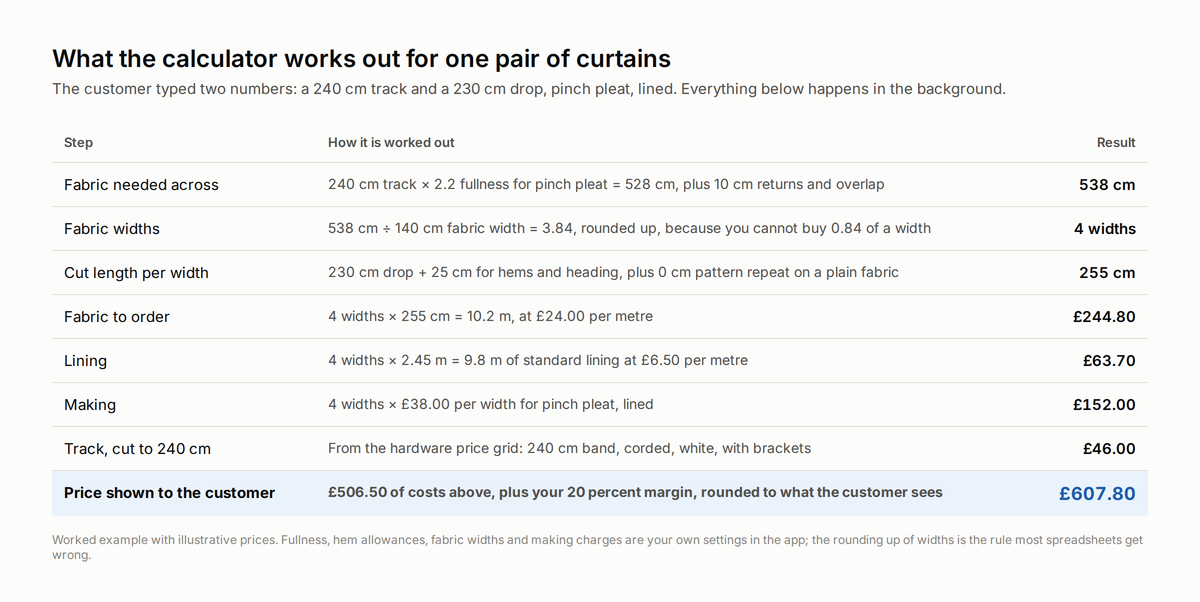
Fabric across. Track width times the fullness for the heading, 2.0 to 2.2 for pinch pleat, 2.0 for pencil pleat, 1.8 for wave, plus returns and overlap. On a 240 cm track with 2.2 fullness that is 528 cm, plus 10 cm, 538 cm.
Widths. Fabric across divided by the fabric width, rounded up. 538 divided by 140 is 3.84, so four widths, because nobody sells 0.84 of a width and a pair made from 3.84 widths would be two curtains of different sizes.
Cut length. The finished drop plus hem and heading allowances, plus the pattern repeat if the fabric has one, because every drop has to start at the same point of the pattern. 230 cm drop plus 25 cm is 255 cm on a plain fabric.
Fabric and lining to order. Widths times cut length. Four times 255 cm is 10.2 m of fabric, and about 9.8 m of lining because the lining needs slightly smaller allowances.
Making. Your making charge per width for that heading and that lining. Four widths at £38 is £152.
Hardware. The track or pole, cut to the same 240 cm, from the hardware price grid, with brackets, because a pole is priced by length like everything else in a curtain shop.
Add the lines, apply your margin, add VAT, and that is the price. In the worked example it comes to £607.80. The customer never sees the six steps. She sees £607.80, and if she changes the heading to wave the fullness drops to 1.8, the widths drop to four or three, and the price changes in front of her.
What does the customer see?
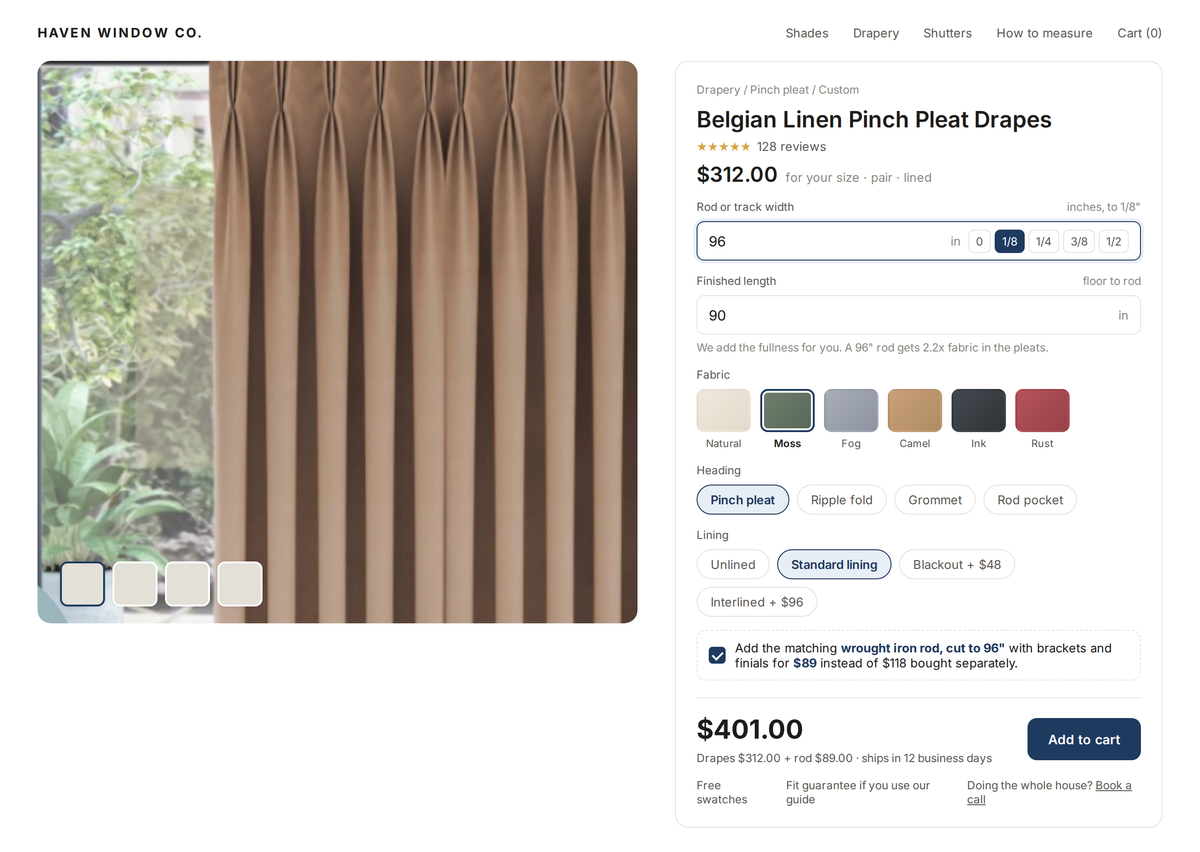
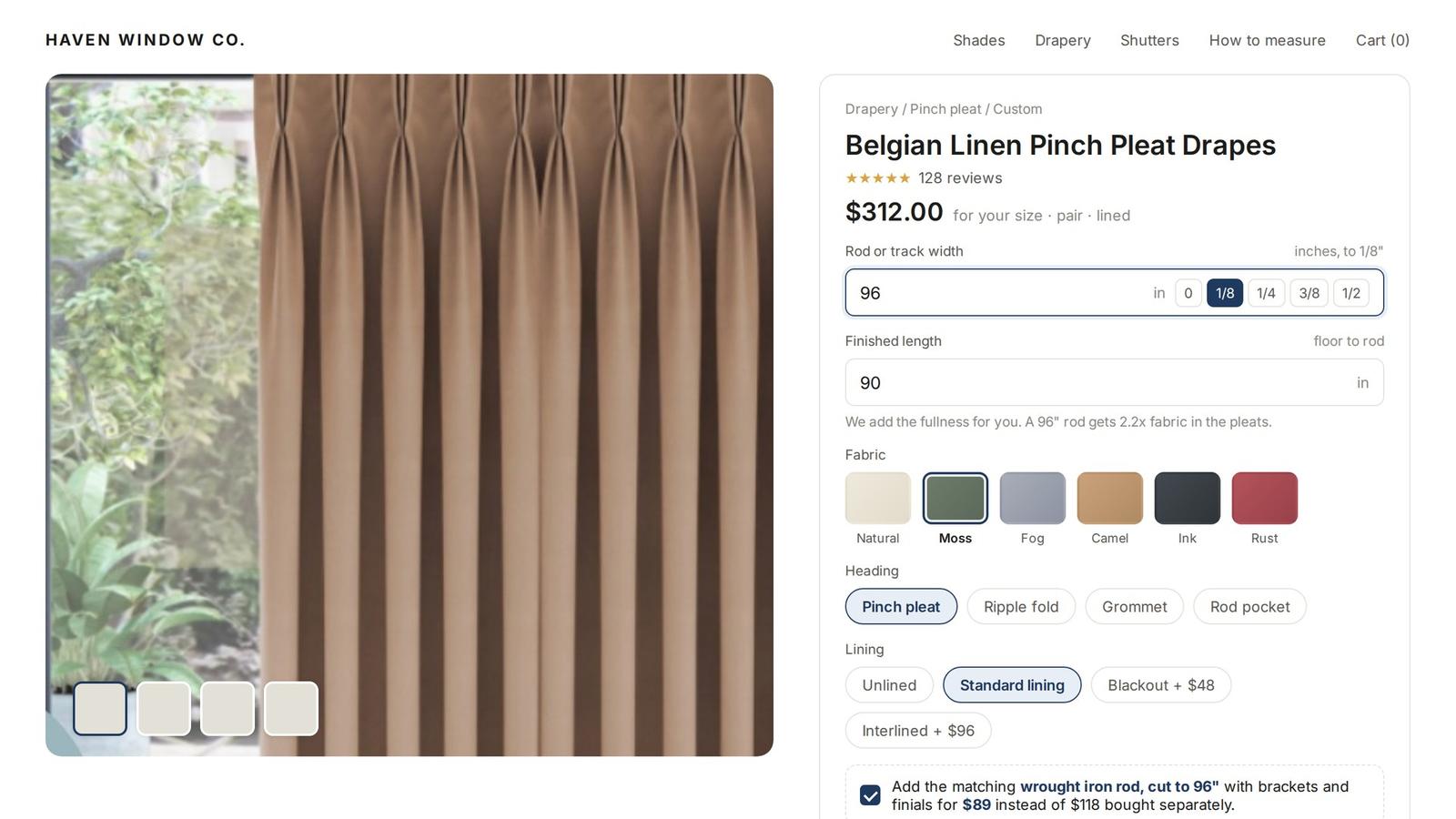
A product page that looks like the rest of the store, with the curtain photo where the photo always is and the calculator where the price used to be. The width and the drop first. The fullness explained in one line, "we add the fullness for you, a 96 inch rod gets 2.2 times the fabric in the pleats", because it is the question every curtain customer asks and almost no website answers. Fabrics as swatches. Heading and lining as pills. And a bundle at the bottom: the matching pole cut to the same length, with brackets and finials, for less than the two bought separately, because a customer who has just bought curtains needs a pole and would rather not open a second website to find one.
What about pairs, singles and bay windows?
Pairs and singles are one switch, and it changes the widths, because a single curtain on a 240 cm track still needs the full fullness but no overlap. Bay windows are where the calculator stops and the person starts. A three-sided bay needs a bent track, the widths depend on how the track is bent, and no customer should be asked to work that out on a phone at 11pm. The right answer is the popup we showed in the piece on what a calculator should look like: a form for a phone call, a video call or a home visit, with the sizes she has already typed attached to it.
Where does AI help, and where does it not?
AI will draw a beautiful curtain calculator for you in ten minutes, and it will explain fullness to your customers better than most product pages do today. Use it for both. What it will get wrong, quietly, is the rounding of widths, the pattern repeat and the allowances, because those are trade rules that live in a curtain maker's head, not on the internet. Those go into the app as your rules, checked against the curtains you actually made last month. The picture can come from AI. The number of widths has to come from the workroom.
Frequently asked questions
Can the customer see the price before checkout?
Yes. The price updates on the product page with every choice, without a form and without waiting for a quote.
Does it handle pattern repeat?
Yes. Pattern repeat is a property of the fabric, and the cut length per width includes it automatically.
Can I charge making per width or per drop?
Either. The making charge is a rule you set per heading and per lining type.
Does it work in inches?
Yes. US stores can take the rod width and the length in inches to the nearest eighth, and the widths and yardage are worked out the same way.
Can the pole be sold in the same order?
Yes. Tracks and poles are priced by cut length from their own grid and can be bundled at the total with the curtains.
The first piece on this page covers which Shopify app does this, and the price grid piece explains the table lookup that prices the pole.
If a customer typed 240 cm on your website tonight, would she see a price, or a phone number?
1reading now
Watch & subscribe
Curtain & Blind Calculator also publishes on YouTube
1.24K subscribers
One click subscribes you on YouTube - you stay here on PUBlish.
Get an email when Curtain publishes