Which Proof of Origin Should Your Sauna Import From the EU Carry?

Key Takeaways
Preferential origin is a tariff status, not simply the shipping country.
Fix the destination and HS classification before testing an origin rule.
Confirm that a relevant trade arrangement is in force for that route.
Test the product-specific origin rule against materials and processing.
The accepted proof may be a certificate, statement or importer knowledge.
EUR.1 is not a universal document for every sauna exported from the EU.
A sauna can leave an EU factory without automatically qualifying for preferential EU origin. Because we manufacture outdoor saunas in Lithuania and supply European partners, I treat origin as a route-and-evidence question, not a factory-address slogan. This method prevents the buyer from requesting the wrong form before the destination, classification, agreement and manufacturing test are fixed.
Which Proof of Origin Should Your Sauna Import From the EU Carry?
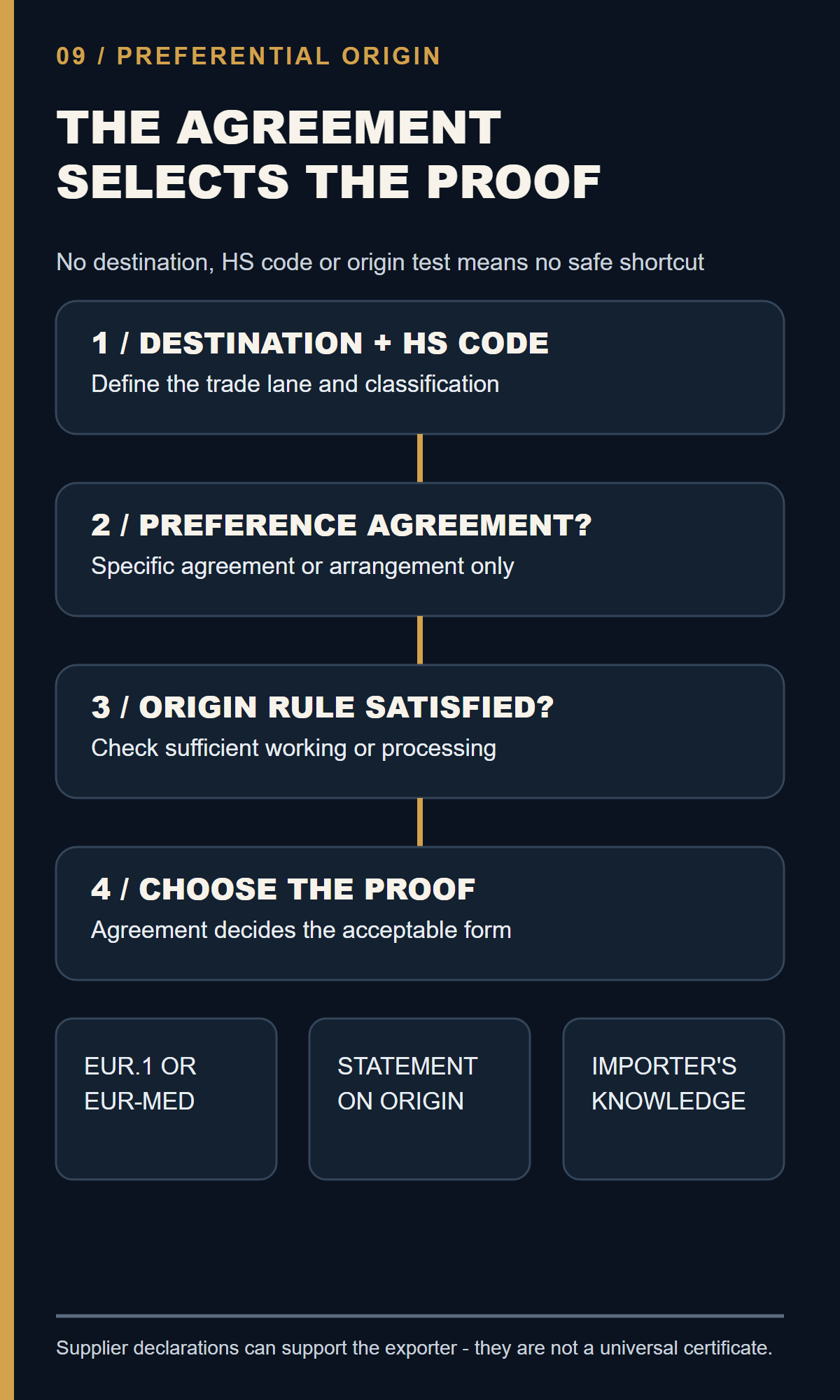
There is no universal answer such as EUR.1. First identify the destination, the sauna's HS classification and the preferential arrangement in force. Then test the agreement's product-specific origin rule against the materials and processing. Only after the product qualifies should you select the permitted proof, which may be a movement certificate, a statement on origin, an origin declaration or importer knowledge. If no preference is claimed, a different non-preferential origin question may remain.
Separate preferential origin from shipping history
EU customs guidance defines origin as the economic nationality of goods, not the place from which they were dispatched. Its rules-of-origin overview also separates non-preferential origin from preferential origin. Those two systems serve different purposes and can require different evidence.
Preferential origin can reduce or remove customs duty under a particular arrangement. It is not awarded merely because final assembly took place in the EU. The European Commission's preferential-origin introduction explains that products must be wholly obtained or undergo the working or processing required by the applicable origin protocol.
This is also different from checking where production physically happened. Our manufacturing-origin verification guide helps a buyer test factory and process evidence. Customs origin adds a legal rule to those facts.
Use a five-gate origin decision
Gate | Question | Evidence to retain |
|---|---|---|
1. Destination | Which customs territory will import the sauna? | Consignee, route and importer confirmation |
2. Classification | What is the final product's HS code? | Classification rationale or binding decision where obtained |
3. Arrangement | Is a preferential agreement or autonomous arrangement in force? | Official agreement and origin protocol |
4. Origin test | Does the sauna satisfy the relevant list rule and other conditions? | Bill of materials, supplier declarations and processing records |
5. Proof | Which proof and wording does that arrangement permit? | Correct certificate, statement or importer-knowledge record |
Do not reverse the order. Selecting EUR.1 first and searching for a justification later creates a document without a tested claim. Likewise, a supplier declaration can support an exporter's origin determination, but it is not automatically the proof presented for preference at import.
Classification comes before the product-specific rule
The Commission states that origin list rules follow the Harmonized System structure. You therefore need the HS classification before deciding which processing threshold applies. A complete outdoor sauna may not follow the same rule as loose timber, an electrical heater or separately imported accessories.
Use the importing authority's classification tools and obtain professional customs advice where the result is uncertain. Our separate sauna customs-code decision guide shows how to frame the classification question without pretending that one code fits every configuration.
Then open the arrangement for the destination. The Commission's official arrangements list points to the legal framework and origin protocol. It also directs traders to the Rules of Origin Self-Assessment tool in Access2Markets. Use the live agreement, not a form from a previous destination.
Select the proof only after qualification
The Commission's proof-of-origin guidance lists several possible routes. Certain agreements use movement certificates EUR.1 or EUR-MED. Others allow exporter self-certification through a statement on origin or origin declaration. Some arrangements permit a claim based on importer knowledge.
The wording, exporter status, value threshold, validity and supporting records depend on the arrangement. Do not copy a statement from another agreement. Do not request a green EUR.1 certificate where the live arrangement expects self-certification. If importer knowledge is used, the importer must hold enough information to support the claim.
If the product fails the preferential origin rule, do not issue a preferential proof. The shipment may still move, but the importer should assess the normal tariff and any non-preferential origin evidence required for customs or trade-policy measures.
Send a copy-ready origin request
Copy-ready request to exporter and broker
Shipment: [PROJECT / ORDER]. Importing customs territory: [DESTINATION].
Confirm the final product description and proposed HS classification, with the classification basis.
Identify the preferential arrangement and the exact origin protocol or product-specific rule relied upon.
Show how the finished sauna satisfies that rule, including relevant non-originating materials, processing and cumulation.
Provide supporting supplier declarations or manufacturing records where relied upon.
Identify the permitted proof of origin for this arrangement and shipment value.
Provide the exact statement, certificate reference or importer-knowledge basis only after the origin test is complete.
State the responsible declarant and record-retention period under the applicable arrangement.
If preference is not available, confirm that no preferential proof will be issued.
Keep the claim ready for verification
A proof is not the whole file. Customs may verify the preferential claim. Keep the classification basis, bill of materials, supplier declarations, production records and issued proof connected to the same order. If a component supplier changes, repeat the affected origin calculation before reusing the statement.
The test must be route-specific. A sauna qualifying under one agreement may need different wording or may fail a different agreement's list rule. Even where the economic origin result is unchanged, the acceptable proof can change with the destination.
That is the operational answer to Which Proof of Origin Should Your Sauna Import From the EU Carry? Fix destination and classification, test the live agreement, then choose its allowed proof. The form is the final step, not the starting point.
Before asking the chamber or exporter for a certificate, send the five-gate request to the customs broker. A written answer naming the agreement, rule and proof will prevent the most common origin-document mismatch.
Frequently Asked Questions
Does every EU sauna export need EUR.1?
No. EUR.1 is used under certain preferential arrangements, not every EU export. Other arrangements use an origin statement, origin declaration or importer knowledge. Some shipments do not claim preference at all. Select the document only after checking destination, HS classification, agreement and qualifying origin rule.
Is “made in the EU” enough for preference?
No. Preferential origin follows the conditions in the relevant agreement or autonomous arrangement. Final assembly in the EU may or may not satisfy the product-specific rule. Test the permitted working, non-originating materials, cumulation and other conditions, then retain the evidence supporting the conclusion.
Does the supplier declaration replace proof of origin?
Not automatically. A supplier declaration can provide supporting information used by an exporter to establish originating status. The proof presented for the import preference must still be the form permitted by the relevant arrangement. Keep the supplier evidence linked to the exported product and issued claim.
Can an importer use its own knowledge?
Only where the applicable arrangement permits importer knowledge and the importer holds sufficient supporting information. The European Commission identifies this route in agreements including those with Japan, New Zealand and the United Kingdom. Do not treat it as an option under every trade agreement.
What happens if no trade preference applies?
The sauna can still be imported, subject to normal customs requirements and duties. Do not issue a preferential proof without a valid arrangement and qualifying origin. The importer may still need non-preferential origin information for tariff treatment, trade-policy measures, statistics or origin-marking rules.
When should the origin test be repeated?
Repeat it when the destination, HS classification, agreement, material sourcing or manufacturing process changes. Also recheck before reusing an old statement because proof formats and exporter conditions can differ. An unchanged factory address does not establish that the same origin rule and supporting facts still apply.
1reading now
Get an email when Giedrius publishes