How Should a Hotel Compare the Energy Performance of Two Saunas?
Key Takeaways
Compare measured energy for the same service outcome, not heater nameplate power alone.
Fix one measurement boundary before either supplier runs a test.
Match six conditions: cabin, climate, start, target, use and controls.
Separate heat-up, ready-state holding and guest-session energy.
Keep time and service availability beside every kWh result.
Reject any result that arrives without its raw meter record and test conditions.
Two sauna energy figures are comparable only when they describe the same job. We preassemble and check each sauna at our Klaipėda facility, and that discipline has taught us how quickly an unstated boundary hides a difference. The comparison card below gives procurement, engineering and operations six fields they can sign together.
How Should a Hotel Compare the Energy Performance of Two Saunas?
A hotel should compare two saunas through the same measured test, with the same service outcome and a written boundary. Match the cabin configuration, starting conditions, target state, door pattern, control mode and included electrical loads. Record both energy and elapsed time. Split the result into heat-up, ready-state holding and occupied use. A smaller kWh number wins only when the sauna delivered the same temperature condition, availability and guest-use pattern.
Why doesn't heater power settle the comparison?
A heater's rated power tells you its input rate under stated electrical conditions. It doesn't tell you how long the heater runs, how the controls cycle or what the whole installed sauna consumes during a guest session. Kilowatts and kilowatt-hours answer different questions.
A lower-rated heater can run for longer. A higher-rated heater can reach the agreed condition sooner. Either outcome may suit a project. Neither becomes an energy-performance verdict until both systems perform the same job under the same boundary.
This is where polished quotations become dangerous. One supplier may measure only the heater. Another may include controls, lighting and ventilation. One may stop the clock when the controller display reaches its set point. Another may wait until the agreed sensor reaches a stable target. The figures look precise. The jobs are different.
The measurement discipline comes from ISO 50015:2014, which remains the current ISO guidance for measuring and verifying energy performance. It doesn't contain a hotel-sauna benchmark. Its value here is to define what is measured, how it is measured and which conditions can change the result.
Which six conditions must match?
Freeze six fields before testing. If a field differs, don't average the difference away. Mark the run as non-comparable and either repeat it or explain why the change belongs in the commercial decision.
Field | Record before the test | Why it changes the result |
|---|---|---|
Measurement boundary | Heater only, or heater plus controls, lights and ventilation | Different included loads create different totals |
Cabin | Internal volume, glazing, construction and selected heater | The systems must deliver heat into a defined enclosure |
Climate | Indoor or outdoor location, ambient temperature and exposure | Starting and surrounding conditions affect the test |
Start and target | Initial state, target condition, sensor and end rule | A stopwatch needs the same start and finish |
Use pattern | Door events, occupied periods and recovery rule | Guest traffic changes the service delivered |
Controls | Set point, schedule, standby mode and enabled auxiliaries | Control strategy changes runtime and availability |
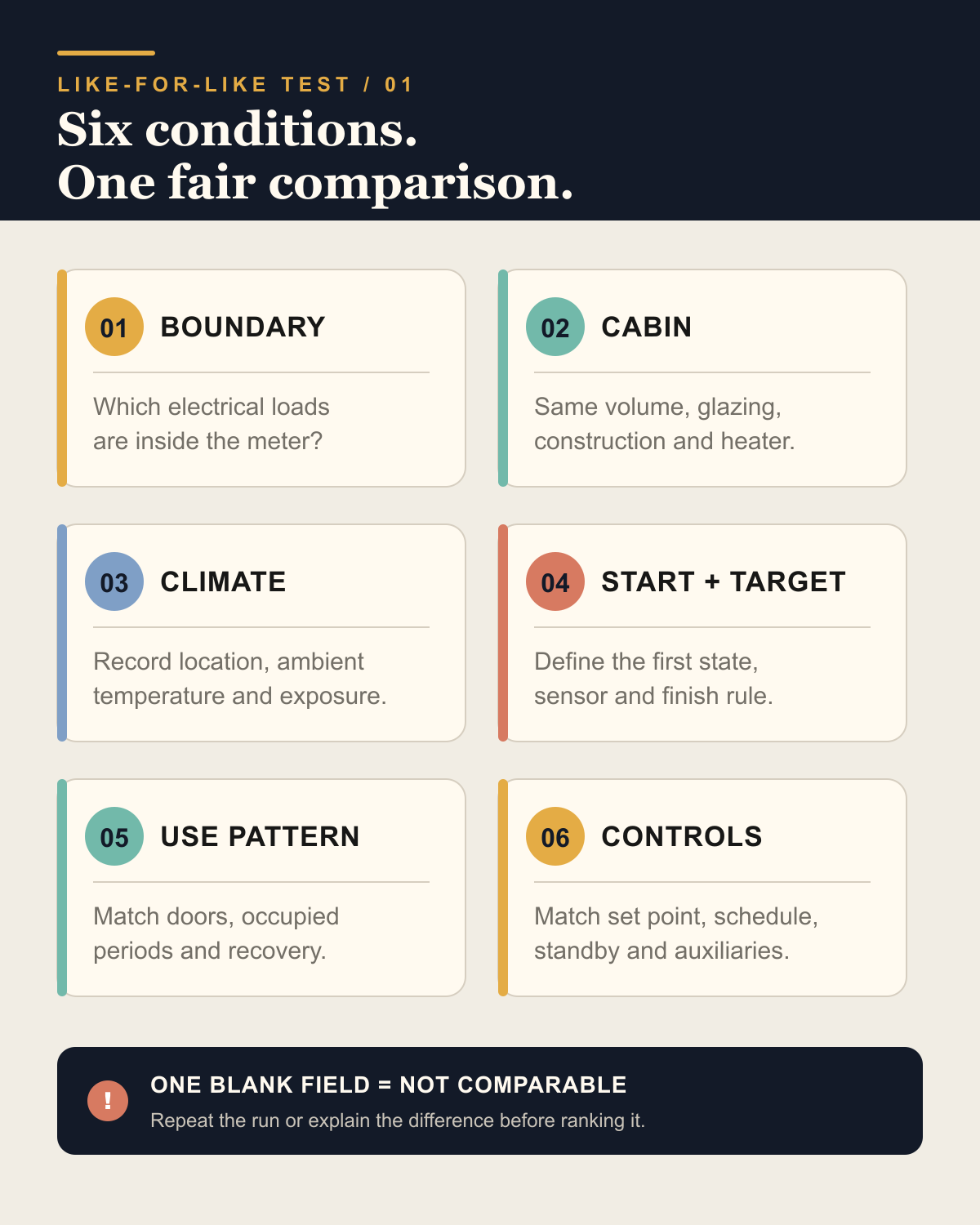
The six fields make two energy results comparable. A blank field is not a minor omission. It means the test boundary is still open.
The U.S. Department of Energy's measurement and verification guidance, checked on 25 August 2026, lists baseline conditions such as equipment, nameplate data, occupancy, control strategies, loads and operating hours. A sauna comparison is smaller than a federal energy project. The logic still applies.
At Wood Architects, factory assembly lets us check the supplied product in one controlled place before shipment. That check can confirm configuration and workmanship. It cannot create a universal hotel-energy claim. The final site, climate, operating schedule and guest behaviour remain outside the factory door.
How should the hotel run the comparison?
Use three separate test lanes. Don't compress them into one headline figure. Each lane answers a different operating question.
1. Measure the route to ready
Begin from the agreed starting state. Start the meter and timer together. End both when the agreed sensor and target rule are satisfied. Record energy, elapsed time and any control event. This lane tells operations what it costs and how long it takes to make the service available.
2. Measure the ready-state hold
Keep the same target and control mode. Record the energy used while the sauna remains ready but unoccupied. This lane exposes the cost of availability between sessions. It should not be mixed with heat-up energy, because the hotel can manage those periods differently.
3. Measure an agreed guest-use pattern
Run the same door events and occupied window for both saunas. Record meter readings, temperature response and whether the agreed service condition was restored. This lane turns energy into an operational result. It also prevents a low-energy score achieved by delivering a colder or less available sauna.
The DOE describes system-level Option B measurement as measuring all relevant performance and operational parameters. That does not make this test an IPMVP project. It gives the hotel a useful principle: measure enough of the system to explain the decision, not only the easiest number to export.
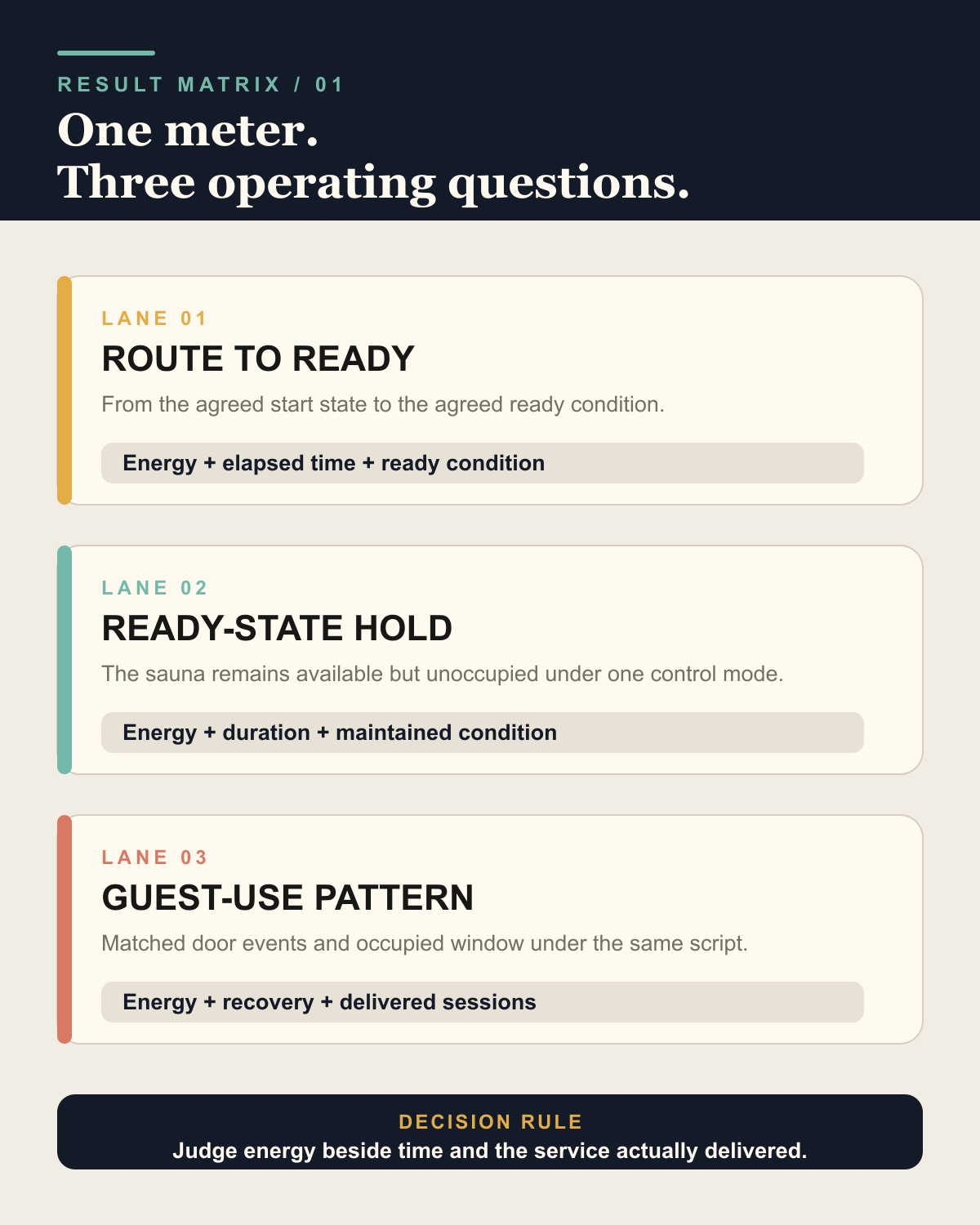
The same meter can answer three different questions. Keep heat-up, holding and guest use in separate lanes, then judge energy beside time and delivered service.
Which result should procurement choose?
Choose the result that fits the hotel's operating brief, not the smallest isolated number. A property with fixed evening sessions may value predictable heat-up. A spa with uncertain walk-in demand may value ready-state efficiency. A busy commercial route may care most about recovery and delivered sessions.
Write the priority before the supplier results arrive. Otherwise the weighting will drift towards whichever sauna already looks better.
Use this decision line:
“For this hotel, the winning sauna is the one that meets [service condition] within [approved availability rule], measured inside [electrical boundary], under [test conditions]. Energy, time and failed service outcomes will be reported separately.”
For the wider commercial scope, use How Should a European Hotel Compare Two Outdoor Sauna Quotes?. That article aligns delivery, site work, maintenance and whole-life cost. This one stays inside the energy-performance test.
What evidence should accompany the result?
Ask each supplier or test team to return the same small evidence pack. Keep the raw record beside the summary. A presentation slide is not the measurement.
“Sauna model, revision, heater and controller: [exact identification].”
“Measurement boundary and meter identification: [included loads and device].”
“Cabin, glazing and location conditions: [recorded values and photographs].”
“Start state, target state, sensor position and end rule: [definitions].”
“Door, occupancy, schedule and auxiliary settings: [test script].”
“Raw time-stamped meter and temperature record: [attached file].”
“Deviations, interruptions and excluded runs: [signed note].”
STOP: don't rank the two saunas when either result lacks its boundary, conditions or service outcome. A missing record cannot be repaired by adding more decimal places to the summary.
You don't need a laboratory campaign to improve the next decision. Print the six-field card and attach it to the request for test data. If both suppliers cannot fill the same page, their energy figures aren't ready for comparison.
Frequently asked questions
Can a hotel compare energy figures from two manufacturers?
Yes, when both figures use the same electrical boundary, cabin conditions, starting state, target rule, control mode and use pattern. If the protocols differ, treat the values as product information rather than a ranking. Ask for the raw time-stamped record and repeat the test under one agreed method.
Is a lower-rated sauna heater more energy efficient?
Not necessarily. Rated power describes input rate, not measured energy for a completed hotel service. A lower-rated heater may operate longer, while a higher-rated unit may reach the target sooner. Compare kWh, elapsed time and the delivered condition under the same test before judging efficiency.
Does panoramic glazing always mean higher sauna energy use?
Glazing belongs in the test record because the enclosure affects installed performance. It doesn't create a universal penalty that can be read from a photograph. Compare the complete cabins under matched conditions, including their construction, glass area, controls, target state and location.
How many sauna energy tests should a hotel run?
There is no universal count for every hotel. Repeat enough runs to expose normal variation across the operating conditions that matter to the property. Exclude and document interrupted runs. If results move widely, investigate the cause before reporting an average or choosing a supplier.
Should a hotel rely on factory or site energy data?
Factory data can support a controlled product comparison when both tests share one protocol. Site data shows how the installed sauna behaves with the hotel's climate, schedule and guests. Keep the two evidence types separate. Neither should be relabelled as the other.
1reading
Written by
 Giedrius PatlabaCEO & co-founder, Wood Architects163 pieces · 30 followers
Follow Giedrius to see new posts in your feed, on your phone or by email.