How Should a Hotel Plan the Winter Route to an Outdoor Sauna?

Key Takeaways
Plan the complete guest journey in both directions, not only the outward walk to the sauna.
Separate guest, staff and service movements before deciding how each route will be controlled.
Test darkness, rain, wet leaves, ice and snow as distinct operating conditions.
Give every route condition an owner, a trigger, an action and visible closure evidence.
A summer site photograph can reveal route questions, but it cannot prove winter readiness.
Local specialists must validate accessibility, safety and legal requirements for the actual hotel site.
A winter sauna experience starts at the hotel door and finishes only when the guest is safely back inside. This guide turns that return journey into an operational route plan. It covers guests, staff and service access in dark, wet, icy and snowy conditions without pretending to set universal dimensions or approve a local site.
How Should a Hotel Plan the Winter Route to an Outdoor Sauna?
A hotel should map the complete outward and return journey, separate guest, staff and service movements, and test each section in darkness, rain, wet leaves, ice and snow. Every recurring condition needs a named owner, a clear inspection trigger, a practical response and a recorded reopening decision. The route plan should cover changing, towels, footwear, lighting, thresholds and emergency return. Competent local specialists must still validate accessibility, safety and legal requirements for the actual property.
Why is the return route as important as the approach?
A guest may walk out wearing dry footwear, carrying little and seeing the route for the first time. The same person can return warm, wet, tired and less attentive. Towels, robes and personal items occupy hands. Steam on glasses, abrupt changes in light and unfamiliar thresholds can make the return feel different from the outward journey.
Start the map inside the hotel. Mark where a guest changes, collects a towel, receives footwear guidance and enters the outdoor transition. Continue through every door, turn, level change and threshold. Then trace the same journey backwards. Add the staff route used for opening checks, cleaning and guest assistance. Add any service movement that could meet guests.
This is operational planning, not a declaration that a route is accessible or compliant. A competent local adviser should validate those questions against the real site, user groups and applicable rules.
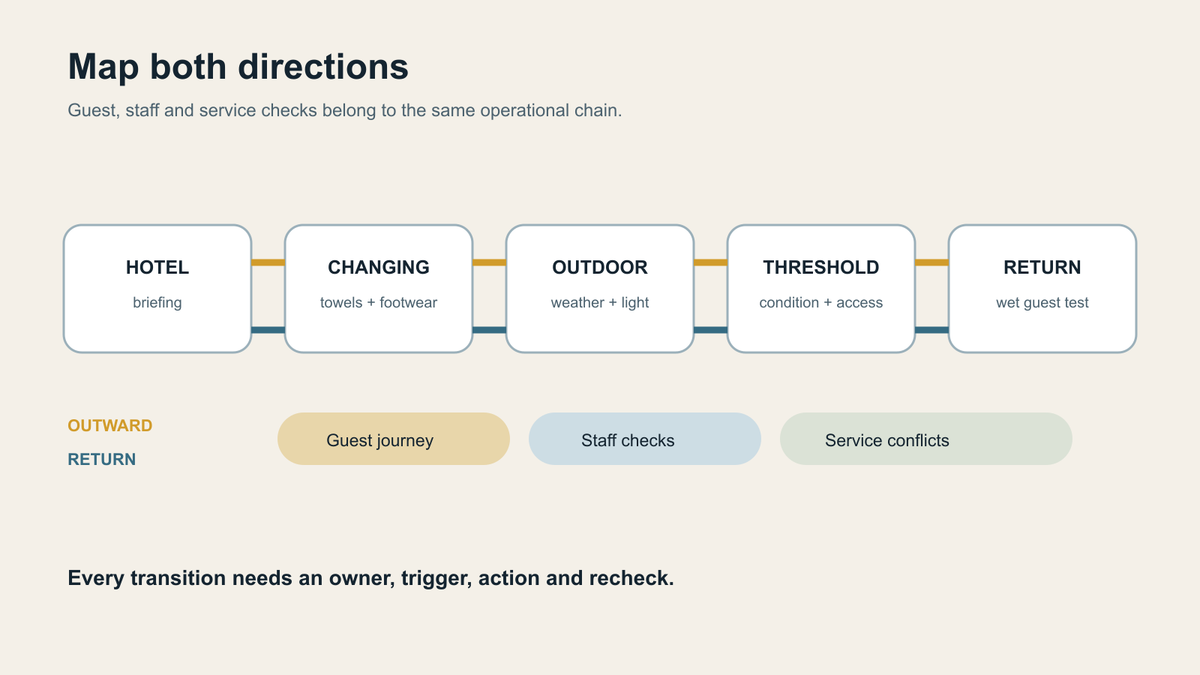
Map the outward and return journey as linked operating zones, then assign the guest, staff and service checks at each transition.
Which winter conditions should be tested separately?
Do not reduce winter to one snow icon. Darkness, rainfall, wet leaves, refreezing water, compacted snow and fresh snowfall create different operating questions. A route that is readable in dry daylight may lose its edges in low light. A surface that drains in rain may still collect meltwater at a threshold and refreeze later.
The UK Health and Safety Executive's haulage and distribution page notes less daylight, wet and slippery leaves, ice and snow on paths. It also describes checking lighting, removing leaves and gritting or diverting people from slippery walkways. We use this haulage and distribution-sector guidance only as a practical route-check example, not as hotel or sauna regulation.
Test the route at the time guests will actually use it. Walk it from the guest viewpoint and again as the staff member responsible for checking it. Look back towards the hotel to find glare, dark transitions and confusing reflections. Observe where water, snow and leaves collect after weather, not only during a dry inspection.
How should guest, staff and service movements be separated?
The three movements may share physical space, but they should not share unexamined assumptions. A guest route prioritises intuitive wayfinding and a comfortable return. A staff route needs reliable access for checks and assistance. A service route may involve deliveries, waste movement or maintenance activity that should not surprise a guest.
HSE workplace transport guidance recommends understanding how pedestrians and vehicles move around a site, reducing contact between them and considering separation, crossing points and lighting. For a hotel, that provides a useful way to examine staff and service movement. It does not set the legal answer for every country or property.
Draw each movement in a different colour. Mark time conflicts as well as physical crossings. A service vehicle that never meets guests during opening hours may require a scheduling control. A cleaning trolley that crosses the route during every reset needs a clearer operating decision. The map should say who owns that decision.
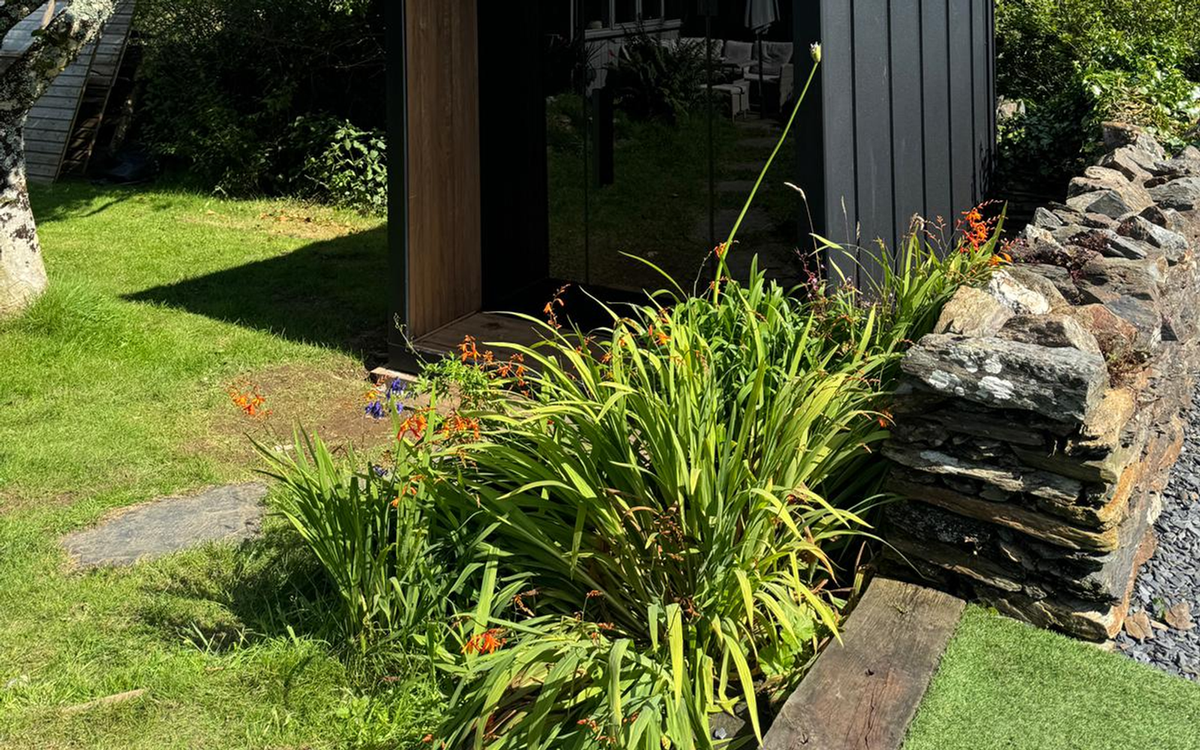
This summer photograph is useful for inspecting route and threshold context. Grass, stones and vegetation are not presented as a compliant path, and the image is not evidence of winter safety, accessibility, drainage or compliance.
What should the opening check record?
A vague instruction to check the path is difficult to repeat and harder to audit. Define the route by zones and name the condition that closes each zone. An opening check might record visibility, standing water, loose contamination, snow or ice, an obstructed threshold and any conflict with service activity.
Each finding needs a response. The response may be removal, treatment, temporary redirection, additional supervision or closure. The hotel should choose those controls with competent local advice. The record should identify the person, time, condition, action and reopening decision. A photograph can support the record when it is tied to the correct zone and time. It should not replace a decision.
Lighting needs its own observation after dark. HSE's workplace transport lighting note says lighting should be provided for pedestrian routes and that winter lighting should be positioned to avoid glare and shadows. Apply those concepts as test questions, then let the hotel's competent designers determine the actual solution and local requirements.
What can a hotel copy into its winter route plan?
Use this as an operating artefact. Replace every bracketed item with the site's own zones, responsible people and approved responses.
WINTER SAUNA ROUTE CONTROL

Route ID: [name]
Opening period: [times]
Weather source and check trigger: [define]

ZONE 1  HOTEL TO OUTDOOR TRANSITION
Guest condition to observe: [define]
Staff check and owner: [define]
Action or closure trigger: [define]

ZONE 2  OUTDOOR ROUTE
Darkness, water, leaves, ice, snow: [record each]
Guest and service conflict: [record]
Action completed by and at: [name and time]

ZONE 3  SAUNA THRESHOLD
Approach and threshold condition: [record]
Lighting observation after dark: [record]
Reopening decision: [name and time]

RETURN JOURNEY
Wet guest and carried-item test completed: [yes or no]
Assistance and emergency return owner: [name]
Unresolved finding and escalation: [record]
How can the hotel decide whether the route is ready?
A readiness decision should be condition-specific. Green does not mean the route is permanently safe. It means the defined checks were completed for the stated period and no unresolved closure trigger remains. Amber means an approved temporary control is active and owned. Red means the route stays closed until the named condition is resolved and rechecked.
Condition | Observe | Owner | Closure evidence |
|---|---|---|---|
Dark | Edges, transitions, glare and shadows | [name] | Night check recorded |
Wet | Water, leaves and threshold contamination | [name] | Action and recheck recorded |
Ice | Known collection and refreeze points | [name] | Treatment or closure recorded |
Snow | Route visibility, depth and compacted areas | [name] | Clearance and recheck recorded |
Conflict | Guest, staff and service overlap | [name] | Separation or timing control recorded |
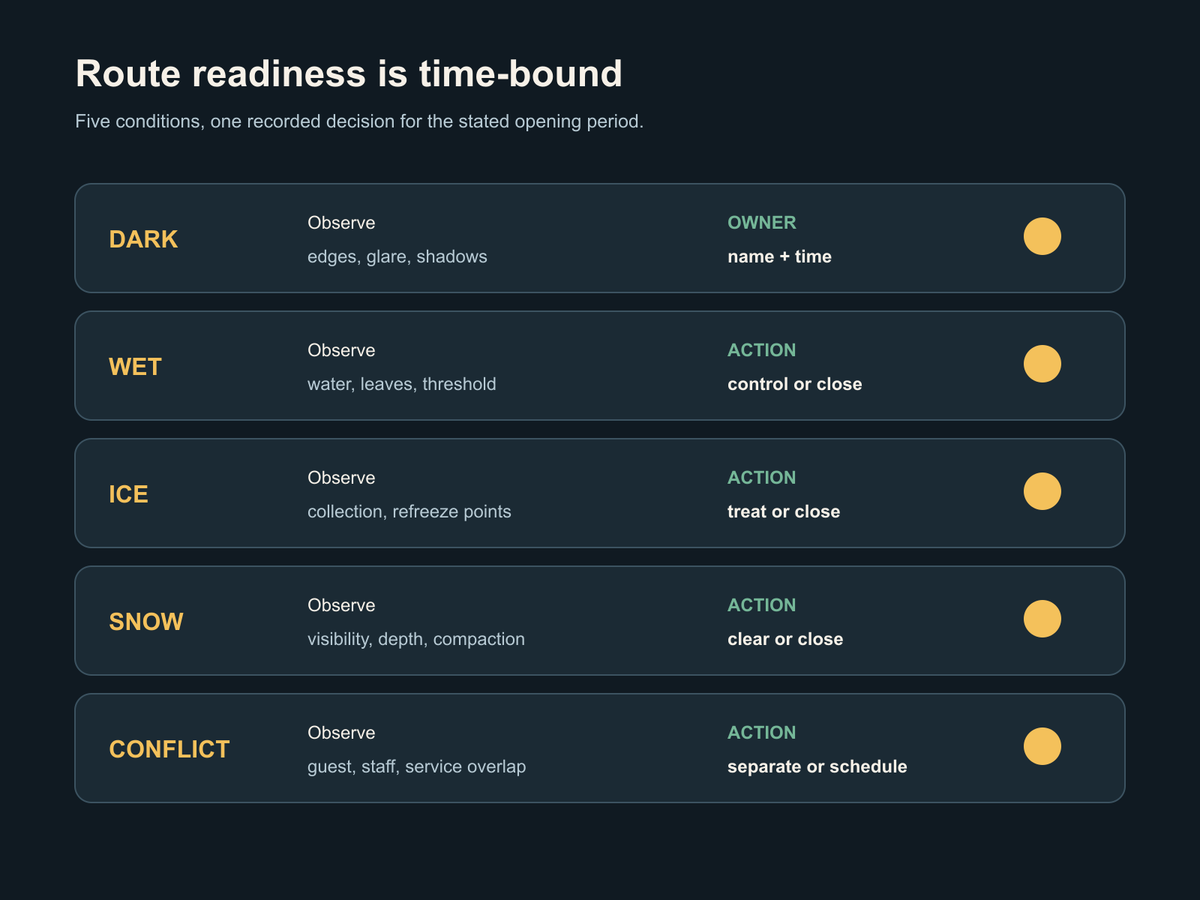
Readiness is a time-bound operating decision supported by an owner, an action and a recorded recheck.
Where does the sauna manufacturer fit?
I am Giedrius Patlaba, CEO of Wood Architects. Our public product information states that our panoramic cube saunas are delivered fully assembled. That manufacturer fact helps a hotel understand the product boundary. It does not approve the guest route, winter controls, threshold interface, drainage, lighting, accessibility or local compliance.
The manufacturer should provide the cabin interface information that the project team needs. The hotel and its competent local specialists must integrate that information into the actual route and operating plan. If the proposed position itself is unresolved, begin with How Should You Position Your Outdoor Sauna on the Site?. Positioning and winter route operation are connected, but they are not the same decision.
The best winter route plan is not a polished drawing left in the project file. It is a short, owned routine that staff can run after darkness and weather change the site. Walk the complete return journey, mark one unresolved condition and assign its next action before opening the route.
Frequently Asked Questions
Should a hotel keep the same route open all winter?
Not automatically. The hotel should define route conditions, inspection triggers and approved responses for the real site. Weather, darkness or service activity may require a temporary control, redirection or closure. The responsible person should record the decision and recheck before reopening.
Does this guide set minimum path widths or gradients?
No. It deliberately avoids universal dimensions because accessibility, building and safety requirements depend on the jurisdiction, property and users. The hotel should appoint competent local specialists to validate the route. This guide helps organise operating questions and ownership around that validated design.
How often should staff inspect the winter route?
The frequency should follow the hotel's risk assessment, weather exposure, use pattern and local obligations. Fixed opening checks may need additional event-based checks after snowfall, rain, freezing or contamination. The plan should state the trigger, responsible person, action and recorded reopening decision.
Can a photograph prove that the route is safe?
No. A dated photograph can support a record by showing a limited visible condition at one moment. It cannot prove grip, drainage, lighting performance, accessibility or compliance. Tie any image to the correct route zone, time, observer, decision and required follow-up.
Who owns the route after the sauna is delivered?
The hotel should name the operational owner and the competent specialists responsible for local validation. The sauna manufacturer can provide product interface information, but it does not operate the hotel site. Ownership for inspection, treatment, closure, assistance and records must remain explicit.
1reading now
Get an email when Giedrius publishes