When Should Your Outdoor Sauna Design Be Frozen?
Key Takeaways
A useful design freeze names a configuration, interfaces and current document references.
A render alone isn't a frozen production set.
The manufacturer freezes only the selected product information within its supply scope.
Appointed project parties retain design, verification and approval within their roles.
Every post-freeze change needs a written exception and impact review.
Unknown open decisions should stop the affected factory release.
Imagine a client approving the final exterior view while three working files remain open. The product schedule shows one opening, the coordinated plan shows another and a later email changes the heater option. Everyone remembers a “freeze”, yet no dated set identifies which configuration and documents were actually accepted.
When Should Your Outdoor Sauna Design Be Frozen?
Freeze the design before factory release, once the selected configuration, product interfaces, client choices and current project references are defined enough for that release decision. The manufacturer can confirm its product configuration and production constraints for the chosen release decision. Appointed designers, engineers and installers retain their project-specific design and verification. The client or named project lead should record the accepted set, open exceptions and change route within the actual appointments.
What belongs in the design-freeze set?
The freeze set should name the selected configuration, affected interfaces, accepted client choices and every current document used for release. It should also list unresolved items as explicit exceptions. A folder of files isn't controlled evidence unless the accepted references are visible.
As checked on 25 August 2026, the RIBA Plan of Work 2020 Overview introduces change control during Stage 3 Spatial Coordination. It describes Stage 4 as completing the information needed to manufacture and construct the project. This is UK professional-practice guidance, not a universal freeze date, appointment or sauna contract.
The framework helps explain why a freeze is a gate between coordinated decisions and technical release. It doesn't say that every project must use the same label or timing. The actual programme and approval route come from the project's appointments.
My manufacturer view is specific. A useful freeze covers the selected configuration, affected product interfaces and approved document references, not merely a render. The manufacturer can freeze its production set only within the accepted supply scope and available project inputs.
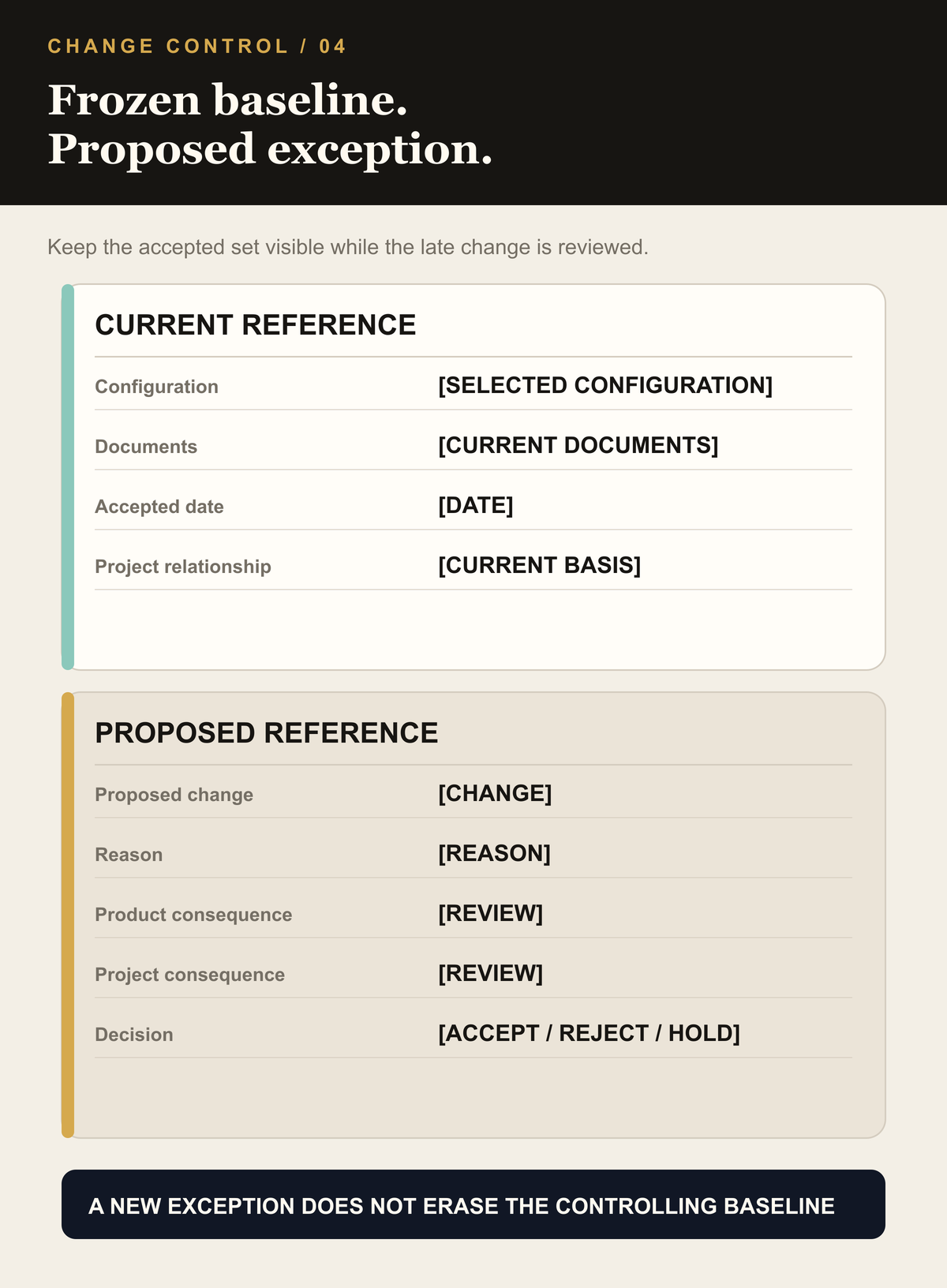
The comparison keeps the accepted baseline visible while the product and project consequences of a late change are reviewed. It does not accept the exception or supersede the current set.
How should controlled exceptions work?
An exception should name the proposed change, reason, affected references, reviewers, decision and resulting status. It should never overwrite the frozen set without a visible trail. The previous reference remains part of the record even when a new one supersedes it.
The UK BIM Framework Guidance Part D starts information requirements with purpose and distinguishes content, form and format. Those prompts help define a useful change record. This is information-management guidance, not technical approval, contract administration or permission to alter a project.
A proposed change can have several consequences without changing the external footprint. The project team should review only the consequences within each party's appointment, then record a combined release decision through the named route.
At Wood Architects, our bounded judgement is that changing the heater, control, glazing, openings or orientation can invalidate earlier product and interface assumptions. That remains possible even when the footprint is unchanged. We can assess our product-side consequences, not approve the connected project's design.
For supplier-selection context, read How Do You Spot a Reliable Sauna Manufacturer? by Giedrius Patlaba. It discusses manufacturer evidence. It doesn't replace a project-specific freeze record or authorise a post-freeze change.
Who reviews a change after the freeze?
Route the change to every appointed party whose work is affected, and no further than necessary. The manufacturer reviews product configuration and production consequences. Designers, engineers, installers, the client and relevant authorities retain their defined project decisions.
Change field | Required review | Decision evidence |
|---|---|---|
Product configuration | Manufacturer checks product-side consequences | Revised configuration reference and status |
Project relationship | Appointed designer checks coordinated project work | Updated project reference and acceptance |
Specialist interface | Appointed specialist verifies affected scope | Named technical evidence within the appointment |
Client or authority decision | Named party reviews the choice within its role | Dated decision and stated boundary |
Copy these lines into the exception record:
“Frozen set: [configuration], documents: [references], accepted: [date].”
“Proposed change: [field], reason: [text], requested by: [name].”
“Product review: [consequence], evidence: [reference], status: [text].”
“Project review: [affected scope], owner: [name], evidence: [reference].”
“Decision: [accept, reject or defer], superseded reference: [document].”
The question “When Should Your Outdoor Sauna Design Be Frozen?” is answered by the release evidence, not a calendar phrase. The gate is ready when its required decisions are named, current and accepted, with every exception visible.
The trade-off is deliberate. Freezing earlier protects production planning and document clarity, but it can lock a weak assumption. Freezing later preserves choice, yet it reduces the time available to review consequences before release.
Consider a hypothetical project where the exterior view is approved and called final. Later emails change the opening direction and control option, while the factory folder still carries the earlier schedule. The plan, product record and client expectation now describe different saunas. The failure is an undocumented exception, not a missing render.
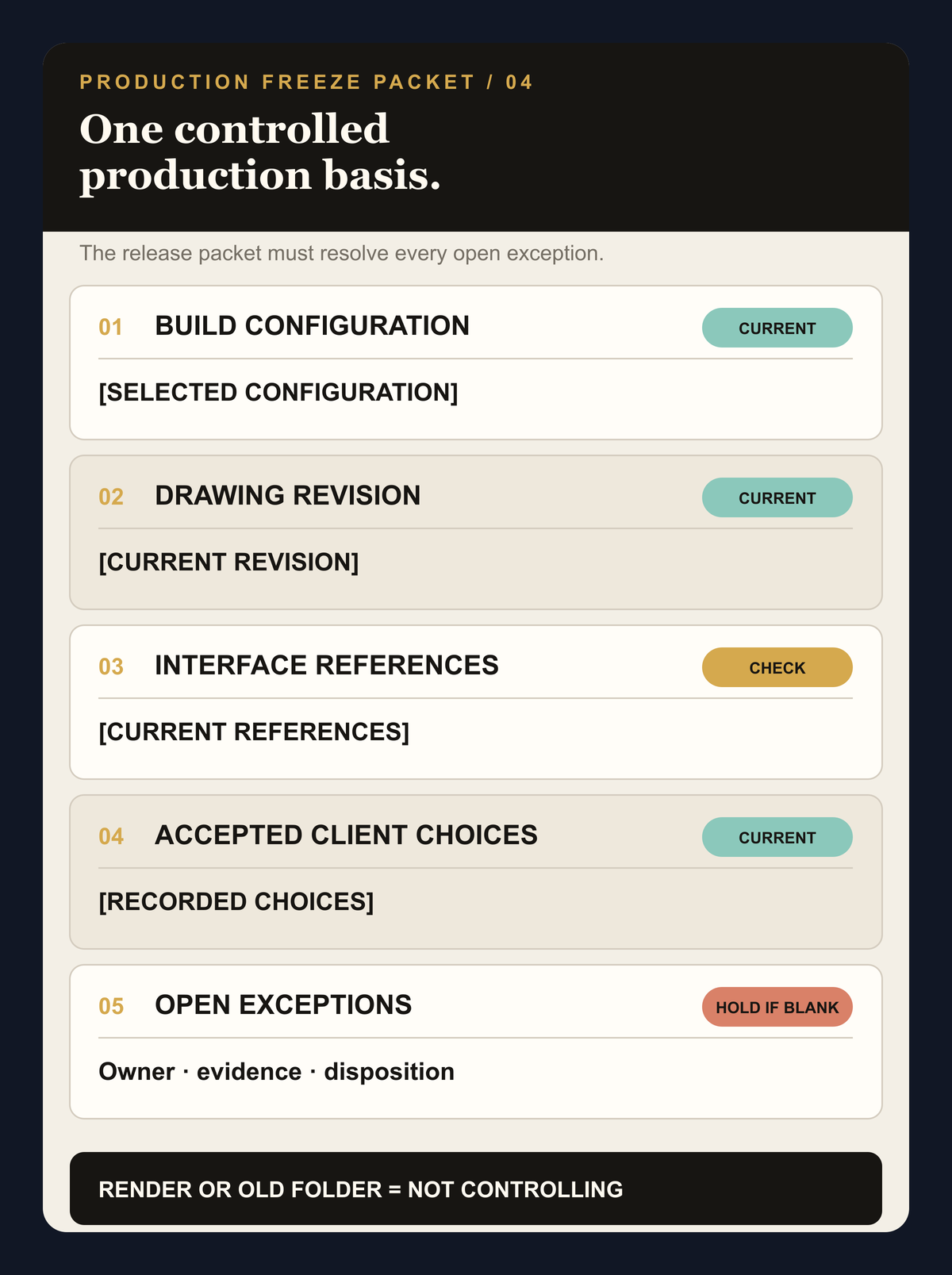
The packet shows the minimum records that must agree before release. An old render or folder remains non-controlling, and an exception stays on HOLD until owner, evidence and disposition are recorded.
What should stop factory release?
Factory release should pause when the configuration isn't identifiable, a dependent interface remains open or the current document set is disputed. It should also pause when a proposed change lacks the product or project review required by the named route.
Decision: “Release configuration [reference] against frozen documents [references], accepted exceptions [references] and open exclusions [references]. The authorised release date is [date].”
STOP: don't release the affected production work while the selected configuration, current frozen set or owner of an open exception remains unknown. Record the missing decision and its required evidence first.
Print the one-page freeze sheet and place it on top of the current drawing set. Tick each referenced document against the folder, then attach every accepted exception behind it. The physical packet should show exactly what the factory may use.
Frequently asked questions
Is a signed render enough to freeze the design?
No. A render may record appearance or one client choice, but it rarely identifies every production field and interface. Link it to the selected configuration, current drawings, specialist inputs and stated exceptions. The required set depends on the supply scope and project appointments.
Can the design change after the freeze?
Yes, through the agreed exception route. Record the request, affected references, product and project reviews, decision and superseded information. A change isn't harmless because it looks small. Its consequences should be checked by the appointed parties whose work or approval is affected.
Who approves the final freeze?
The answer comes from the project's appointments and decision route. The manufacturer may authorise its product-side production set within supply scope. The client, designers, engineers, installers and relevant authorities retain their own decisions. Record each acceptance instead of creating one blanket approval.
What if one detail remains undecided?
List it as an open exception with an owner, due gate and affected work. Release only work that doesn't depend on that detail, when the controlled plan permits it. Don't hide the gap inside a “mostly frozen” label or assume a later email will close it.
Should every email become part of the frozen set?
No. The frozen set should reference controlled decisions and current documents, not every conversation. Capture an email's accepted decision in the project record, identify what it supersedes and link the evidence. Keep discussion history available without treating every message as production instruction.
1reading now
Written by
 Giedrius PatlabaCEO & co-founder, Wood Architects163 pieces · 31 followers
Follow Giedrius to see new posts in your feed, on your phone or by email.
- views