How Should Your Team Review a Proposed Sauna Substitution?
Key Takeaways
A substitute should be compared with the selected product against explicit project requirements.
Review declared performance, function, interfaces, appearance, documentation and commercial effect separately.
Record every difference, including an improvement that creates a new interface or maintenance need.
Manufacturer confirmation covers the supplied product, not the project's complete design approval.
A named competent party should decide whether each departure is acceptable.
Missing evidence should produce a stop, not an unsupported claim of equivalence.
Imagine a hypothetical project where a contractor proposes a different heater after the selected model becomes unavailable. Its headline output looks similar and delivery is faster, but the controller, safety distances and connection data are different. Calling it equivalent would hide the changes, while rejecting it without review could waste a workable option. The team needs an evidence path.
How Should Your Team Review a Proposed Sauna Substitution?
Review the proposed substitute against the selected product and the project's stated requirements. Compare exact identity, intended use, declared performance, dimensions, interfaces, controls, appearance, operation, maintenance evidence, availability, price and programme. List every difference, route it to the competent owner and record the evidence, conditions, revised documents and effects on connected work for the exact selected sauna configuration. A manufacturer's product confirmation doesn't replace project design, installation or authority approval.
What does equivalent actually mean?
Equivalent doesn't mean similar in one headline value. The proposed product must satisfy the accepted requirements relevant to its actual use without creating an unreviewed difference elsewhere. Those requirements may include documented performance, geometry, control compatibility, finishes, access and maintenance. They also include consequences for connected work.
For a relevant product within scope, the European Commission's Construction Products Regulation page sets out shared terminology for performance and the Declaration of Performance mechanism. Reviewers can use the applicable declared fields to compare the selected baseline with the proposed substitute, including its stated intended use.
Build a delta record field by field, then connect each difference to the requirement and competent owner that must review it. Keep product comparison separate from effects on glazing, controls, access, services or connected work. This method doesn't establish whole-project equivalence, erase interface consequences or grant approval.
Review dimension | Evidence to compare | Decision question |
|---|---|---|
Identity and use | Exact model, product type and intended use | Are we comparing the correct products? |
Declared performance | Applicable declarations and technical data | Are required characteristics supported? |
Function and interface | Dimensions, controls, connections and clearances | What connected work must change? |
Appearance and operation | Finish samples, user controls and maintenance information | Will the accepted experience change? |
Commercial effect | Price, lead time, warranty and programme impact | Who accepts each consequence? |
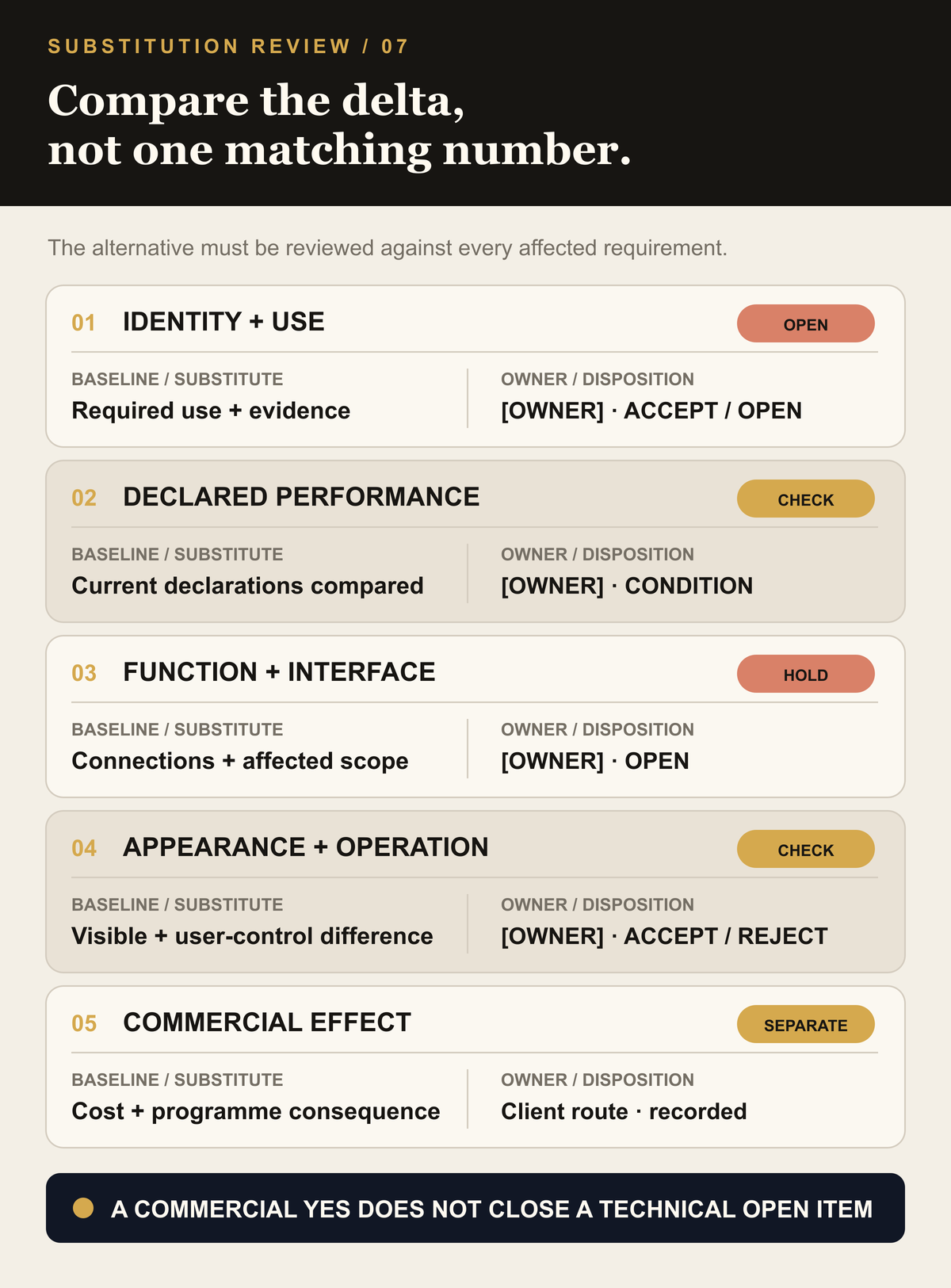
The register prevents one matching number from standing in for a complete substitution review. Each difference remains OPEN, CONDITION, ACCEPT or REJECT under the relevant decision route.
How should your team record every difference?
Create one delta register. Use the selected product as the baseline and state the proposed value beside it. Name the evidence source, affected scope, decision owner and required revision. A blank cell means the comparison is incomplete, not that the products match.
Copy these lines into the substitution record:
“Baseline product: [exact model], proposed substitute: [exact model].”
“Requirement: [text], baseline evidence: [source], substitute evidence: [source].”
“Difference: [delta], affected scope or interface: [description].”
“Decision owner: [name], disposition: [accept, condition, reject], reason: [reason].”
“Required document changes: [list], commercial effect: [time and cost].”
The trade-off isn't quality versus price in one number. A substitute may shorten lead time while increasing design work, changing the guest interface or reducing finish continuity. A fair review exposes those exchanges so the client can accept a real consequence instead of a vague promise of sameness.
Consider a hypothetical spa where a faster heater is accepted because its nominal output matches the schedule. The new controller needs a different location and the required clearances alter the bench layout. The substitution appeared isolated, but three connected drawings and the user experience changed without a recorded review.
For a separate commercial comparison method, read How Should a European Hotel Compare Two Outdoor Sauna Quotes? by Giedrius Patlaba. Quote comparison can reveal scope differences, but it isn't evidence that two technical products are equivalent.
Who should approve the proposed substitute?
Approval belongs to the competent parties named for the affected scopes and the project's agreed route. The manufacturer can confirm whether the proposed change fits the supplied product and what factory documents must change. Designers, installers, contractors, clients and authorities retain the decisions assigned to them.
From the factory side, two brochures looking similar is never the meaningful test. Each changed characteristic and interface must be named, evidenced and routed to the competent owner. If the delta stays invisible, acceptance is premature.
My manufacturer judgement is that an accepted substitute needs a named baseline, not a memory of what was intended. Without that baseline, reviewers can compare brochures yet miss the exact finish, control or interface that the order depended on.
The question “How Should Your Team Review a Proposed Sauna Substitution?” is resolved only when each difference has evidence, an owner, a disposition and an updated document.
Decision: “Accept proposed substitute [exact model] for baseline [exact model], subject to conditions [list]. Accepted differences are [list]. Required document and interface changes are [list], with owners [names].”
STOP: don't accept a proposed substitute while its exact identity, intended use, required performance evidence, dimensions, controls, interfaces, appearance impact or document changes remain unknown. Obtain the relevant evidence and the competent owner's recorded disposition for every affected scope first.
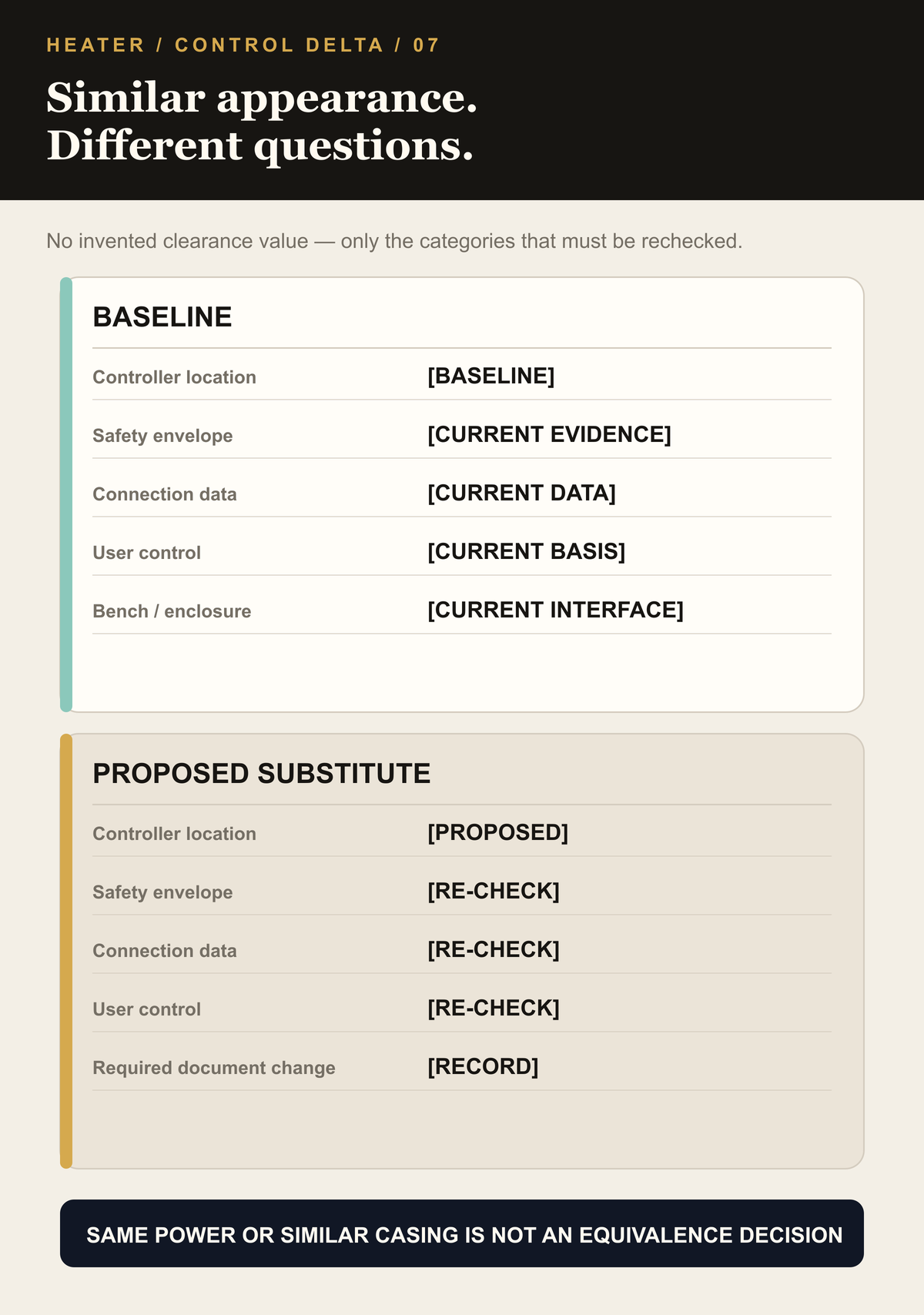
The comparison shows which information categories must be rechecked without inventing clearance values. Similar power or appearance does not establish equivalence.
Finish with a cold read. Give a reviewer the baseline, proposal and completed delta register. They should be able to explain what changes, who accepted it and which drawings now control. If the answer relies on verbal reassurance, the substitution remains open.
Frequently asked questions
Is matching heater output enough to prove equivalence?
No. Output is only one comparison line. Review the exact model's documented intended use, dimensions, controls, required clearances, connection information, operating features and effects on surrounding work. The appointed competent parties decide which characteristics matter for the actual project and selected sauna configuration.
Can a cheaper sauna component still be acceptable?
Yes, price alone doesn't decide technical suitability. Compare the component against the accepted requirements and record every difference, including warranty, maintenance, appearance, interfaces and programme. The client can consider the commercial benefit only after competent reviewers understand and dispose of the consequences within their scopes.
Who pays for changes caused by a substitution?
That depends on the contract, cause, request and agreed approval route. The technical review should identify cost and programme effects without pretending to allocate legal responsibility. Record who proposed the change, which work is affected and what commercial decision the authorised project parties make.
Should rejected substitutes remain in the project record?
Keep the proposal, evidence reviewed, reasons for rejection and decision date in the controlled record. That history prevents the same unsupported option returning under a new email thread. It also distinguishes a technical rejection from a commercial choice or a proposal that simply lacked enough evidence.
Does manufacturer acceptance make a substitute project-approved?
No. Manufacturer acceptance can cover the supplied product and stated factory interfaces within available evidence. Project designers, installers, contractors, clients and authorities retain their appointed or statutory decisions. The substitution record should show each affected scope so one product-side confirmation isn't mistaken for complete project approval.
1reading
Written by
 Giedrius PatlabaCEO & co-founder, Wood Architects163 pieces · 30 followers
Follow Giedrius to see new posts in your feed, on your phone or by email.