Does Your Sauna Export Packaging Need an ISPM 15 Mark?

Key Takeaways
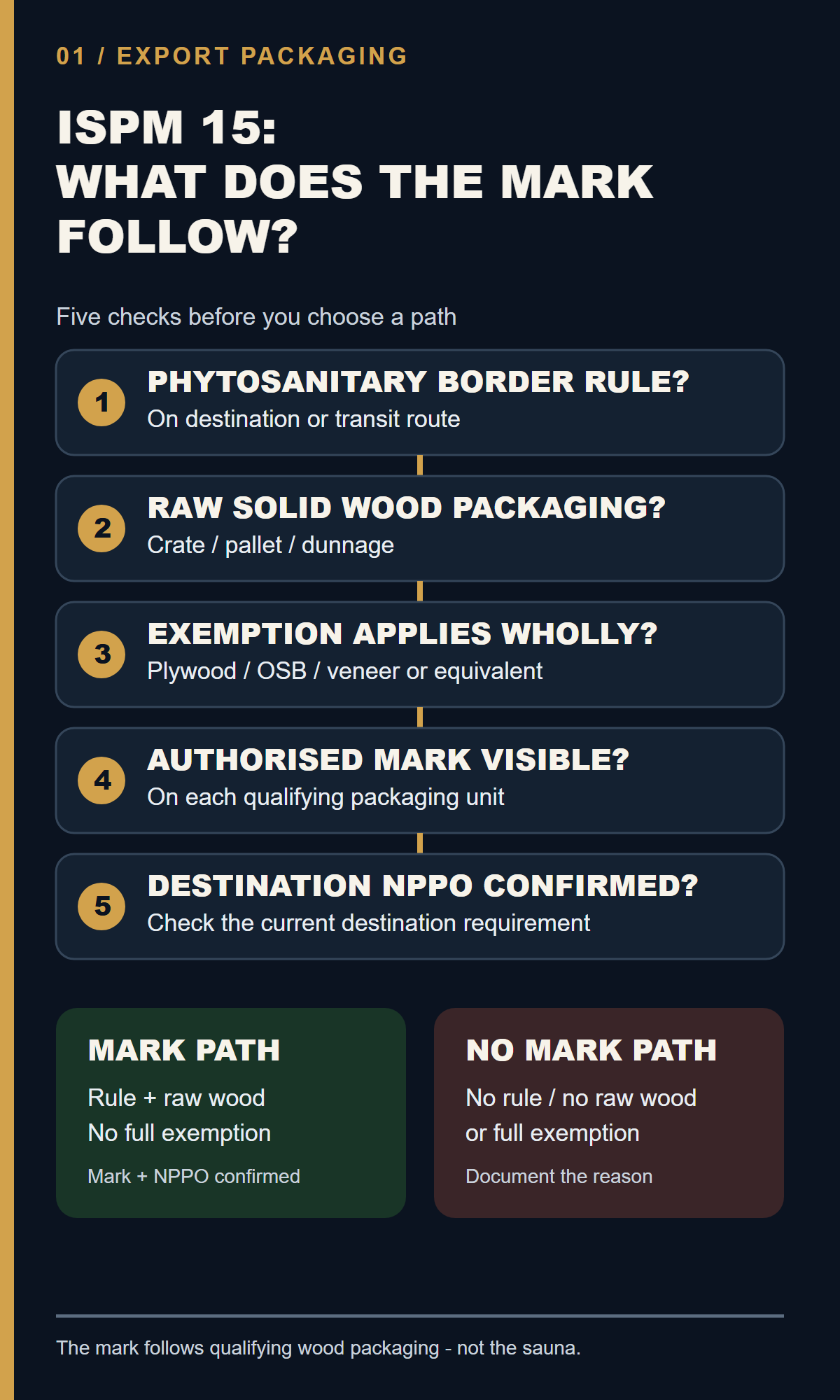
ISPM 15 concerns raw solid-wood packaging, not the sauna being carried.
Pallets, crates, cases, blocking and loose dunnage can all fall within scope.
Packaging made wholly from plywood, OSB or wood no thicker than 6 mm is exempt.
The destination country and every transit border decide the final import requirement.
A compliant unit needs an authorised, legible and durable IPPC mark.
Check every separate wood unit before loading, not after the lorry reaches the port.
A finished sauna can cross a border while its pallet cannot. We ship completed outdoor saunas from Klaipėda, so the packaging route matters as much as the product route. By the end of this article you'll have a decision tree, a mark check and a copy-ready clause for your packing specification.
Does Your Sauna Export Packaging Need an ISPM 15 Mark?
Your sauna export packaging needs an ISPM 15 mark when the destination or transit authority applies the standard and the load uses regulated raw solid wood. That usually includes pallets, crates, cases, blocking and dunnage. The rule attaches to the packaging, not to the sauna. Packaging made wholly from processed wood such as plywood or OSB, or entirely from wood 6 mm thick or less, falls within the standard's listed exemptions. Confirm the route with the destination's plant protection authority before packing.
Start with the route, not the sauna
The product can be timber and still sit outside this question. ISPM 15 regulates wood used to support, protect or carry goods in international trade. The IPPC standard names crates, boxes, packing cases, dunnage and pallets.
Now draw the actual route. An EU delivery that stays inside the Union is different from a delivery to Great Britain, Norway or Switzerland. A shipment can also cross a regulated transit country before reaching the buyer. The importing and transit National Plant Protection Organisations, or NPPOs, can set the operational controls.
Don't turn that into a country list copied from an old freight email. The IPPC maintains a country implementation resource, but the destination NPPO remains the authority for the shipment in front of you.
Which packaging components fall within ISPM 15?
Component | Initial scope decision | Evidence to request |
|---|---|---|
Solid-wood pallet | Usually regulated on a route applying ISPM 15 | Visible mark on the pallet unit |
Solid-wood crate or case | Usually regulated | Mark that remains visible after loading |
Loose solid-wood blocks or dunnage | Regulated even when used only to brace the sauna | A complete mark on every cut piece used |
Packaging wholly made from plywood, OSB or particle board | Listed as exempt processed wood | Material specification showing the construction |
Packaging entirely made from wood 6 mm thick or less | Listed as exempt thin wood | Material and thickness specification |
Steel shipping frame with no raw-wood blocks | Outside this wood-packaging question | Packing drawing and material list |
A mixed crate needs a component-level check. Plywood panels don't make untreated solid-wood skids disappear. The exemption applies when the wood packaging is made wholly from the listed processed material.
What does a valid mark prove?
The IPPC mark identifies the country, the authorised producer or treatment provider and the approved treatment code. The standard says the mark must be legible, durable, non-transferable and visible while the packaging is in use. It should preferably appear on at least two opposite sides. A hand-drawn mark isn't acceptable.
The mark is the control point. The standard treats it as evidence that approved phytosanitary measures were applied under NPPO authority. For Great Britain, the Forestry Commission's current guidance says a treatment or phytosanitary certificate can't replace the mark on imported wood packaging.
Look at the actual unit. A clear stamp on one pallet doesn't cover an unmarked loose block added beside it.
How should you write the packing specification?
Put the requirement into the purchase order before anyone cuts timber. “Export-ready packing” is too vague. It doesn't name the route, the material boundary or the evidence the receiving team must see.
Copy-ready ISPM 15 packing clause
Destination and transit route: [COUNTRIES].
All regulated raw solid-wood pallets, crates, cases, blocking and dunnage shall comply with the current destination and transit NPPO requirements based on ISPM 15.
Every separate regulated wood-packaging unit shall carry a legible, durable and visible authorised IPPC mark.
Processed-wood exemptions shall be identified in the packing material list.
No unmarked solid-wood packing component may be added during loading.
Provide dated photographs of the marks and the complete packed load before dispatch.
This clause asks for observable evidence. It doesn't claim that a supplier certificate overrides border rules.
What should happen before the truck leaves?
Freeze the final destination and transit countries with the freight forwarder.
Check the current NPPO rule for each relevant border.
List every pallet, crate, case, skid, block and loose dunnage item.
Separate raw solid wood from wholly processed-wood components.
Inspect each required mark for its symbol, country code, provider code and treatment code.
Photograph the complete mark and enough of the unit to identify where it sits.
Keep the packing list and photographs with the shipment record.
Used pallets need their own check. Under ISPM 15, a treated and marked unit can remain in service without a new treatment if it hasn't been repaired, remanufactured or altered. Repair and remanufacture trigger specific controls, including treatment and marking rules for replacement components.
If you're still checking the supplier itself, use our separate sauna factory verification checklist. Factory identity and packaging compliance are different checks. You need both before a deposit becomes a shipment.
Where can the importing country change the answer?
ISPM 15 is an international base, not a substitute for the destination's live import instructions. Great Britain, for example, requires solid wood packaging imported from any country to meet ISPM 15. Its official guidance also warns that non-compliant packaging can be rejected or destroyed, leaving the importer to arrange another way to move the goods.
Other routes may handle inspections, declarations or exceptions differently. Ask the destination NPPO or the importer of record to confirm the current rule in writing. If the answer relies on “we have always shipped it this way”, the check isn't finished.
That is how you answer the operational question: Does Your Sauna Export Packaging Need an ISPM 15 Mark?
You don't need to redesign the entire load today. Take the packing drawing, mark every raw-wood component and send the route plus material list to the destination NPPO or broker. The useful object is a photographed mark on the exact skid under the sauna, not a promise in a supplier email.
Frequently Asked Questions
Does ISPM 15 apply to the sauna itself?
No. ISPM 15 addresses wood packaging material used to support, protect or carry a commodity in international trade. A timber sauna may face other product, customs or plant-health rules, but its material doesn't turn the sauna itself into wood packaging. Assess the pallet, crate, blocking and dunnage separately.
Does plywood packaging need an ISPM 15 mark?
Packaging made wholly from processed wood such as plywood, particle board or OSB is listed as exempt by ISPM 15. A mixed construction still needs checking because solid-wood skids or braces may remain regulated. Keep a material list that identifies both the panels and every supporting timber component.
Do intra-EU sauna shipments need ISPM 15 marks?
ISPM 15 controls arise at phytosanitary borders and under country implementation rules. A shipment moving only between EU Member States isn't an introduction from a third country under the Union plant-health import rule. Still check the full route, any transit border and the buyer's packing specification before using unmarked solid wood.
Can a treatment certificate replace the ISPM 15 mark?
Don't assume it can. ISPM 15 uses the authorised mark as the recognised evidence on the wood-packaging unit. Great Britain's Forestry Commission states that a phytosanitary or treatment certificate isn't required and can't be used instead of the mark for imported wood packaging. Confirm the destination rule.
Can you reuse an ISPM 15-marked pallet?
Yes, if the unit was treated and marked correctly and hasn't been repaired, remanufactured or otherwise altered. ISPM 15 says such a unit doesn't need fresh treatment or a new mark during its service life. Repairs and substantial component replacement trigger separate treatment and marking controls.
Who may apply an ISPM 15 mark?
Use of the mark sits under the authority of the exporting country's NPPO. The NPPO authorises or oversees producers and treatment providers, then monitors treatment and marking systems. A sauna maker or packer can't create its own mark simply because the wood looks treated or a kiln certificate exists.
1reading now
Get an email when Giedrius publishes