What Proof Do You Need Before Calling an Outdoor Sauna “Sustainable”?

Key Takeaways
Replace broad green adjectives with a precise, bounded claim.
Name the evidence holder, date and system boundary for every claim.
Material origin alone does not prove whole-life performance.
Include treatment, maintenance, repair, transport and end-of-life assumptions.
Make limitations visible beside the claim, not hidden in a distant file.
Review the Claim-to-Proof Ledger whenever the product or supplier changes.
What Proof Do You Need Before Calling an Outdoor Sauna “Sustainable”?
Before calling an outdoor sauna sustainable, define exactly what the claim covers and what it does not. A credible evidence pack links the exact wording to dated material-origin records, treatment information, durability and maintenance assumptions, repair and spare-part arrangements, transport scope and end-of-life notes. No single certificate proves the whole product, and a timber claim should not be presented as a whole-life conclusion without a declared boundary.
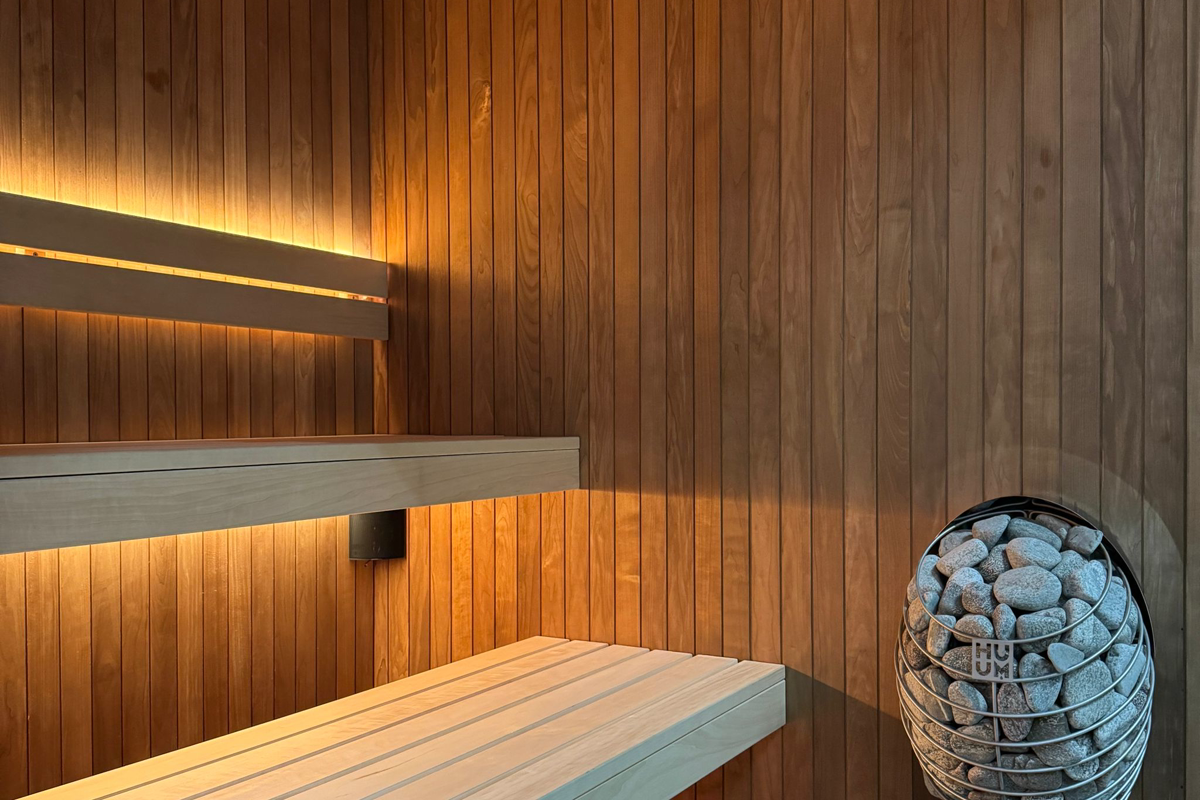
Visible timber is a starting point for questions, not proof of whole-product environmental performance.
For our cube sauna, full-height panoramic glazing, a 128 mm wall build-up and a burnt thermowood exterior are three distinct product facts, but I would not use any one of them as proof that the whole sauna is sustainable.
Turn the adjective into a testable sentence
“Sustainable”, “green” and “eco” can sound decisive while leaving the buyer with nothing to verify. Start with the exact claim. Is it about the origin of one timber component, a treatment process, packaging, transport distance, repair access or expected service conditions? A narrower statement is often more useful because its evidence and limits can be checked.
The EU rules on empowering consumers for the green transition strengthen protection against vague environmental claims. Member States apply the measures from 27 September 2026. The legal assessment depends on the audience, wording and context, so this article is a procurement method, not legal advice. The official Directive (EU) 2024/825 and the Commission's sustainable consumption overview are the primary references.
Build a Claim-to-Proof Ledger
Ledger field | Buyer question |
|---|---|
Exact wording | What is being claimed, without slogans? |
Evidence holder and date | Who can produce the current record? |
System boundary | Which material, stage, market and period are included? |
What it does not prove | Which wider conclusions remain outside the evidence? |
Next review | When will a supplier or product change trigger rechecking? |
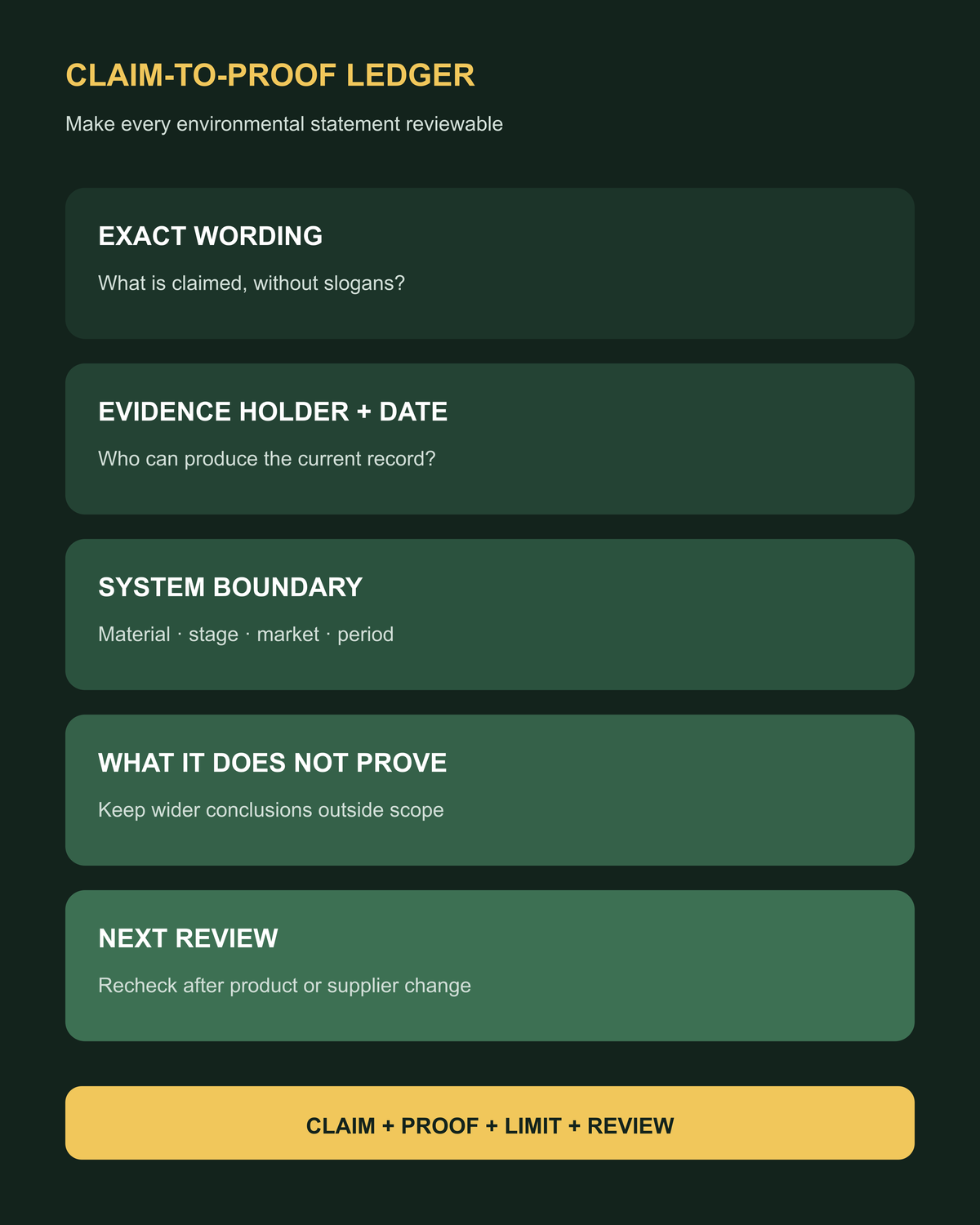
A defensible claim travels with its evidence, boundary, limitation and review date.
When we review a material or supplier change, we ask whether the dated evidence and declared boundary still match what is being offered.
Check the lifecycle without pretending to complete an LCA
A buyer can examine important stages without claiming to have a full life-cycle assessment. For materials, request origin and treatment records relevant to the exact components. For manufacture, ask what evidence supports the stated process boundary. For delivery, record the route and packaging assumptions used. For use, state maintenance and replacement assumptions. For repair, identify replaceable parts and support. For end of life, distinguish known routes from aspirations.
This scope map prevents a common error: using evidence from one stage to imply performance across the whole product. “Local timber” does not automatically prove low whole-life impact. “Thermowood” names a material or treatment category, not a universal sustainability conclusion. “Long service life” needs defined use conditions, maintenance and evidence.
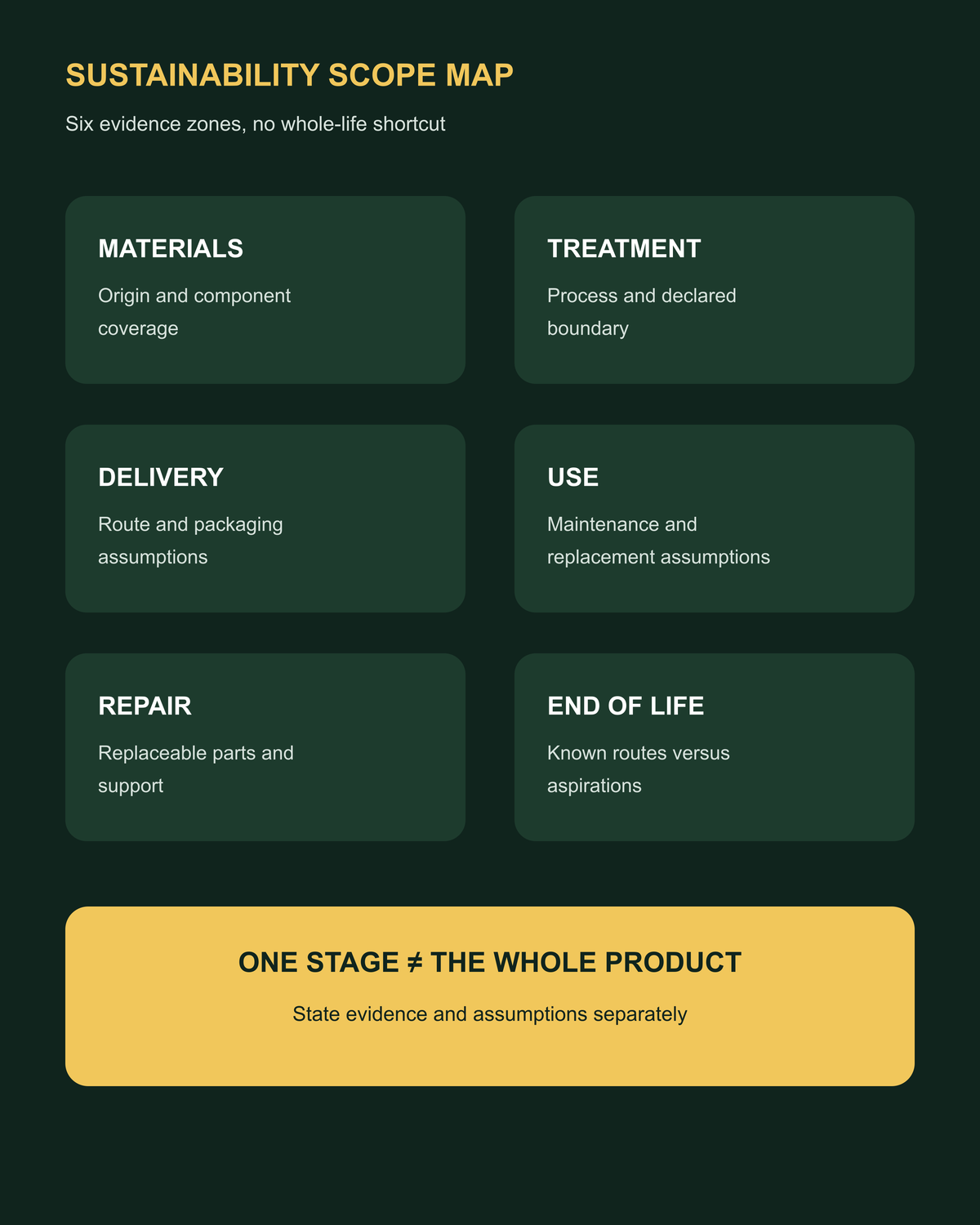
The scope map shows where evidence may exist and where the buyer must state assumptions or limits.
Pictures can make a claim too
Environmental meaning does not come only from the headline. Leaves, badges, colour, landscape and nearby wording can create an overall impression. If a visual implies an environmental benefit, the supporting qualification should be clear and prominent in the same medium. A distant technical folder does not correct an immediate misleading impression.
Do not invent a green badge. Do not imply independent certification when the evidence is an internal supplier statement. If a recognised scheme is cited, record its scope, certificate holder, validity and the components actually covered.
In our work, a precise limitation is more credible than a badge that suggests proof we do not hold.
Keep regulatory scope honest
The EU Construction Products Regulation creates a framework for construction products, but whether a particular prefabricated sauna or component falls within a specific obligation depends on the product, intended use and applicable specification. Do not present the Regulation as whole-life sustainability proof. Official text is available in Regulation (EU) 2024/3110.
For a practical related evidence question, see How Local Should Your Sauna Timber Supply Be?. Locality can be a defined input, but it should not be inflated into an unbounded conclusion.
FAQ
Is timber automatically a sustainable sauna material?
No. Timber can support a specific environmental claim only when the claim, source, component coverage and evidence are defined. Treatment, durability, maintenance, transport and end-of-life assumptions still matter. A material category alone should not be used as proof that the entire outdoor sauna is sustainable.
Does every sauna need a life-cycle assessment?
This article does not claim that every sauna legally requires a life-cycle assessment. The appropriate evidence depends on the claim, product and market. A buyer can still request a bounded evidence pack and clearly state what has not been measured, rather than presenting partial records as whole-life proof.
Can we call locally sourced timber sustainable?
Only with careful scope. “Locally sourced” should define the material, origin, distance or region and evidence date. It does not automatically prove lower whole-life impact or responsible forestry. State the exact locality fact and avoid converting it into a broader environmental conclusion that the records do not support.
What evidence should stay beside the claim?
Keep the exact wording, evidence owner, issue date, covered component, geographic and lifecycle boundary, key assumptions and exclusions together. If a certificate is used, record its holder, validity and scope. This makes review possible when suppliers, materials, transport routes or the product configuration change.
Does a green image count as an environmental claim?
Images, colour and presentation can contribute to the overall environmental impression. A forest background or invented badge may therefore matter even if the headline is cautious. Keep qualifications clear and prominent on the same medium, and avoid visual cues that imply independent proof which the evidence pack does not contain.
1reading now
Get an email when Giedrius publishes