How Should a Dealer Separate Site Work From the Sauna Quote?

How Should a Dealer Separate Site Work From the Sauna Quote?
A dealer should use a line-by-line scope schedule that assigns every foundation, access, unloading, lifting, utilities, local connection, approvals and reinstatement row to the supplier, client or named local contractor. The signed offer should describe the supplied product boundary, required inputs, exclusions and change route for each interface. Where responsibility is not yet agreed, mark it as an open item with an owner and decision date rather than assuming inclusion, exclusion or zero cost.
Key Takeaways
“Complete sauna” doesn't mean a complete site installation.
Every interface needs an inclusion, exclusion or named assumption.
Site information belongs in the quote before work is priced.
Qualified local connection remains distinct from supplied equipment.
Change control starts before an unknown becomes urgent.
Stop when two parties both assume the other owns one interface.
A dealer wins an order for an assembled outdoor sauna. Two weeks before delivery, the client asks who forms the base, protects the access road, books the crane and extends the electrical supply. The supplier priced the unit. The local contractor priced none of those interfaces. Everyone has a quote, but the site still has no complete scope.

The illustration makes the handoff between product information and local site information visible. It depicts no real contract, project or included work.
Where does the sauna package end and site work begin?
Start with supplied objects and supplied documents. List the unit, heater, controls, accessories, packaging, delivery basis, drawings, manuals and anything else named in the offer. Then list every condition needed before those items can become an operating installation.
A current HUUM CLIFF installation and operation manual illustrates the boundary on one heater family. It identifies the heater, a separately required control system, required sauna stones and electrical work reserved for a certified electrician. It is product guidance, not EEA contract law and not a manual for every heater. Its narrow lesson is that supplied equipment still needs an exact installation context.
Wood Architects assembles and checks each sauna in Klaipėda before dispatch. For the unit we supply, that creates a clearer product state. It doesn't automatically include the customer's foundation, unloading, lifting, cable route, electrical connection, drainage, permit, landscape work or reinstatement.
We fit Harvia and HUUM heaters. The chosen model and its manual inform the local design, but a heater name in our offer cannot replace site electrical information or the qualified person's connection work.
Finished isn't installed.
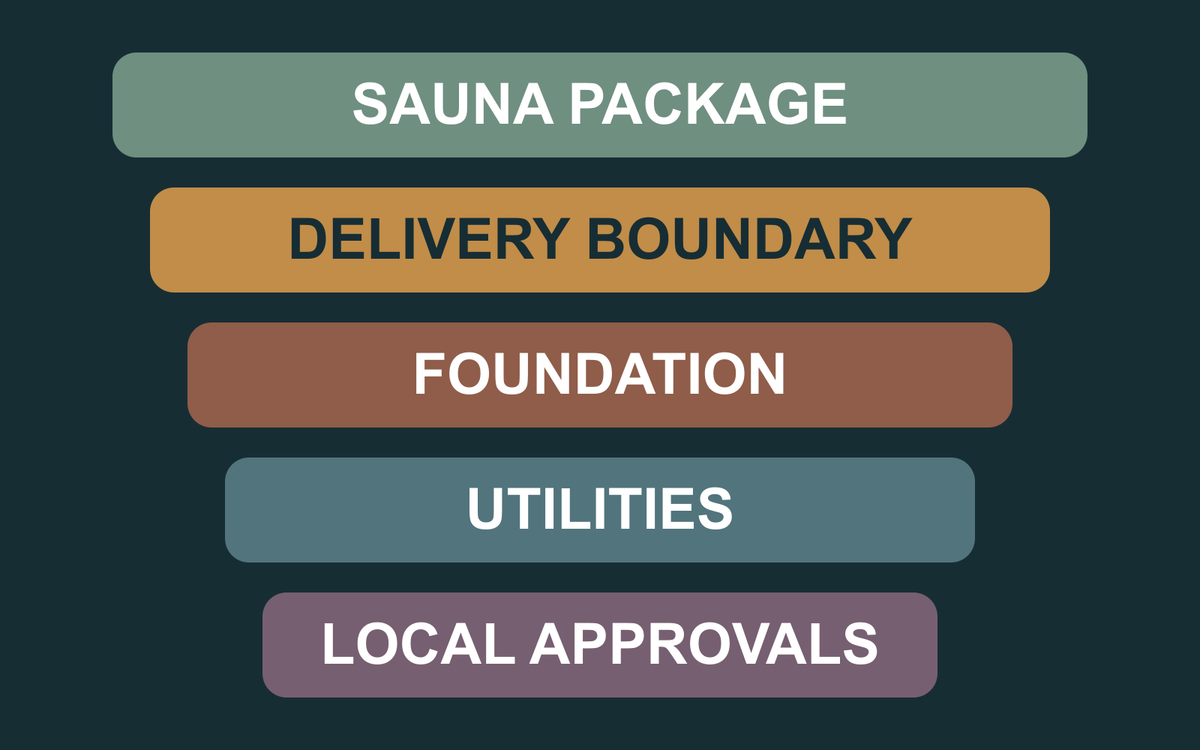
The boundary map separates what travels with the unit from what the destination must provide. It is a prompt, not a contract or technical design.
Which site unknowns become expensive variations?
The dangerous unknown sits at an interface. Delivery reaches the property, but not the foundation. The base is level, but its load and drainage basis are unconfirmed. Power reaches the garden, but the cable, protection or route doesn't match the selected equipment. A crane is booked, but the operator never received the unit weight, reach or access constraints.
The UK's Health and Safety Executive says a client provides relevant site information and management arrangements for building work. Its building-work guidance also says underground services need checking before excavation. This is UK guidance framed around agricultural building work. It supports one practical boundary only: local ground and service information cannot be invented by a distant sauna supplier.
Consider a hypothetical delivery morning. The sauna is on the vehicle, the crane is waiting and the prepared base looks complete. The lift path crosses an unverified buried service, so the competent site team stops the operation. The dealer calls it a delay. The real failure happened earlier, when “access by others” replaced a checked route and named decision.
The trade-off is between a short quote and a usable quote. Short wording is easy to sell and easy to misunderstand. A scope schedule adds pages, but lets the dealer price coordination, expose exclusions and protect the client from duplicate or missing work.
Assumptions are not scope.
EU Directive 2014/24/EU's Article 72 uses clear, precise and unequivocal review clauses for changes in public contracts. A private sauna sale isn't governed by that article merely because we cite it. The useful discipline is to write the change route before site conditions force a decision.
What belongs in the dealer's scope schedule?
Interface | Quote line | Acceptance clue |
|---|---|---|
Delivery and lifting | Endpoint, unloading method, access data and protection | Route and lifting plan checked before dispatch |
Foundation and ground | Design basis, tolerances, drainage and local contractor | Prepared base released against named criteria |
Electrical and controls | Supply point, local design, connection and test responsibility | Exact model information reaches the qualified person |
Approvals and completion | Applications, inspections, landscape and reinstatement | Each item has a named local route |
Change control | Notice, information, decision and price route | No changed work starts from a verbal assumption |
Copy these five lines into the offer:
“Our supplied product ends at ___.”
“The client or local contractor provides ___ before ___.”
“This price assumes the verified site condition ___.”
“If that condition differs, work stops and ___ issues the change.”
“Acceptance of this interface is recorded by ___.”

The card gives each interface a visible commercial state. It doesn't decide local liability or replace project-specific contract advice.
How does the dealer control a site change?
Freeze four facts before anyone prices the change: observed condition, affected scope line, immediate safety or programme constraint, and the information still needed. Then send one written decision request to the people able to resolve it.
No verbal rescue work.
State whether the response changes price, programme, supplied design, local work or acceptance. Record who can authorise it under the actual contract. Keep the original assumption beside the revised one, so the client can see why the change exists.
The quote is a boundary map.
STOP: don't release manufacture, excavation, utility work or delivery while one critical interface is claimed by neither party, claimed by both parties, or described only as “by others” without a named deliverable and date. Resolve the scope line with the relevant designer, contractor and contract adviser first.
Put one physical document on the next call: the scope schedule beside the site plan. Read every boundary line aloud. Silence is an unknown, not agreement.
Frequently asked questions
Is the foundation normally included in a sauna quote?
There is no safe universal answer. The offer needs to say whether foundation design, construction, setting out, tolerances, drainage and release checks are included, excluded or provided by a named local party. A product drawing may inform the base, but it doesn't automatically appoint or price the local foundation work.
Who books the crane for an assembled sauna?
The agreed delivery scope decides. Name who supplies the unit data, surveys access, selects the lifting method, protects the route, books the crane and accepts the lifting plan. Don't leave “crane by others” alone in the quote. It hides the information handoff that makes the lift possible.
Does the heater price include electrical connection?
Only when the offer expressly says so and the local arrangement permits it. The supplied heater and control package is distinct from site supply design, cable route, protection, connection, testing and certification. Use the exact model manual and a qualified local professional. Never infer connection scope from a product name.
How can two dealers compare supplier quotes fairly?
Use the same site information and scope rows, then mark every inclusion, exclusion and assumption. Obtain local prices for omitted enabling work before ranking totals. Our related article, How Should a European Hotel Compare Two Outdoor Sauna Quotes?, covers the wider comparison method.
What happens when the site condition changes?
Follow the written change route in the actual contract. Record the observed difference, affected scope, information needed, decision authority and effect on price or programme before changed work begins. Local contract advice still governs. This article offers a coordination discipline, not a legal conclusion about who pays.
1reading now
Get an email when Giedrius publishes