What Evidence Must Precede a Sauna Warranty Decision?

Key Takeaways
A warranty decision needs product identity, unchanged evidence, context, chronology and a safety status.
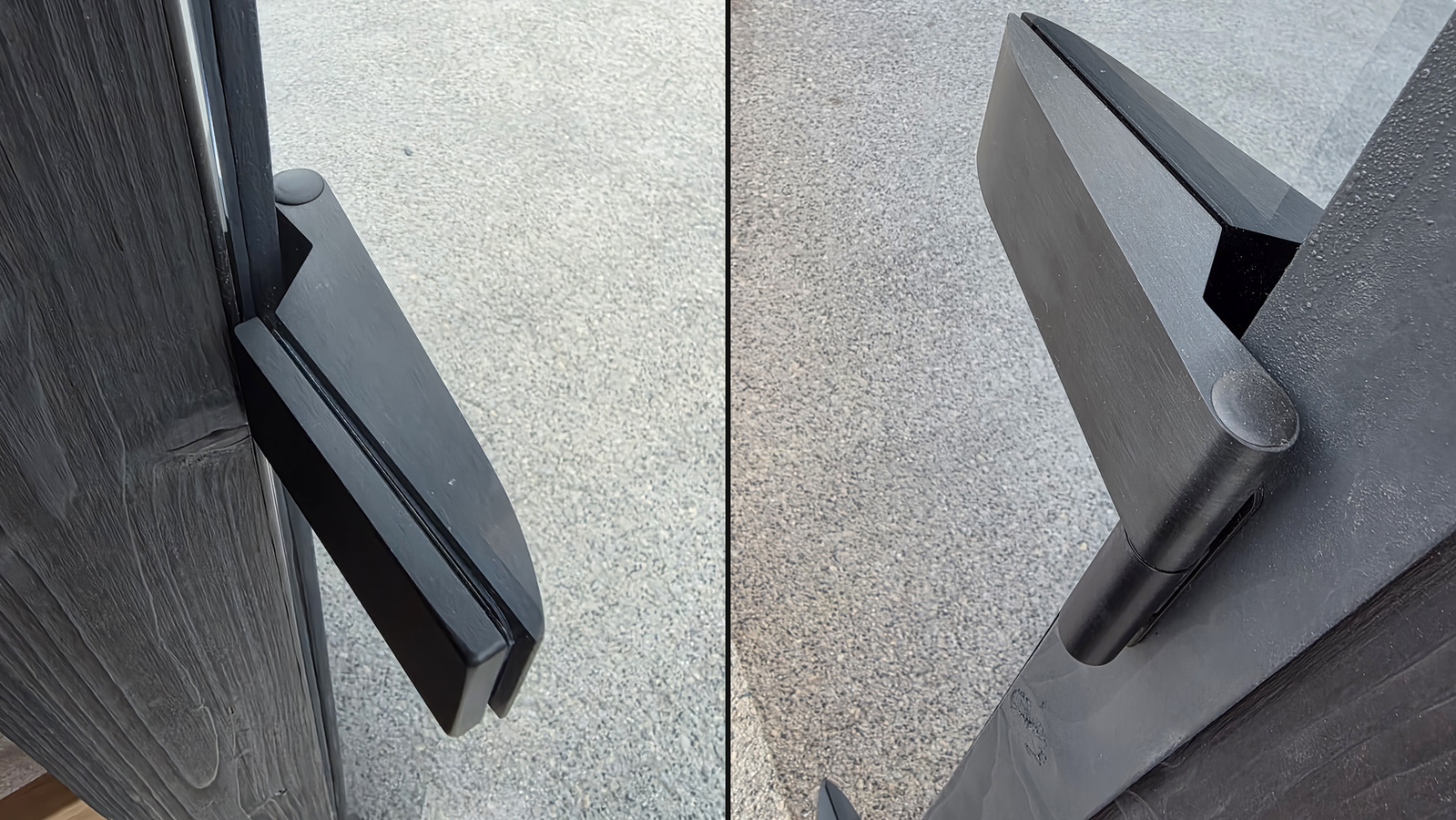
One close-up photograph can show damage, but it rarely explains cause.
Record the sauna's condition before repair unless immediate protective action is needed.
GPSR Article 9 requires in-scope manufacturers to investigate alleged dangerous-product complaints.
GDPR Articles 5, 25 and 32 govern minimisation and security of identifiable evidence.
A complete packet enables a decision. It never guarantees a particular warranty outcome.
A warranty decision made from one close-up photograph can be fast and completely wrong. We know this from the factory side because our saunas leave Klaipėda assembled and checked, while field conditions arrive later. By the end of this article, you'll have a usable evidence packet and a clear fork between ordinary service and a potential safety incident.
What Evidence Must Precede a Sauna Warranty Decision?
A sauna warranty decision needs a dated evidence packet. Always include the product identifier and configuration, unchanged photographs, the reported symptom, relevant installation and maintenance context, change history and a clear safety status. Under Article 9 of the EU General Product Safety Regulation, manufacturers in scope must investigate safety complaints and accident information concerning products alleged to be dangerous. That rule doesn't make this packet a statutory warranty form or guarantee that any claim will be accepted.
Why does one photograph produce weak decisions?
A close-up removes the very context needed to read it. You might see discoloured timber, a loose fitting or an error display. You still can't see the complete product, the installation, the controller configuration or what changed before the image was taken.
The opposite mistake is a folder of unsorted media. Thirty files with no product identifier, date or explanation create volume, not evidence. The reviewer has to guess which sauna is shown and whether the photographs were taken before or after intervention.
Separate observation from diagnosis. “The controller displayed [exact code] at [local date and time]” is an observation. “The heater is defective” is a diagnosis. The first can be checked against the selected configuration and instructions. The second assigns a cause before the evidence has done the work.
At Wood Architects, we know how a sauna left Klaipėda because it's assembled and checked there before it ships. A field packet describes what exists now. A sound review compares those two states. Neither one explains the whole case alone.
What belongs in a dealer's evidence packet?
My recommendation, as the manufacturer, is to use the same intake order every time. It isn't an EU warranty form. It's a practical way to keep enough context for a technical review without asking the dealer to diagnose the cause.
Evidence group | What to record | Why it matters |
|---|---|---|
Identity | Visible serial, batch or other product identifier, plus the known model and configuration | Connects the field case to the correct product record and document set |
Unchanged condition | Full-scene photographs, detail photographs, exact display messages and a short video when behaviour matters | Shows both the symptom and its physical context before work changes the scene |
Installation context | Relevant installation and commissioning records, selected settings and applicable installer documentation | Lets the competent reviewer compare the field configuration with the supplied information |
Use and maintenance | Reported use conditions, maintenance records and the first date the symptom was noticed | Builds chronology without turning the dealer's report into a fault judgement |
Changes | Repairs, substitutions, setting changes, software changes or other interventions already made | Prevents a changed product from being reviewed as though it were still in its original state |
Safety status | Whether an accident, injury or potential safety issue has been reported, including what has been done to prevent further use | Routes the case before anyone debates commercial warranty responsibility |
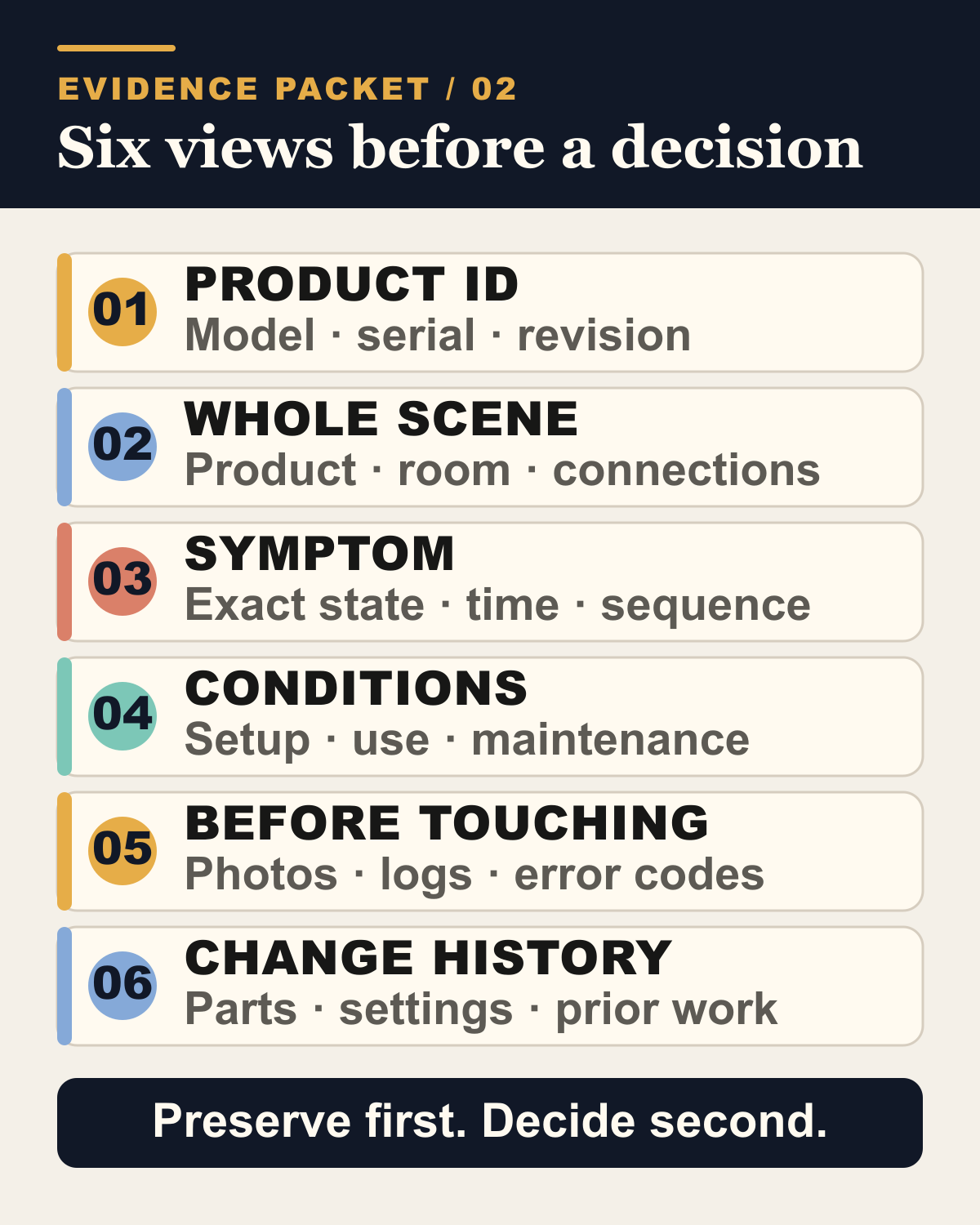
The six views show what to capture for the identity, condition, context and change rows above. Safety status is routed separately, in the next section. The contract, the guarantee, the product instructions and a competent technical assessment still decide the outcome.
Use “unknown” when a field can't be confirmed. A blank field looks forgotten. An explicit unknown tells the manufacturer what to ask next.
Why should the unchanged condition be preserved?
A repair can remove the symptom, destroy the evidence or introduce a new variable. That doesn't mean you should leave a dangerous product operating for the sake of a photograph. Protective action comes first. Preserve only what can be captured safely, then record exactly what was isolated, removed or changed.
As checked on 7 October 2026, Directive (EU) 2024/2853 treats product defect, damage and causation as separate questions in its product-liability regime. Under Article 2(1), as corrected by the corrigendum of 7 May 2026, it applies to products placed on the market or put into service after 8 December 2026. It isn't an everyday warranty checklist, and it doesn't make a damaged component automatic proof of product defect.
The useful lesson is narrower. Keep original files. Keep their timestamps. Photograph the whole setting before the detail. If somebody removes a component, record who did it, when, why and what replaced it. You're preserving sequence, not building a courtroom file.
When must service branch into a safety response?
An ordinary service ticket and a potential safety incident shouldn't share one queue until somebody eventually notices the difference. Make the fork visible at intake. If the status is unclear, don't guess it back into the ordinary lane.
Intake lane | Typical report | Immediate route |
|---|---|---|
Ordinary service | A performance, usability or cosmetic issue with no reported accident, injury or sign of immediate danger | Preserve the condition, follow the documented service route and request only the missing evidence |
Potential safety incident | An accident, injury, smoke, fire, electrical shock, uncontrolled heating, instability or another reported safety concern | Stop use, prevent access, follow the product's safety instructions and escalate immediately to the responsible parties |
Unknown | The report is too incomplete to exclude a safety concern | Hold the ordinary warranty decision and obtain competent safety or technical review before resuming the service route |
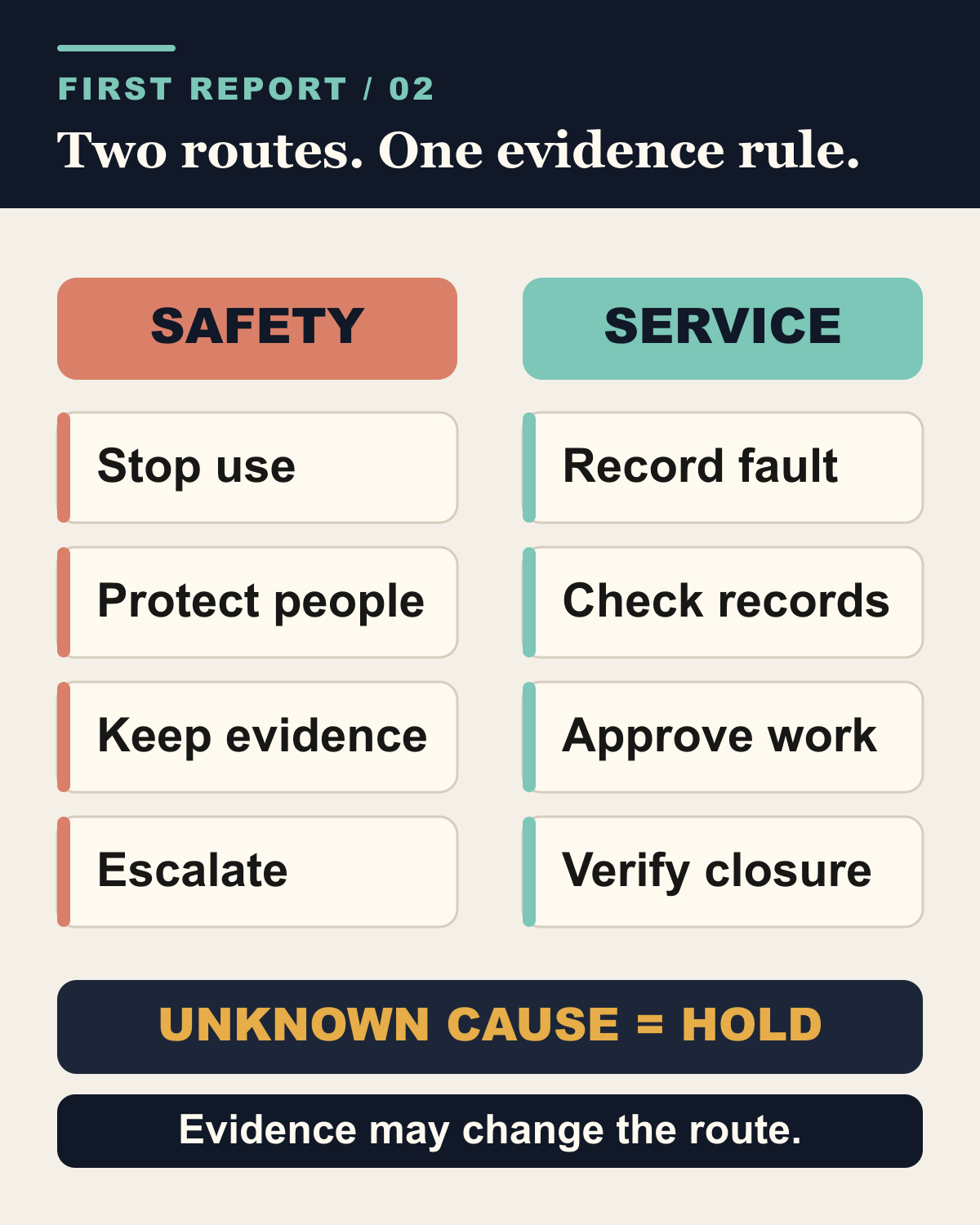
The first report can follow a safety route or an ordinary service route. If the cause or severity is unclear, the warranty decision stays on hold while competent review and evidence collection continue.
The GPSR requires in-scope manufacturers to investigate complaints and accident information concerning products alleged to be dangerous. It also requires complaint records and corrective-action records in that safety context. That's why “potential safety incident” must remain a distinct route, not a red flag hidden inside an ordinary warranty email.
How should photos and logs be shared safely?
Technical evidence can contain people, addresses, vehicle plates, voices, device identifiers or account information. Collecting everything “just in case” creates a second risk that doesn't improve the sauna diagnosis.
GDPR Articles 5, 25 and 32 require a specified, legitimate purpose, data minimisation and appropriate security for personal data. The lawful basis under Article 6, the retention period and the controller roles depend on the real workflow. A warranty inbox doesn't create permission to circulate identifiable customer material through an unrestricted group chat.
Keep the technical original in controlled storage when it's genuinely needed. Make a separate redacted copy for wider review. Don't crop away the product context or overwrite the source file. Remove faces and unrelated personal details from the working copy, label it as redacted and control who receives the original.
How should the manufacturer use the packet?
The manufacturer should first confirm that the evidence belongs to the stated product and configuration. Then the reviewer checks whether the reported condition, chronology and documents are sufficient for the decision required under the actual warranty statement, contract and applicable law. Missing evidence should produce a targeted question, not a broad demand to “send more photos”.
Copy these lines into the case record:
“Case received: [date and time], case owner: [name], product identifier: [value].”
“Reported symptom: [observation], first observed: [date and time].”
“Unchanged evidence attached: [full scene], [detail], [display or video].”
“Relevant records attached: [installation], [commissioning], [maintenance].”
“Changes before review: [none / list / unknown].”
“Safety status: [ordinary service / potential safety incident / unknown].”
“Decision required: [precise question], missing evidence: [precise item].”
So what evidence must precede a sauna warranty decision? Those seven lines, filled in before anyone asks for a verdict.
This evidence packet doesn't decide who carries contractual cost. For that adjacent question, read Who Pays When Your Customer's Sauna Fails in Year Three? by Giedrius Patlaba. It covers how long your customer can claim against you as the seller. It also shows why your route back to the factory depends on your supply contract.
You don't need a longer warranty form. Take the next open case and fill the seven lines before asking for a decision. If the safety line says “unknown”, stop there and escalate it. The strongest claim file is the one that lets a reviewer decide without inventing the missing scene.
Frequently asked questions
Is one photograph enough for a sauna warranty claim?
Usually not for a reasoned decision. A close-up may show the reported condition but not the product identity, installation, configuration, chronology or changes already made. Send a full-scene image, a detail image, the visible identifier and a short factual description. Avoid diagnosing the cause in the caption.
Should a dealer repair the sauna before submitting evidence?
Preserve the unchanged condition first when that can be done safely. Don't delay action needed to protect people or property. If work starts, record what was isolated, removed or changed, who did it and when. Keep removed parts identified until the manufacturer gives appropriate handling instructions.
What if the sauna's serial number cannot be found?
Record that the identifier is missing rather than guessing it. Provide the product location, known model, purchase or delivery documents, configuration photographs and any other traceable reference. The manufacturer can then ask a targeted identification question. A missing identifier may limit certainty, but it doesn't justify inventing one.
Does a complete evidence packet guarantee warranty acceptance?
No. The packet lets the review run on evidence, under the actual warranty statement, contract and applicable law. It doesn't create coverage, assign fault or guarantee a remedy. A reviewer may still need engineering input, an installer record, a returned component or further evidence before making the decision.
What changes when the report may involve safety?
Safety routing comes before the commercial warranty decision. Stop use, prevent access and follow the product's safety instructions, then notify the responsible parties without delay. Preserve evidence only where that doesn't obstruct protective action. Authority reporting and corrective measures depend on the product, event and applicable law.
Can customer information be included in a warranty file?
Yes, when it's necessary for a defined purpose and you have a lawful basis under GDPR Article 6. Remove unrelated faces, addresses and account details from working copies. Keep any required original secure, restrict access and agree the retention period with whoever handles data protection in your company.
1reading now
Get an email when Giedrius publishes