What Should a Dealer Check Before Signing a Sauna CMR Note?

Key Takeaways
Before signing, check the paperwork and six points on the cabin: packaging, glass, corners, roof, lifting points and doors.
For damage you can see, the reservation is due not later than the time of delivery (CMR Convention, Article 30(1)).
Damage that isn't apparent needs a written reservation within seven days of delivery, Sundays and public holidays excepted.
A reservation has to indicate the loss or damage. “Subject to inspection” names neither.
Photograph the sauna before unloading. Article 17(4)(c) relieves the carrier of liability for damage arising from the consignee's unloading.
Send the reservation to the carrier named on the note the same day.
At Wood Architects we assemble and check each sauna at our factory in Klaipėda before it ships. The carrier's driver then signs for it, and the cabin travels with the carrier until someone signs at your end. Here's what to look at and what to write before you sign.
What Should a Dealer Check Before Signing a Sauna CMR Note?
Before signing a sauna CMR note, a dealer should check the paperwork against the load, then the cabin itself while it's still on the truck. Look at the packaging, glass, corners, roof, lifting points and doors. Write any damage you can see on the note before you sign. Article 30(1) of the CMR Convention sets the time of delivery as the limit for apparent damage. Damage that isn't apparent needs a written reservation within seven days of delivery, Sundays and public holidays excepted.
What does your signature on a CMR note confirm?
Your signature confirms that you took delivery. Under Article 30(1), taking delivery without a joint check or a reservation is prima facie evidence that you received the goods as the note describes them. You can still rebut it. You'd be arguing against your own signature.
The note itself is the consignment note of the Convention on the Contract for the International Carriage of Goods by Road, done at Geneva on 19 May 1956. It covers paid road carriage between two countries when at least one is a party (Article 1(1)). The UN Treaty Collection listed 58 parties on 7 October 2026.
It arrives already signed by the sender and the carrier (Article 5(1)). Under Article 8 the carrier checks the apparent condition of the goods and their packaging on taking them over.
Read the carrier's remarks first. If there are none, Article 9(2) presumes goods and packaging appeared to be in good condition at takeover. Damage you record at delivery then points at the journey.
A joint check binds you too. Under Article 30(2), a result you reached with the driver can later be contradicted only for damage that wasn't apparent. Even that takes a written reservation within seven days of the check. Don't write “received in good condition” after looking at two sides of four.
What should you inspect while the sauna is still on the truck?
Inspect before the straps come off. Article 17(4)(c) relieves the carrier of liability when damage arises from unloading by the consignee or people acting for the consignee. Once your crane takes the weight, a fresh mark is yours to explain.
Start with the paper. Check that the consignee box names your company and count the packages against the note. Then walk the cabin in this order.
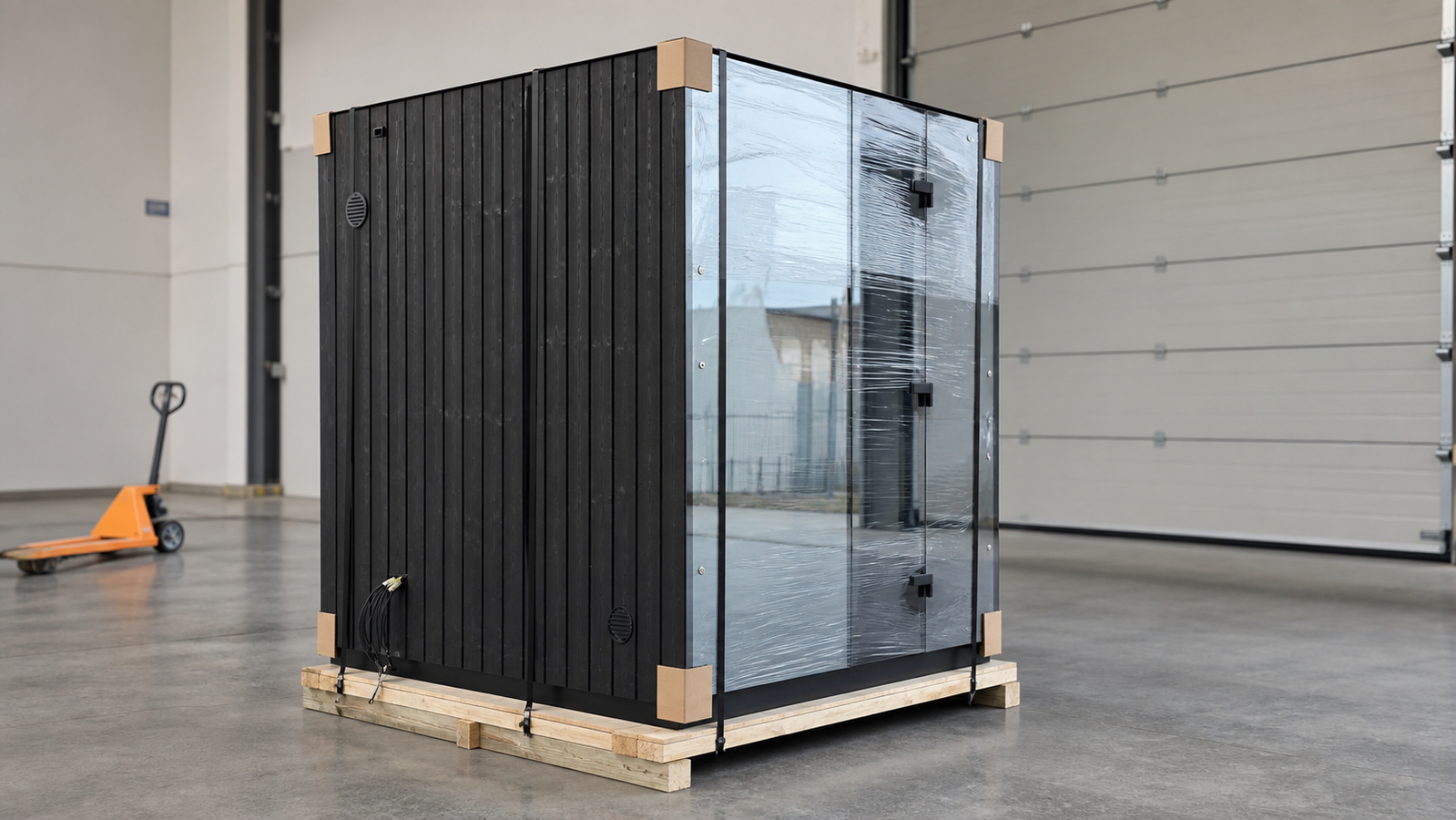
Packaging. Look for torn or wet wrap and crushed corner protectors. Check whether the straps have shifted. Photograph it all before anyone removes it.
Glass. Check the edges and corners of every pane before the faces. On our cube line the panoramic glass runs full height, so it gets the longest look.
Corners and lower edges. Look for dents and rub marks where a strap or a fork could reach.
Roof. Check the roof edge and the covering from a safe position.
Lifting points and base. If anything there looks bent or pulled, send the photograph to the manufacturer before the lift.
Doors. Open and close the door once it's free. A door that rubs or won't latch may mean the frame has moved. Record it.
Glass packing and restraint are covered in How Do You Protect Sauna Glass During Delivery?
How do you word a reservation on the CMR note?
Article 30(1) asks for a reservation “giving a general indication of the loss or damage”. A survey report isn't needed. Name the part and the place.
Write it beside your signature on every copy, above all the one the driver takes away. Ask the driver to print their name and sign next to it. Article 13(1) entitles you to the second copy of the note. Keep it.
Go by the box titles, because box numbers differ between printed versions. On the IRU 2007 model the consignee signs in box 24. IRU's guidance on that model asks for the date there, with the vehicle's arrival and departure times.
Situation | Write on the CMR note | Time-limit | Who to tell first |
|---|---|---|---|
Damage you can see on the truck | “Received with visible damage: [part, side, size]. Photographed on the vehicle before unloading, [date, time].” | Not later than the time of delivery (Art. 30(1)) | The driver, on the note. The carrier by email the same day. |
Cabin wrapped, surfaces beneath not visible | “Delivered wrapped. Wrap [intact / torn / wet]. Surfaces beneath not inspected at delivery.” | For damage that wasn't apparent: in writing within seven days of delivery, Sundays and public holidays excepted (Art. 30(1)) | The carrier, in writing. |
A package is missing | “Received [x] of [y] packages. Missing: [description].” | At delivery, as loss you can see (Art. 30(1)) | The carrier and the forwarder. |
The truck arrives late | “Delivered [date, time]. Agreed date: [date].” | In writing within twenty-one days from when the goods were placed at your disposal (Art. 30(3)) | The carrier in writing. |
The driver won't wait | “Driver left at [time] before the inspection was complete. Seen so far: [list].” | At delivery for what you saw (Art. 30(1)). Send the rest in writing the same day | The carrier's office, before the truck leaves. |
What's the difference between visible and hidden damage?
The Convention calls them apparent and not apparent, and it defines neither word. For apparent damage the reservation is due not later than the time of delivery. Damage that isn't apparent gets seven days from delivery, in writing, and Article 30(4) leaves the delivery day out of the count.
Assume that anything you could have seen by walking round the cabin and opening the door is apparent. A cracked pane under clear film is visible. A loosened fixing behind a bench isn't.
So don't spend the seven days. Unwrap the cabin the day it lands and go through it again. If the unit waits in your yard until the installation date, the clock runs anyway.
The deadlines are worked through in How Long Do You Have to Claim Damage on Your Sauna Delivery?
What evidence should you collect before the driver leaves?
Six items, in this order.
The cabin on the vehicle from all four sides, with the number plate in one frame.
The roof and the lifting points before the lift.
Each damaged area twice: one wide shot, one close with a tape measure in frame.
The packaging before removal, then the same area after.
Every copy of the consignment note once you've written on it, with the driver's signature.
Arrival and departure times, written on the note.
Ask the manufacturer for the loading photographs before delivery day. The same corner photographed at both ends of the journey shows what changed.
Keep the damaged part and its packaging until the carrier has had the chance to inspect.
Who do you notify, and when?
The reservation goes to the carrier, the company named in the carrier box under Article 6(1)(c). Email the reservation the same day with the photographs and the annotated note. If a different forwarder sold the transport, write to both.
Tell the manufacturer the same day. If you carry cargo insurance, tell the insurer and check the policy's notice clause.
Don't treat the reservation as the claim. The Convention handles them separately. Article 32(1) sets a one-year limitation period. Under Article 32(2) a written claim suspends it until the carrier rejects the claim in writing and returns the documents.
Agree with your supplier and forwarder who files the claim before the first truck. This article explains the Convention's text as checked on 7 October 2026. It isn't legal advice, and a disputed claim belongs with a transport lawyer.
Print the table and hand it to whoever meets the truck. The note is open while the driver is still there. Once the truck leaves, the note says what it says.
Frequently asked questions
What should I write on the CMR note if the driver won't wait?
Write what you've seen so far and the time the driver left, noting that the inspection wasn't complete. Email the carrier a written reservation the same day. Article 30(5) of the CMR Convention obliges carrier and consignee to give each other every reasonable facility for checks.
Is “subject to inspection” a valid reservation on a CMR note?
Don't rely on it. Article 30(1) of the CMR Convention asks for a reservation giving a general indication of the loss or damage, and “subject to inspection” names neither. Write what you can see and what you couldn't check. A transport lawyer can say how your courts treat it.
Does the driver have to countersign my reservation on the CMR note?
Article 30 of the CMR Convention asks you to send the carrier a reservation and doesn't mention a countersignature. Ask for the driver's printed name and signature anyway. If the driver refuses, write “driver declined to sign” beside the reservation. Then photograph the page and email it to the carrier.
Can I add a reservation to an electronic CMR on the driver's tablet?
Yes, where the 2008 Additional Protocol to the CMR Convention applies. Its Article 2 lists reservations among the communications that may be made electronically, and gives a compliant electronic note the same evidentiary value as paper. The UN Treaty Collection listed 42 parties on 7 October 2026. Type the reservation before you sign.
Does the CMR note still apply if the truck crossed by ferry?
Yes, if the sauna stayed on the vehicle. Under Article 2(1) the CMR Convention then applies to the whole carriage, with a special rule for damage caused only by the sea leg. If the sauna was unloaded for the crossing, ask your forwarder which rules govern.
1reading now
Get an email when Giedrius publishes