What should I prepare before adding a size calculator to my Shopify store?
The calculator is the quick part. Installing a Shopify app and adding its block to a product page takes minutes. What takes an afternoon is finding the price list, deciding what each option really costs, and writing down the sizes you will and will not make. Shops that do that first go live in a day. Shops that do not spend a fortnight changing prices on a live page.
What should I prepare before adding a size calculator to my Shopify store?
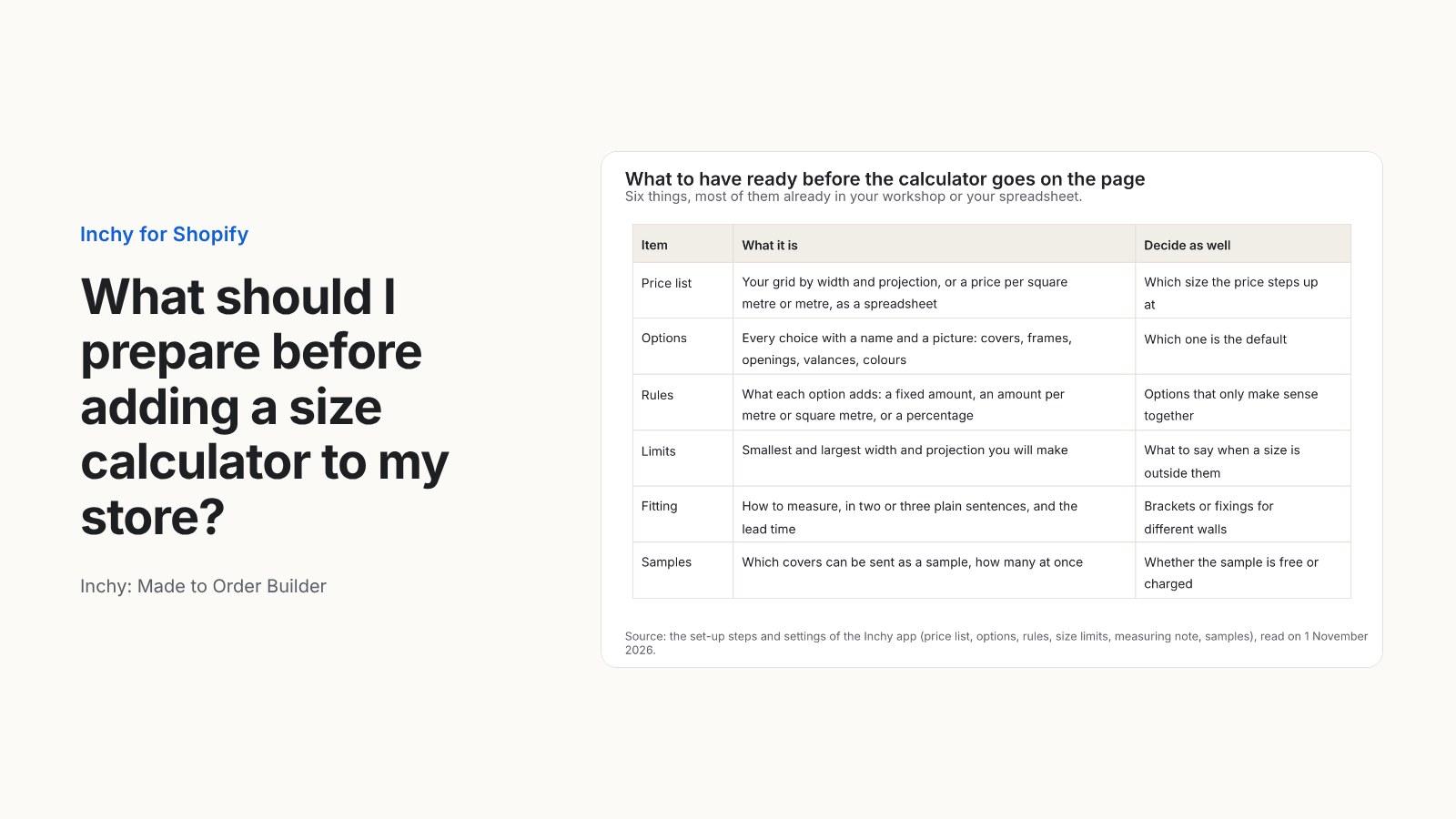
Six things: your price list in a spreadsheet, the list of options with a picture for each, the rule for what each option adds, the smallest and largest sizes you will make, a plain note on how to measure with the lead time, and a decision on fabric samples. All six already exist somewhere in your business. The job is to get them into one sheet before you touch the app. Inchy, a Shopify app for made to order products, asks for these six when you set up a product.
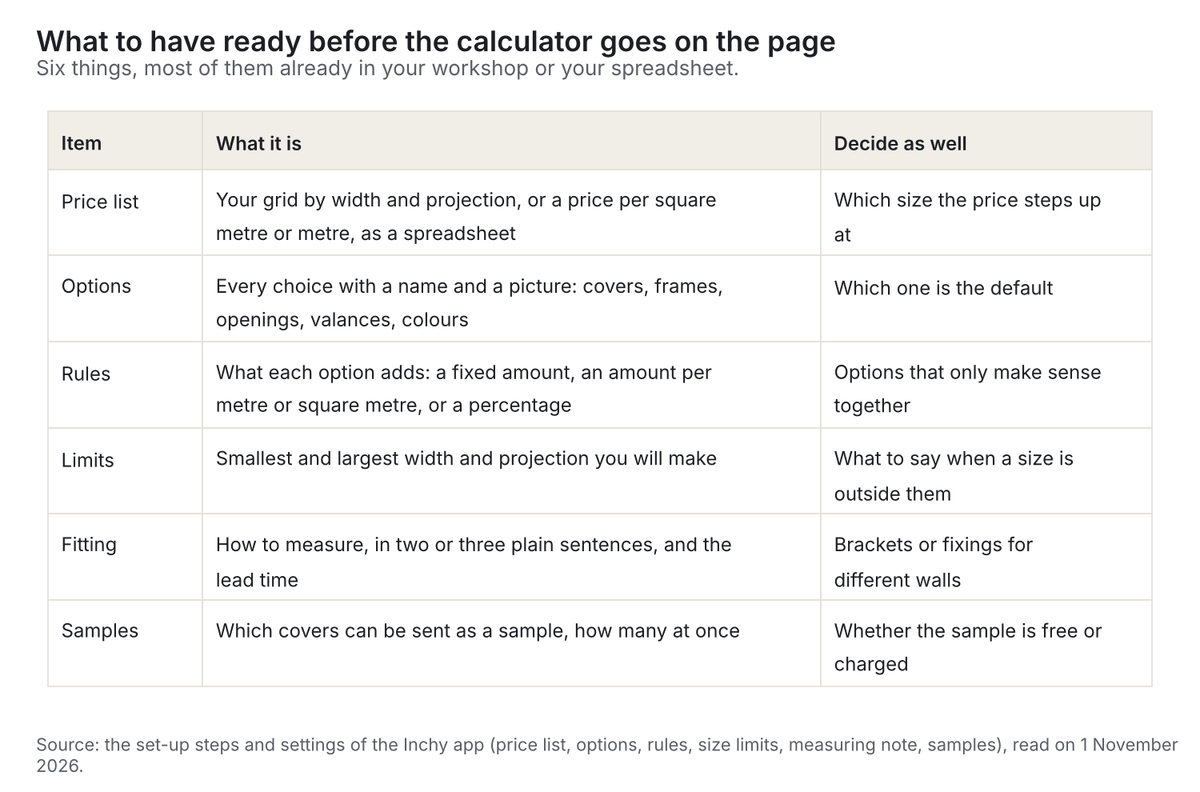
The six items and the small decisions that go with them.
1. What goes in the price list?
Start with how you quote today. For most awning and outdoor shade shops that is a grid: widths across the top, projections down the side, a price in each cell, and a customer's size goes up to the next column and row. For others it is a price per square metre or per metre of width, with a minimum charge. Any of these works. What does not work is a price in your head.
Put it in a spreadsheet with the sizes as numbers, not ranges in words, because the calculator reads numbers. Decide where the price steps up. If your grid has columns at 200, 250, 300 and so on, a 251 cm awning costs the 300 price, and you should be happy with that before a customer sees it. How to sell made to measure awnings and charge the exact price for each size shows a full grid and how it is read.
2. Which options do I list?
List every choice a customer makes: fabric, frame colour, how it opens, valance shape, and for garments the colour, the print position, the sizes. Give each one a name a customer understands and a picture. A swatch of the fabric, a photo of the frame colour, a small drawing of the valance. Decide which option is selected when the page loads; that default is what most people buy, so make it the one you want to sell.
Count them. Shopify allows three options per product and up to 2,048 variants, which is why made to measure products need a calculator instead of variants in the first place. The demo awning has six choices and 80,601 sizes in 1 cm steps.
3. What does each option add to the price?
For each option, write down what it does to the price. There are only a few kinds of rule.
- A fixed amount. The demo's motor and remote adds £280.00 to any size.
- An amount per metre or per square metre. The demo's winter cover is cut to the width and costs £60.00 at 250 cm and £121.00 at 550 cm.
- A percentage of the price so far.
- Nothing. Some options are a choice, not a charge, such as the valance shape in the demo.
Then write down the options that belong together, so you can sell them as a kit at one price. How an awning shop should price add-ons like a motor or a winter cover goes through each rule with the demo's numbers.
4. Which sizes will I make?
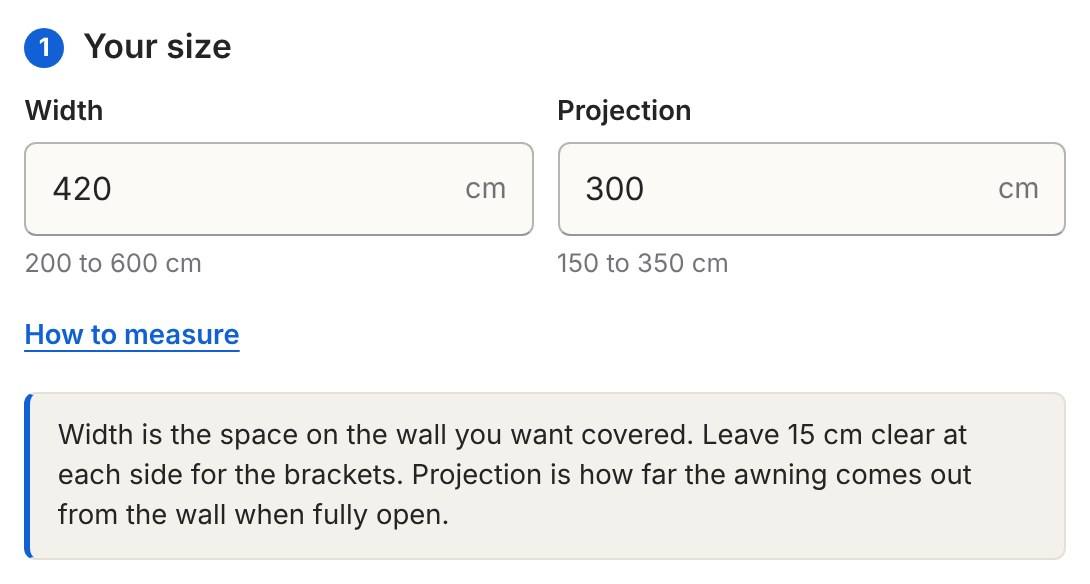
Write the smallest and the largest width and projection you will make, per product, as numbers. These stop the orders you cannot fill. In the demo the awning is made from 200 to 600 cm wide and 150 to 350 cm projection; the limits are printed under each field, and typing 700 cm shows "Width can be up to 600 cm", clears the total and keeps the product out of the basket. Decide what the customer reads then. The demo says "This size is made to order. Send us the details and we will quote you."
Decide also the order value above which you would rather talk first. Big jobs can go to a quote form instead of the basket, and the request arrives with every measurement in it.
5. How does the customer measure, and when will it arrive?
Write the measuring note in two or three plain sentences, as you would say it on the phone. The demo's reads: "Width is the space on the wall you want covered. Leave 15 cm clear at each side for the brackets. Projection is how far the awning comes out from the wall when fully open." That note sits under the size fields behind a "How to measure" link, where the customer is when they need it.
Add the lead time, because a made to measure customer wants to know when. The demo shows "Made to order, dispatched by" and a date under the total. And decide what fixing goes with what wall: in the demo, "Brackets for rendered walls" is an add-on at £35.00, which is simpler than a phone call after the order.
One legal point belongs here too. Under the Consumer Contracts Regulations 2013, regulation 28(1)(b), the 14 day right to cancel does not apply to goods made to the consumer's specifications or clearly personalised. Say that on the page in plain words. It is fair to the customer and it saves an argument.
6. Will I send samples?
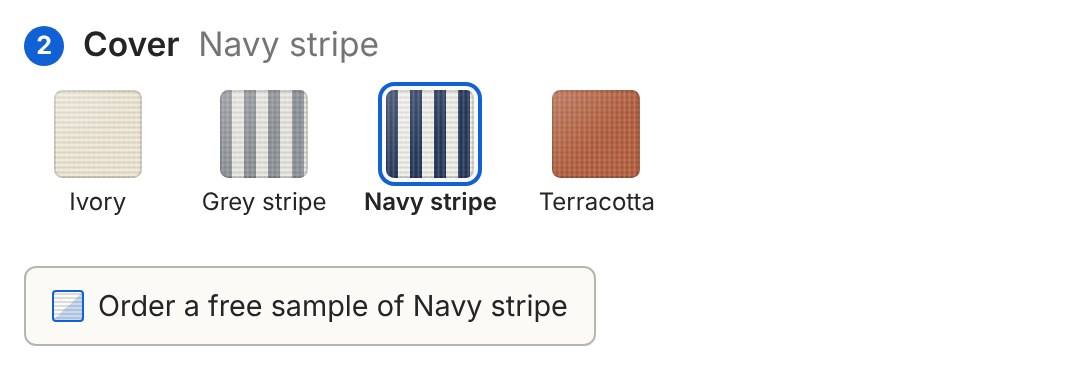
Decide whether a customer can order a piece of the fabric before the product, which fabrics, how many at once, and whether it is free or charged. The demo puts "Order a free sample" of the chosen cover under the swatches. A sample costs you a square of cloth and a stamp; it saves a return of a whole awning. How a Shopify awning shop can offer fabric samples covers the sample flow and the postage.
Then what?
With the sheet in hand, the set-up is short. Pick the awning or t-shirt template, paste the price list, add the options with their pictures and rules, type the limits and the measuring note, switch samples on, and add the Inchy block to the product page in the theme editor. It is a theme app block for Online Store 2.0 themes, so it takes your theme's fonts and nothing is changed in your theme files. Check the page at phone size and at computer size, order your own product once, and print the production sheet from Shopify's Print menu to see what the workshop will get.
Questions and answers
What if my price list is in a PDF from a supplier?
Type it into a spreadsheet first, with your margin on it. The calculator needs numbers it can read, and you need to have looked at every cell once.
Do I need photos of every option?
For awnings and t-shirts, Inchy draws the product and only needs a swatch for each fabric or colour. For other products it shows your own photo for each option, so yes, one photo per option.
Can I change prices after going live?
Yes, at any time, and the change applies to the next order. The checkout works the price out again from the current rules, so the page and the basket stay in step.
Can someone set it up for me?
Yes. Inchy's Custom plan covers set-up, brand styling and integrations, on request. On the standard plans you can also book a short call and send one price list before it.
What does it cost?
Inchy has a Free plan with one product live, no card and no time limit. Team wear is $19.99 a month for garments priced per item. Made to measure is $99 a month for anything priced by size, with every look and style and Bundle kits. Both have unlimited products, are billed by Shopify with no fee per order, and come with a 7-day free trial.
Who makes Inchy?
InterioApp. We have priced and sold made to measure products since 2011, in our own shop first, and our quoting software and calculators are used by made to measure businesses in the UK, Europe, Australia and New Zealand.
Fill in the six rows for one product this week, then put that product on your page and order it yourself. See Inchy and try the live builder. Start the 7-day free trial on the Shopify App Store.
Sources
- Shopify Help Center, Adding variants: up to three options and up to 2,048 variants per product.
- Shopify Partners, Theme app extensions: app blocks are added, removed and configured in the theme editor and work with Online Store 2.0 themes.
- The Consumer Contracts (Information, Cancellation and Additional Charges) Regulations 2013, Part 3: regulation 28(1)(b), goods made to the consumer's specifications or clearly personalised; regulation 30, the 14 day cancellation period.
- Inchy website and live demo: set-up steps, size limits, messages, measuring note, add-on prices and sample button, read on 1 November 2026. The 80,601 size count is 401 widths times 201 projections from the demo's limits.
Written with AI. Every figure is checked against the sources listed above.
1reading
Written by
 Inchy: Made to Order Builder for ShopifyShopify app21 pieces · 9 followers
Follow Inchy: to see new posts in your feed, on your phone or by email.