How Should Cleaning Products Influence Sauna Material Selection?

How Should Cleaning Products Influence Sauna Material Selection?
Choose sauna materials and cleaning products together. Map every surface, confirm the maker's care instructions, review the cleaning product label and safety data, then test any approved treatment on a concealed sample before operational use. A stronger chemical is not automatically a better hotel protocol. Reject combinations that need improvised dilution, leave uncertain residues, visibly alter the surface or conflict with the sauna component instructions. Record the approved method by surface.
Key Takeaways
Cleaning compatibility is a design input, not a handover afterthought.
Timber, glass, metal and treated surfaces need separate decisions.
Product labels, safety data and component instructions set different boundaries.
A concealed test patch reveals appearance change before the whole room is exposed.
Hotel frequency cannot be copied from family-sauna guidance.
Stop when the cleaning team needs to improvise product, dilution or method.
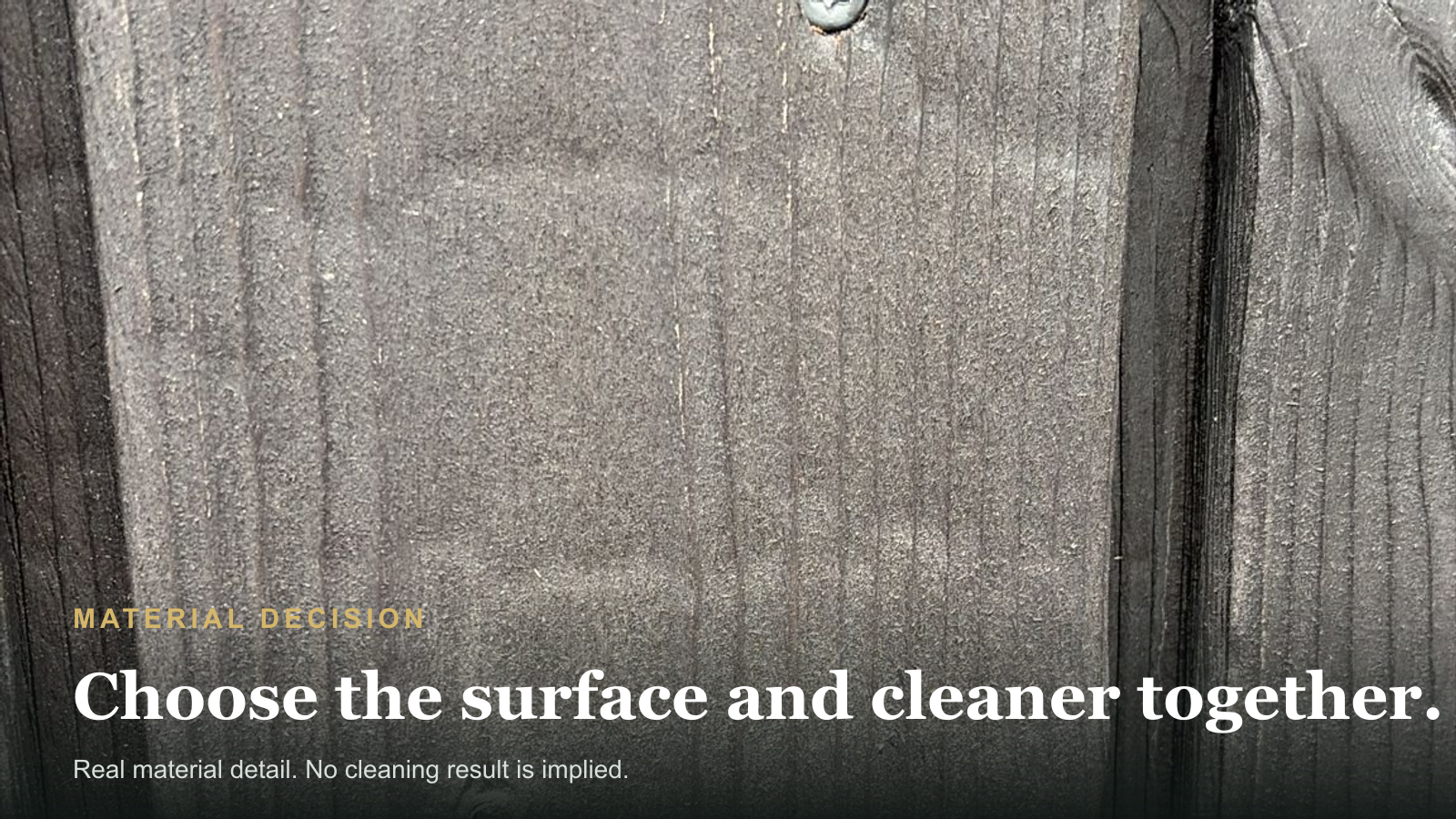
Consider this hypothetical opening week. Housekeeping brings its standard hard-surface cleaner into a warm sauna. The bottle is familiar, but nobody checked the bench treatment, metal finish or permitted application. One test wipe changes the timber tone. The material schedule and cleaning plan have met for the first time on a visible surface.
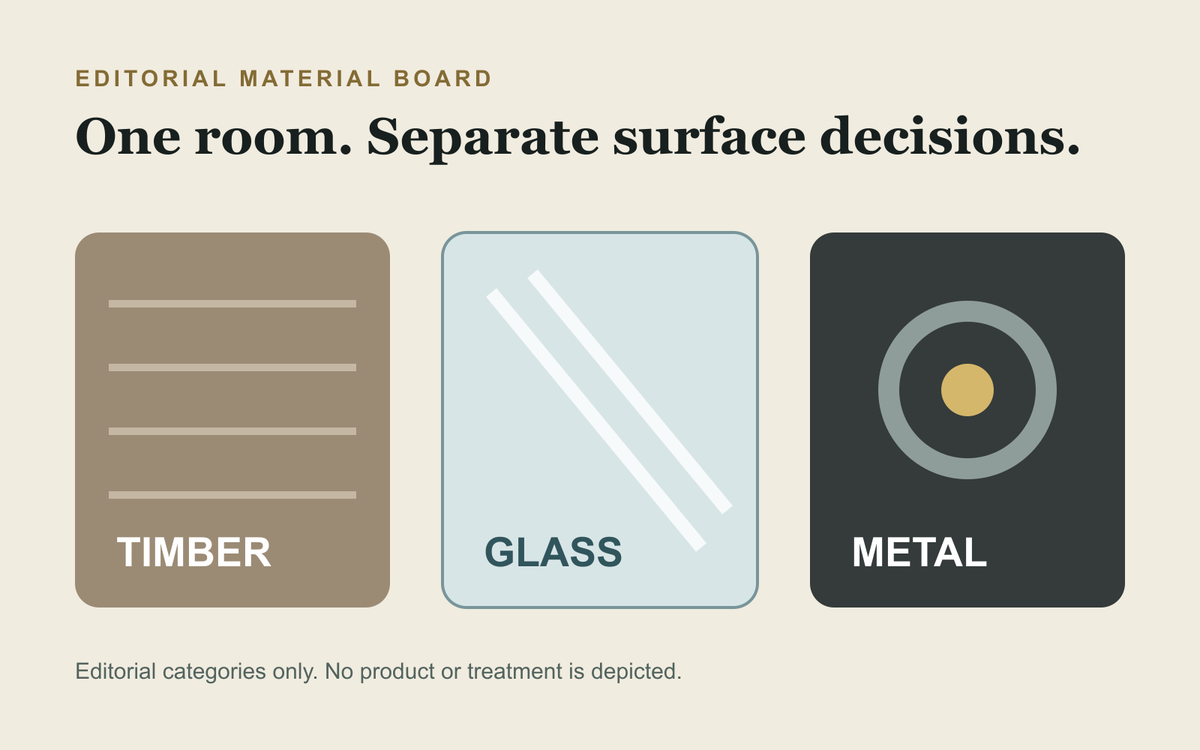
This editorial composition separates material decisions from product selection. It depicts no real chemical, approved dilution or cleaning result.
Which material questions belong in the cleaning brief?
List every surface the cleaning team touches: benches, backrests, wall lining, handles, glass, visible heater surfaces and floor interfaces. Record the actual material or finish and the product maker's care instruction. “Wood cleaner” is no more precise than “heater spare”.
Harvia's January 2026 maintenance guidance prohibits lacquer on sauna interior surfaces, recommends purpose-made treatments and warns that fragrances or care products may stain wood. It also suggests a slightly alkaline cleaner for a family sauna. That family-use example is not a hotel frequency or protocol.
Wood Architects builds with thermowood, uses full-height panoramic glass in our cube-form sauna and fits Harvia and HUUM heaters. Our bounded manufacturer judgement is that one cleaning instruction is still too crude for the installed timber, glazing and equipment. Any additional metal surface belongs in the hotel's general surface schedule, not in this Wood Architects product claim.
Our second judgement concerns the sample. The exact timber or finish offcut used for approval is more useful than a generic colour swatch. It can show a visible change before the installed room becomes the test area.
Test the combination, not the label.
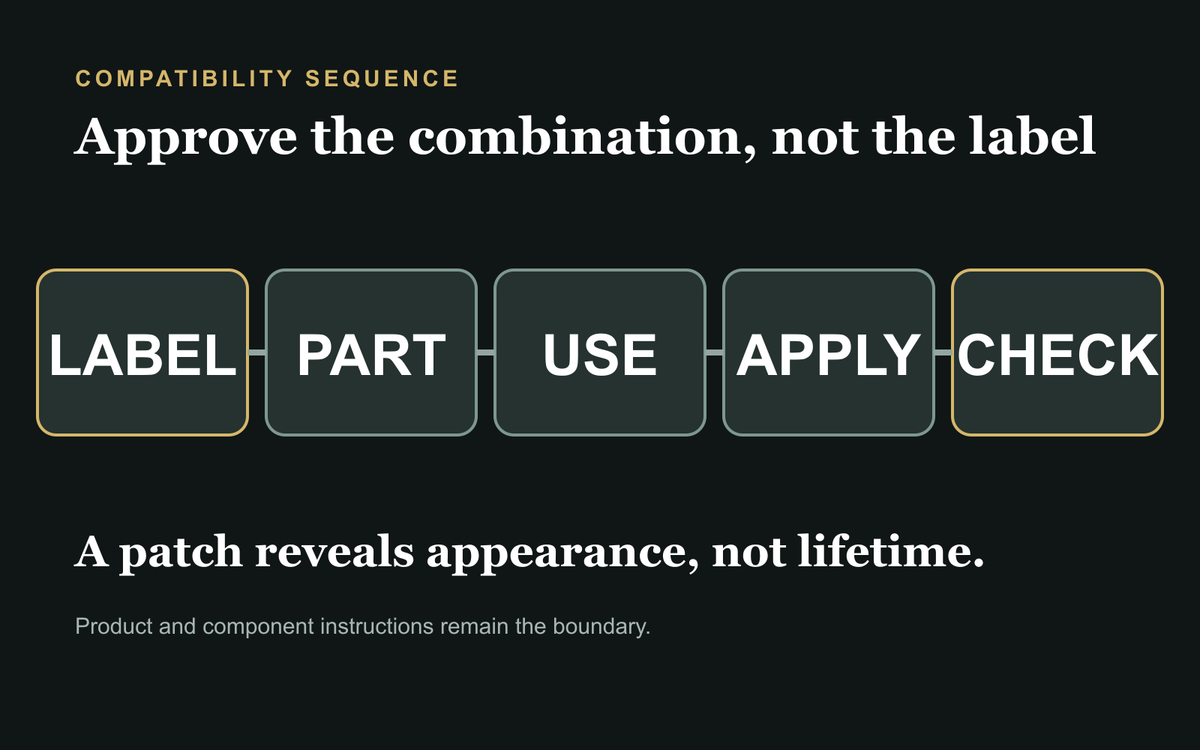
The sequence exposes five variables before approval. It does not predict chemical performance or replace supplier instructions.
What does the cleaning-product file need to prove?
For professional chemical use, keep the current product label and the safety data supplied for the product where required. Record the intended surface, application method, dilution if specified, contact time if specified, rinsing or removal method, personal protective measures and storage route. Do not invent a value that isn't stated by the supplier.
Article 37(5) of the cited 5 July 2021 consolidated REACH text requires downstream users to identify and apply appropriate measures to control risks identified in supplied safety data, their own chemical safety assessment or Article 32 information. This is a chemical risk-control duty, not proof that a cleaner suits a sauna surface.
The European Commission's EU Ecolabel cleaning page describes criteria that consider hazardous-substance limits, sourcing, packaging and use guidance. An ecolabel can inform procurement. It does not override the sauna material or component instruction.
Keep one approved method per surface and one route for a new product request. If housekeeping changes supplier, product name or formulation, the replacement returns to review rather than inheriting the previous approval.
How can a hotel approve a cleaning method?
Start at room temperature on a concealed sample or manufacturer-approved offcut. Follow the product instructions exactly. Inspect colour, sheen, fibre lift, residue, smell and any visible interaction with adjacent finishes. The appropriate technical parties decide whether further testing under representative conditions is safe and useful.
Never turn a visual patch test into a safety certification. It can reveal an obvious appearance problem. It cannot establish indoor exposure safety, long-term durability, microbiological performance or compatibility with every future batch.
The trade-off is between cleaning simplicity and material character. A highly uniform sealed surface may simplify one task but change the tactile or heat-room design. Natural timber preserves another experience but needs a compatible care method and disciplined drying. Decide with operations before specification, not after staining.
Copy into the material schedule | Approval input | Release question |
|---|---|---|
Surface identity | Exact material, finish and component | Is the care instruction current? |
Cleaning product | Label, safety data and intended use | Does the supplier cover this use? |
Method | Application, dilution, removal and drying | Can staff repeat it without guessing? |
Change control | Trigger for new product or formulation review | Who pauses and rechecks the method? |
Those four lines answer “How Should Cleaning Products Influence Sauna Material Selection?” before materials and housekeeping procedures split into separate files.
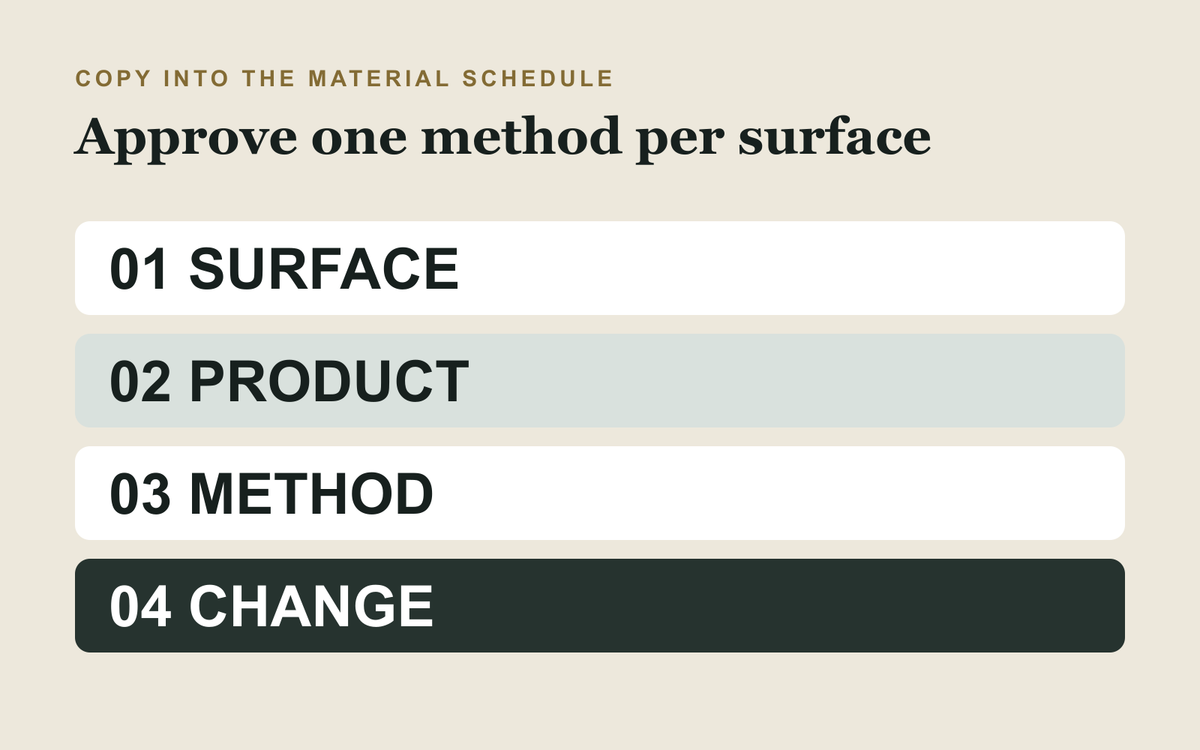
The card can be copied into a material schedule or housekeeping brief. It records approval inputs without claiming a universal cleaner.
What does a cleaning compatibility failure look like?
Picture a weekend changeover. A substitute product arrives in similar packaging and the team uses the familiar dilution from memory. The benches dry with a different tone, a metal edge shows residue and the room smells unusual when heated. Procurement sees a replacement cleaner. Operations now has three separate surface questions.
Run a paper exercise before opening. Replace one approved product with an unreviewed alternative and ask the team what happens next. A strong procedure pauses use, preserves the label and safety data, identifies affected surfaces and routes the decision to the named technical parties.
Similar packaging proves nothing.
Every surface keeps its own method.
STOP: don't release the cleaning schedule while any hot-room surface is described only as “wood” or “metal”, the product instruction is missing, or staff need to invent dilution, contact time, rinsing or drying. The installed sauna must not become the first uncontrolled test patch.
Bring one material offcut and one blank approval card to the next housekeeping review. Make the first product decision before the first guest session.
Frequently asked questions
Can a hotel use one cleaner on every sauna surface?
Only when the relevant material and product instructions support every intended use. Timber, glass, metal, treated areas and component surfaces can have different limits. A single housekeeping product may still be workable, but approval needs to be explicit by surface rather than assumed from the room name.
Is an alkaline cleaner always suitable for sauna timber?
No universal conclusion follows. Harvia gives a slightly alkaline example for basic cleaning of a family sauna, alongside its own care instructions. A hotel needs the installed material and treatment guidance, the actual cleaning product instructions and its professional-use assessment. Do not export one pH example into every protocol.
Does a concealed patch test prove compatibility?
No. A patch can expose visible changes such as colour, sheen, residue or fibre response under the tested method. It does not prove long-term durability, chemical exposure safety or hygiene performance. Use it as one screening step inside the product and material instructions, not as a substitute for them.
What happens when the cleaning supplier changes?
Pause automatic substitution. Compare the new label, safety data, intended use and application method with the approved record. Confirm material and component compatibility, then repeat the agreed approval step. Similar names, packaging or stated purpose do not establish that the formulation or surface response is unchanged.
How is cleaning selection different from maintenance?
Cleaning selection controls the product and method used on each surface. Maintenance covers the wider care, inspection and drying regime over time. The two need to connect without collapsing into one generic instruction. Read What Maintenance Does Your Thermowood Sauna Need? by Giedrius Patlaba for that broader boundary.
1reading now
Get an email when Giedrius publishes