
Who Should Lead Your Outdoor Sauna Project?
Key Takeaways
The client should appoint one project lead and record that person's limits.
The lead coordinates decisions but doesn't inherit every designer's technical responsibility.
The manufacturer supplies product data, configuration limits and production-release inputs.
Architects, engineers and installers retain the work assigned by their appointments.
Every critical interface needs a name, required evidence and decision date.
A blank critical responsibility should stop production release, not invite an assumption.
Picture a coordination call with the architect, electrician, landscape contractor, sauna supplier and hotel team. Each person answers questions inside their own package, but nobody confirms who joins the answers together. The base shifts, the cable route follows, and the product drawing stays unchanged. Everyone has worked, yet the project has not been led.
Who Should Lead Your Outdoor Sauna Project?
One person appointed by the client should coordinate decisions across the whole project. That person may be a project manager, architect, lead designer or contractor, depending on the appointments and procurement route. The lead keeps the decision record, finds gaps and sends questions to the right competent party. That coordinating role doesn't replace the structural engineer, electrical designer, installer, manufacturer or local authority, and technical approval stays with the appointed competent parties.
What does the project lead actually own?
The project lead owns the coordination loop. They collect the current brief, identify each decision, ask for the required input and record the answer. They also expose a question that has no owner. That is different from personally designing every interface.
As checked on 25 August 2026, the current RIBA Plan of Work page describes staged professional practice and includes a Design Responsibility Matrix in its toolbox. RIBA says the matrix can identify who leads a task and who supports it. This guidance is useful, but it isn't universal sauna law or a substitute for project appointments and contracts.
The UK BIM Framework's ISO 19650 guidance on parties and teams distinguishes the appointing party, lead appointed parties and appointed parties. It also says information needs coordination across delivery teams. The guidance concerns information management and gives no automatic legal design liability to someone called the project lead.
My manufacturer judgement is narrower: the coordination lead should see the complete decision chain and reach every appointed discipline. The factory rarely has that view. We see the product, its configuration and its production constraints. We don't hold the client's planning strategy, structural calculations, electrical design or every site appointment.
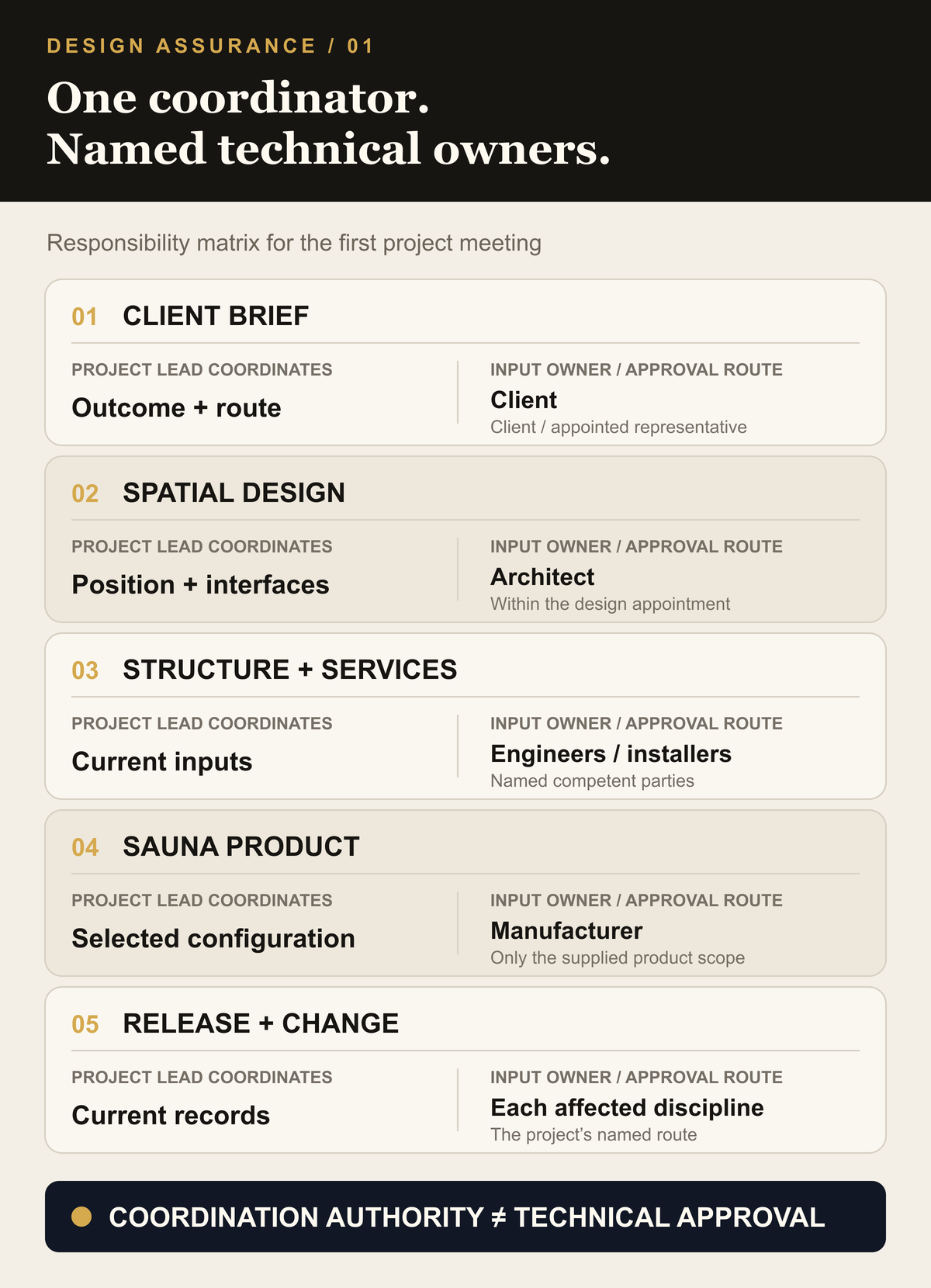
The matrix shows what the project lead coordinates and where technical input or approval remains with a named client, designer, specialist or manufacturer. It helps expose an ownerless decision; it does not change the parties' appointments or create technical authority.
Where should the project lead's authority stop?
A useful lead has enough authority to convene the right people, request missing information and stop an unsupported release. That doesn't make the lead competent to approve work outside their appointment. The boundary should appear beside the role, not in a footnote nobody reads.
Project area | Input the lead coordinates | Boundary to record |
|---|---|---|
Client brief | Required outcome, budget decision and approval route | The client or appointed representative approves the brief |
Spatial design | Position, access, appearance and surrounding interfaces | The appointed designer retains the agreed design scope |
Structure and services | Base, loads, electrical design and connections | Appointed competent designers and installers retain their scopes |
Sauna product | Selected configuration, product data and production constraints | The manufacturer confirms only the supplied product scope |
Release and change | Current documents, accepted departures and decision record | The named approval route follows the project appointments |
At Wood Architects, we assemble and check saunas at our Klaipėda facility before shipment. That gives us direct product evidence. It doesn't let us approve a foundation, sign an electrical design or decide whether a local permission is required. A factory check and a project approval answer different questions.
For the separate question of supplier capability, read How Do You Spot a Reliable Sauna Manufacturer? by Giedrius Patlaba. A reliable manufacturer can still be the wrong project lead. Supplier verification and project coordination are adjacent decisions, not interchangeable ones.
How should the lead run the first responsibility meeting?
Start with interfaces, not job titles. Put one decision on each line. Ask what input proves it, who prepares that input and who can accept the result under the project's appointments. Then give the line a date and a current document reference.
Copy these lines into the meeting record:
“Project lead: [name], appointed by: [client], coordination scope: [scope].”
“Decision required: [decision], input owner: [name], approver: [name].”
“Manufacturer input required: [document or answer], needed before: [gate].”
“Open interface: [interface], current assumption: [text], owner: [name].”
“STOP if this line remains blank at production release.”
The question “Who Should Lead Your Outdoor Sauna Project?” becomes useful only when the answer names a person, scope and stopping point.
The trade-off is real. One lead creates a clear route for questions, but an overpowered lead can become a false technical authority. A broad meeting invites every voice, yet nobody may close the decision. The answer is one coordinator with visible limits and named discipline owners.
Consider a hypothetical project where the architect emails a revised sauna position to the client. The landscape contractor moves the base while the electrician follows an earlier drawing, and the supplier isn't included because nobody owns the interface list. Nothing has failed in the factory. The failure is an unrecorded handoff between three current documents.
From the factory side, one unresolved question from a named lead is safer than three silent assumptions. We can check whether a proposed change affects the product or production release. We can't decide how the whole site absorbs that change.
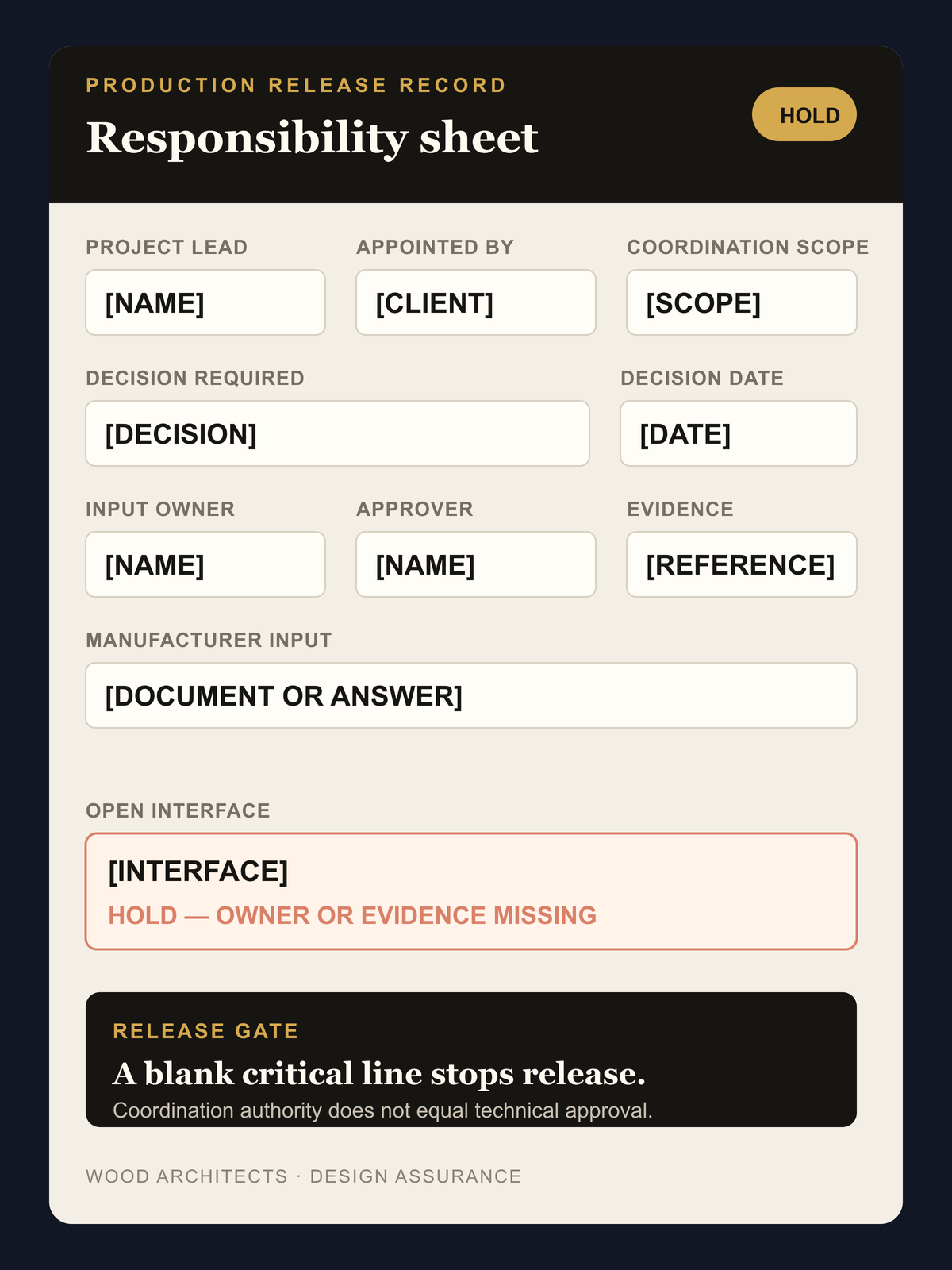
The release sheet makes a critical ownership or evidence gap visible before production. A blank interface remains on HOLD until the competent appointed party resolves it; the sheet does not transfer technical approval to the coordinator.
What belongs on the one-page responsibility sheet?
Give each critical decision a plain-language description, one coordinating name, one input owner, one approval route and one document reference. Add the date, status and effect of any change. Don't write “team” where a person is needed. Don't write “approved” without naming who approved what.
Decision: “[Name] is the project lead for outdoor sauna coordination from [date] until [defined handover point]. Their authority is to coordinate, record and escalate. Technical approval remains with the parties named for each discipline.”
STOP: don't release the sauna for production while a critical product selection, site interface, structural input, electrical requirement or approval route remains assumed, conflicting or ownerless. Resolve the line through the competent appointed party and record the answer first.
You don't need a larger meeting. Print one responsibility sheet and put the lead's name at the top. If a critical row stays blank, the paper has already shown where the project must pause.
Frequently asked questions
Can the architect lead an outdoor sauna project?
Yes, when the client appoints the architect to coordinate the relevant project work and the appointment defines that scope. The architect doesn't automatically inherit the manufacturer's product obligations, an engineer's calculations, an installer's connection work or the client's approvals. Record both the coordinating role and its limits.
Can the sauna manufacturer act as the project lead?
Only if the client formally appoints the manufacturer for a defined coordination scope and that arrangement fits the project. A normal supply role is narrower. The manufacturer can confirm product data, configuration and production constraints, but can't silently absorb planning, structural, electrical or site acceptance duties.
Who should approve the sauna's electrical design?
The competent person named under the project's appointments and applicable local requirements should approve the electrical design. The sauna or heater manufacturer supplies relevant product information for the selected configuration. That information supports the designer and installer. It doesn't replace their project-specific design, connection, testing or certification work.
When should the project lead be appointed?
Appoint the lead before separate disciplines begin making connected sauna decisions. Early appointment lets the team define information routes, responsibility boundaries and escalation before drawings diverge. The exact stage depends on the project's procurement and appointments, so a RIBA stage label shouldn't be treated as universal law.
What if nobody accepts the project-lead role?
Pause any decision that depends on coordination across unowned interfaces. The client should resolve the appointment and authority gap before production release or a site commitment. Splitting technical work among competent parties is normal. Leaving the joining decisions ownerless is not a workable project structure.
1reading now
Written by
 Giedrius PatlabaCEO & co-founder, Wood Architects163 pieces · 31 followers
Follow Giedrius to see new posts in your feed, on your phone or by email.
- views