Why Growing More Food Isn't How Africa Feeds Itself

There is a assumption buried in most conversations about feeding a growing continent: that the answer is to grow more. It is worth challenging, because the fastest way to put more food on more tables often isn't producing more — it's losing less of what has already been grown. And Africa loses a staggering amount.
The loss after harvest
The FAO estimates that 30–50% of the food produced in Sub-Saharan Africa is lost before it ever reaches a market. As innovators working on rural cold chain have made vivid, this is not a farming failure — it is an infrastructure one wearing a farming costume. A cassava root begins spoiling within days of harvest, so the farmer processes now, at whatever cost, or loses the crop entirely. Where the power to cool, dry and process is diesel — expensive and unreliable — the cost of saving the harvest can swallow 40–60% of a farmer's earnings. Reliable, localised, solar-powered cooling and processing is one of the highest-leverage fixes in African agriculture, precisely because it stops food that already exists from rotting.
The loss before harvest
But the harvest is only the midpoint. There is a second, quieter loss that happens months earlier — in the soil. A large share of the fertiliser a farmer buys is never taken up by the crop at all. On compacted, biologically depleted or chemically locked-up soil, applied nutrients fix into unavailable forms, leach away or volatilise. The farmer pays for 100 units of nutrition and the crop receives a fraction. That is loss too — expensive, invisible, and happening before a single root is pulled from the ground.
Same disease, two symptoms
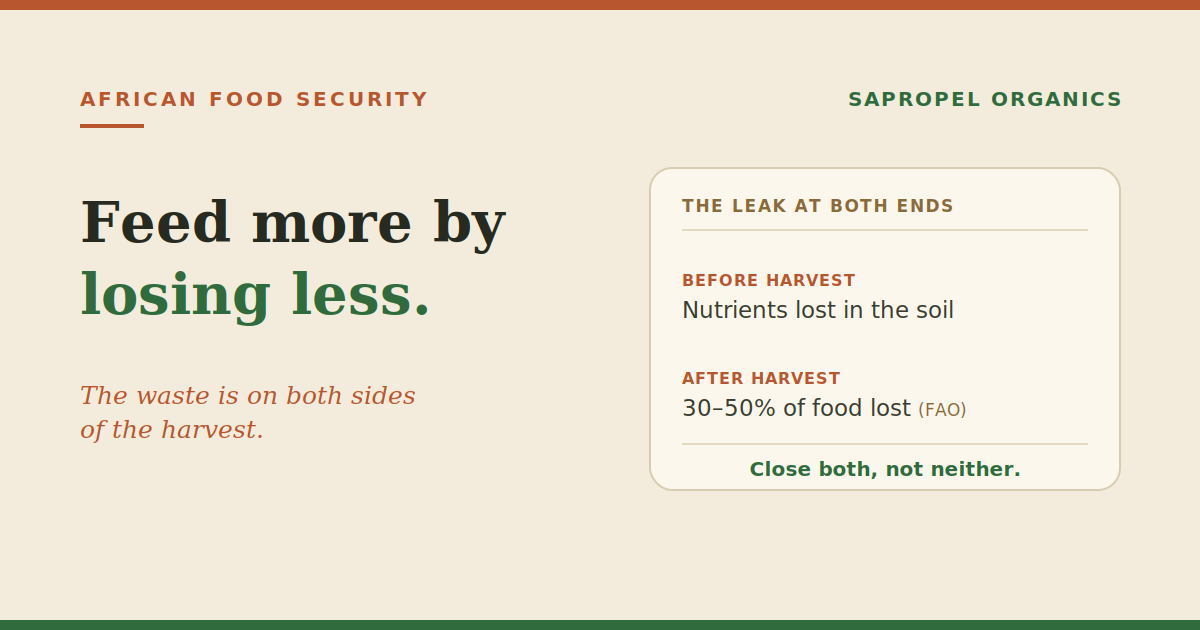
Look at both losses together and they are the same problem. Post-harvest spoilage and pre-harvest nutrient waste are not production failures. They are efficiency failures dressed as production problems. And they share a dangerous implication: if the system is leaking at both ends, growing more simply means growing more to lose. You can double the harvest and still watch half of it vanish between the soil and the market. More production poured into a leaky system is not food security. It is wasted effort at scale.
Closing the pre-harvest gap
This is where a soil-restoration input belongs in the same conversation as cold chain. Humuson Complex, made from sapropel, rebuilds the soil biology and structure that govern whether applied nutrients are actually absorbed — lifting nutrient-use efficiency by around 25% and helping the crop draw on nutrients already in the ground. In plain terms, it means far more of what a farmer pays for ends up in the plant rather than lost to the soil. It does not replace the cold chain that protects the crop after harvest; it protects the farmer's investment before it. Together, the two close the leak at both ends.
Feed more by losing less — on both sides of harvest
The most powerful shift in African food security may be a change of question. Not "how do we grow more?" but "how do we lose less of what we already grow — before harvest and after?" Solar cooling keeps the crop from rotting on the way to market. Restored, efficient soil keeps the inputs from being wasted on the way to the crop. Neither asks the farmer to work more land. Both simply stop the waste that already exists. That is the same efficiency logic behind our earlier piece on soil as a driver of stability and self-reliance.
If you work in African agriculture, food security or the input supply chain, the highest-return move may not be more production at all. It may be closing the leaks — and we'd welcome that conversation.
1reading now
Get an email when Aurimas publishes