
Could Digital Product Passports Apply to Your Outdoor Sauna?

Key Takeaways
A digital product passport is an information system, not simply a QR code.
Outdoor saunas are not currently a confirmed mandatory DPP product group.
Buyers can organise passport-ready records without calling them an official DPP.
Use a durable unit identifier and version-controlled documents.
Separate registry, data carrier and decentralised product records.
Update the handover dossier when components, manuals or ownership change.
Could Digital Product Passports Apply to Your Outdoor Sauna?
Digital product passports could become relevant to outdoor saunas or their components through future product-specific EU rules, but saunas are not currently a confirmed mandatory DPP product group. A buyer can still prepare useful, passport-ready records now: a unit identifier, manual version, material and component references, maintenance and spare-part information, and installation handover. Call this a voluntary buyer dossier, not an official EU digital product passport.

A controlled record connects one configuration to its evidence and owner. It organises accountability, but does not create legal compliance.
For a Wood Architects cube, I would want the unit record to connect its 128 mm wall build-up, full-height panoramic glazing, burnt thermowood exterior and selected Harvia or HUUM equipment to the documents supplied for that exact configuration.
Do not reduce a DPP to a QR code
A QR code is a possible data carrier. It can point a user towards information, but the code alone says nothing about data structure, persistence, access rights, product identity or legal scope. The European Commission describes the DPP as a structured system for product information, designed around decentralised data and defined access.
The Commission's Digital Product Passport overview explains the wider system. Its DPP Registry page states that the registry and test environment went live on 20 July 2026. The registry is an identification layer. It is not described as a central store for every full technical file.
Use a Passport-Ready Evidence Stack
Evidence layer | Useful now | DPP caution |
|---|---|---|
Unit identifier | Connects handover records to one delivered sauna | Not proof of an official EU passport |
Manual version | Shows which instructions were supplied | Required fields depend on future sector rules |
Material and component references | Supports maintenance and replacement questions | Coverage must be defined, not assumed |
Maintenance and spares | Helps the operator plan service | Availability periods need supplier evidence |
Installation handover | Records installer, date and local documents | A buyer dossier is not an official DPP |
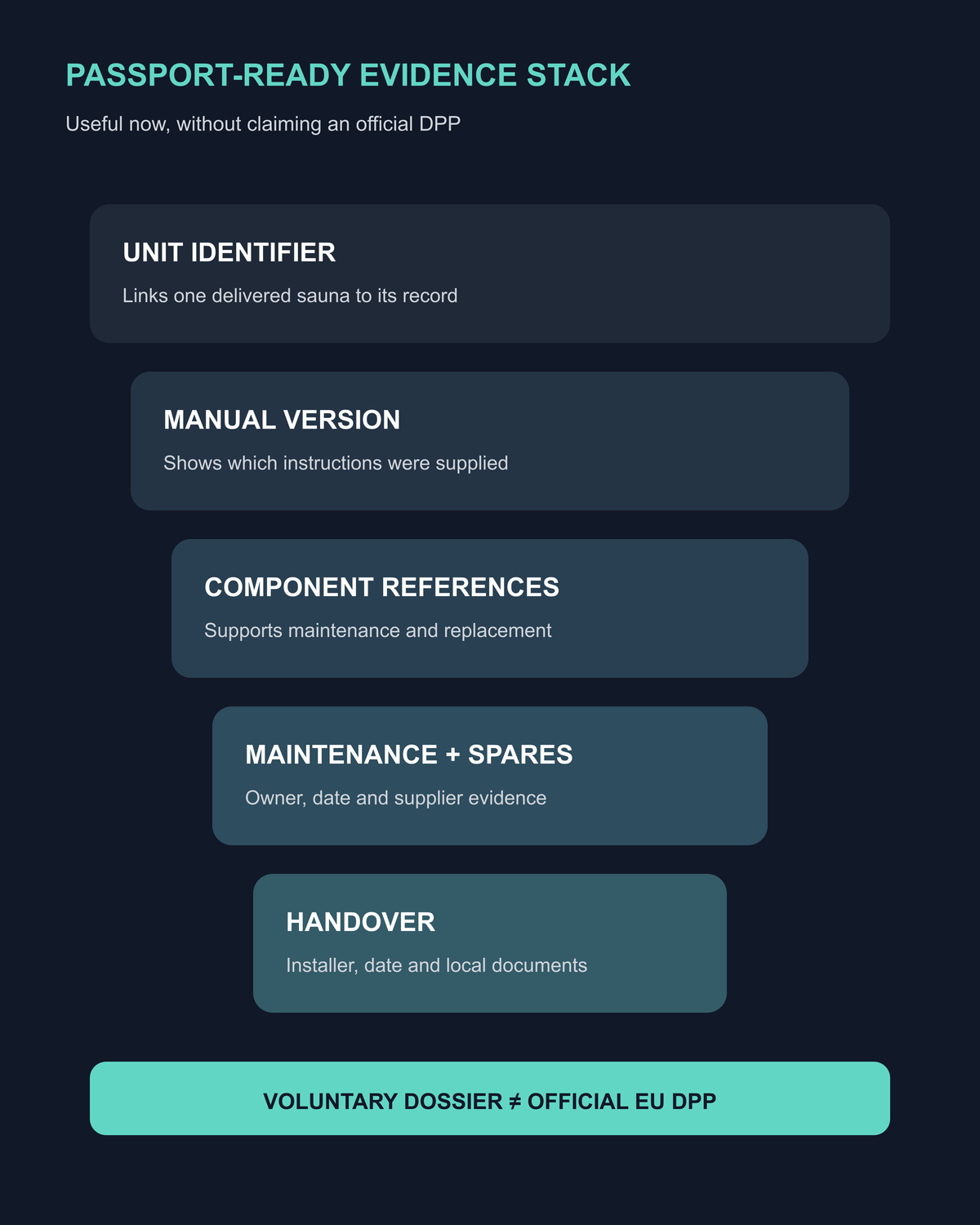
These records have operational value today, even before product-specific DPP obligations are confirmed.
When we review a handover dossier, we want the document owner and version to be as clear as the component name.
Read the timeline carefully
The Ecodesign for Sustainable Products Regulation establishes the framework under which product-specific rules can introduce DPP requirements. It does not make every product group subject to the same passport on the same date. Certain batteries have the first mandatory battery passport date of 18 February 2027 under separate battery rules. That date should not be transferred to outdoor saunas.
The Construction Products Regulation envisages a construction digital product passport system, but the practical requirements depend on delegated acts, product scope and implementation. Do not promise that a 2027 construction milestone automatically covers a sauna. The relevant official texts are Regulation (EU) 2024/1781 and Regulation (EU) 2024/3110.
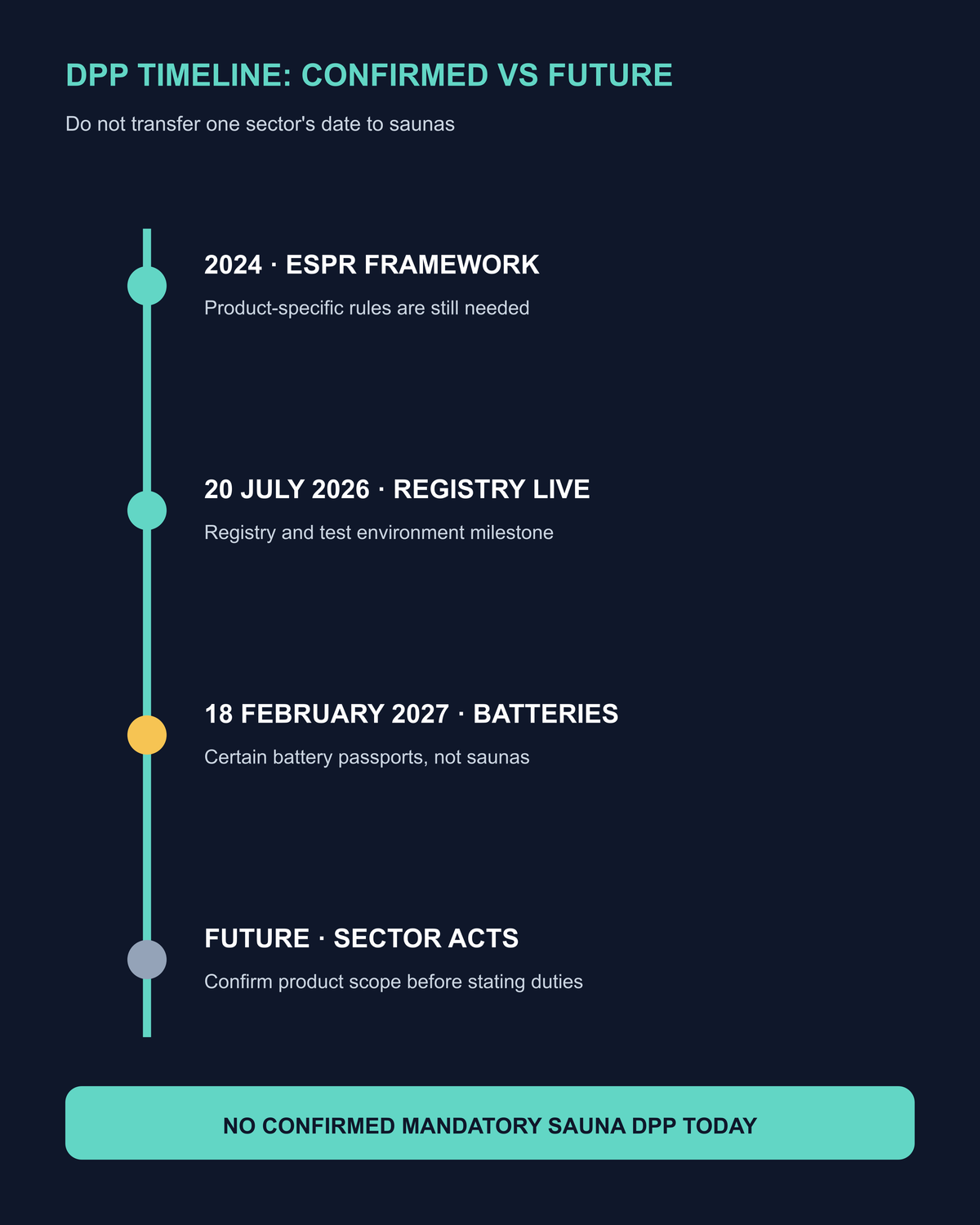
The timeline separates confirmed system milestones from future product-specific decisions.
Design the dossier for handover and change
Start with one durable identifier for the delivered unit. Link it to a controlled index, not an unstructured folder. Record document titles, versions, dates and owners. Keep the delivered controller, heater and other replaceable component references distinct. When a component changes, preserve the old record and add the new one rather than overwriting history.
In our work, a replacement component should add to the history rather than erase the record of what was originally delivered.
Decide who maintains the index after handover. A dealer, installer and operator may all hold different evidence. Access should follow their roles. Public care information can be separated from restricted commercial or technical records. This is sensible information management, not a claim of legal DPP compliance.
For a related lifecycle record, see What Maintenance Does Your Thermowood Sauna Need?. Maintenance information is useful inside a controlled dossier, but one care article should not be presented as a complete digital product passport.
FAQ
Do outdoor saunas need a digital product passport now?
Outdoor saunas are not currently identified here as a confirmed mandatory DPP product group. Applicability depends on future product-specific rules and the scope of the product or component. Buyers can organise passport-ready records now, but should not label a voluntary dossier as an official EU digital product passport.
Is a QR code the same as a DPP?
No. A QR code can act as a data carrier, but a DPP also depends on product identity, structured information, access rules, persistence and the applicable legal specification. A marketing page behind a code should not be presented as an official passport unless the product-specific requirements are met.
What should a voluntary sauna dossier contain?
Use a unit identifier, controlled document index, manual versions, material and component references, maintenance information, spare-part contacts and installation handover. Record dates and owners for each item. The exact fields are a buyer's information design and should not be described as confirmed EU DPP requirements for saunas.
Does the DPP Registry hold the full technical file?
The Commission describes the registry as storing unique identifiers and supporting the DPP system, not as a central repository for every full technical file. Product data is designed to remain decentralised. Access and retention arrangements still need to follow the applicable rules and the buyer's evidence architecture.
Does the 18 February 2027 date apply to saunas?
No. That date concerns mandatory passports for certain batteries under battery rules. It should not be copied onto outdoor saunas. Sauna or construction-product relevance depends on separate product scope and future acts. Use confirmed sector-specific text before stating a date, field list or legal obligation.
1reading now
Get an email when Giedrius publishes