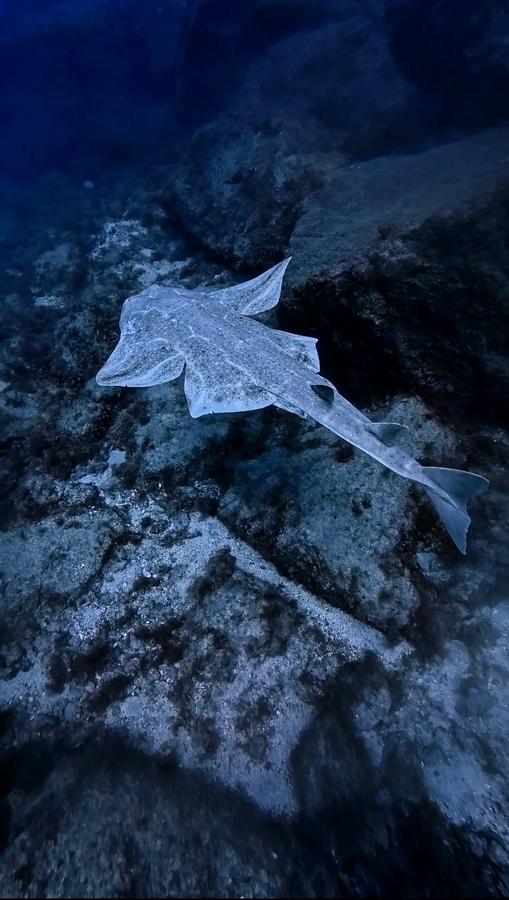
Diving with angel sharks in Tenerife: where, when and what to expect
By Sergio Cruz Álvarez, SSI instructor and co-owner of Barbarian Diving, Los Cristianos
Tenerife is one of the few places on Earth where you can still dive with the angel shark (Squatina squatina). It is critically endangered, and the Canary Islands are its last real stronghold. After about 20 years teaching diving here, seeing one resting on the sand still makes my day.
What is an angel shark?
Angel sharks look more like a ray than a shark. They are flat, sandy coloured and spend most of the day buried in the sand, waiting for fish to swim past. Adults can reach well over a metre long. Once they lived along the coasts from Norway to the Mediterranean. Today the Canary Islands are the only place where divers still see them regularly.
When is the best time to see them?
You can meet angel sharks all year, but winter is the classic season. From roughly October to March they come into shallower water. Research in the Canaries found males are most frequent from November to January, during the mating season, and females and young from April to July, when they give birth. They prefer water around 17 to 22 degrees and sandy bottoms near rocky reefs.
Where do you see them in Tenerife?
Look for sandy patches next to rock and reef, often in quite shallow water. In the south of the island we dive several shore sites with exactly this kind of bottom. Our best spots for angel sharks are Las Vistas beach in Los Cristianos, Abades, La Jaca and San Juan, where Open Water divers can join too. By boat, Palmar Wall and Palmar Cave are also good places to find them. Nobody can promise a sighting: it is a wild animal. A good guide knows where they like to settle and how to spot the outline of a shark under a thin layer of sand.
How to dive with angel sharks responsibly
Angel sharks are calm and not dangerous to divers, but they are easily disturbed. These are the rules we follow on every dive:
Keep your distance and never touch them.
Stay low and keep good buoyancy so you don't kick sand onto them.
Approach slowly from the side, never from the front or above.
If a shark starts swimming, let it go. Don't follow it.
No flash in its face, and keep the group small.
Our groups are never bigger than four divers per guide, which makes a quiet, respectful encounter much easier.
Help protect them
In Spain the angel shark is listed as "in danger of extinction" and is fully protected. The Angel Shark Project: Canary Islands, set up in 2013, studies the population with help from divers. Some sharks carry a small coloured tag between the two dorsal fins. If you see one, note the date, place and depth, and report it on angelsharknetwork.com. Every sighting helps.
Diving with us
At Barbarian Diving in Los Cristianos we dive all year in small groups organised by level, with all equipment included and instruction in English, German and Spanish. In winter we provide a 7 mm wetsuit. If an angel shark is on your wish list, tell us when you book and we will plan your dives around the best chances. More at barbariandiving.com
1reading
Written by
 Barbarian diving TenerifeSSI Dive Instructor1 piece · 1 follower
Follow Barbarian to see new posts in your feed, on your phone or by email.