
What National Rules Apply After Your Sauna's CE and DoP Review?

Key Takeaways
CE marking reports declared product performance, not automatic approval of a sauna project.
First confirm whether each construction product is covered by the applicable CPR route.
Compare declared performance with the destination's requirements for the intended use.
National and local rules can still govern the works, site, installation and approvals.
Use the destination Product Contact Point for Construction for national-rule questions.
The old and new CPR frameworks are in a managed transition during 2026.
A Declaration of Performance can be correct while the proposed sauna still fails a local project check. From a Lithuanian manufacturer's side, we can supply product evidence, but we can't grant permission to build in another country. This guide shows what to do after the applicable CE and DoP review without treating either document as project-wide approval.
What National Rules Apply After Your Sauna's CE and DoP Review?
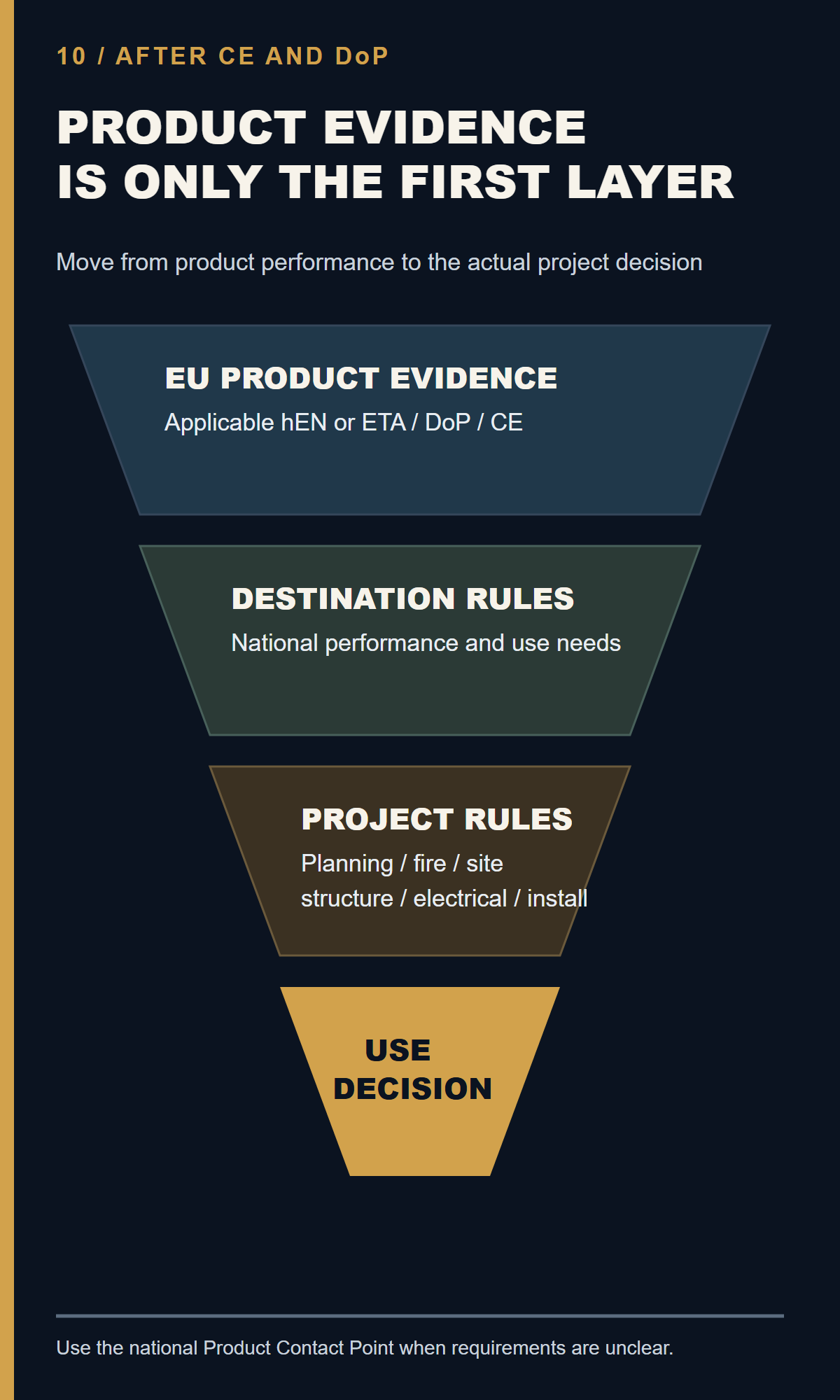
Apply the rules of the country and site where the sauna will be used. Depending on the project, these may cover building permission, structural actions, fire safety, energy, accessibility, electrical work, foundations, drainage, distances and installation. CE marking and the Declaration of Performance describe conformity with declared product performance under the applicable construction-products route. They do not confirm that the selected performance satisfies every national or local requirement for the finished works.
Keep product evidence and project approval separate
The European Commission explains that a Declaration of Performance is required for a construction product covered by a harmonised European standard or one for which a European Technical Assessment has been issued, subject to the applicable framework and exceptions. Its DoP and CE marking guidance says CE marking indicates conformity with the performance declared and the assessment basis used.
That does not decide whether an outdoor sauna can be placed on a particular plot. It does not select the local snow load, approve foundations, size an electrical supply or grant planning permission. Those decisions belong to the works, intended use and destination rules.
Use our separate private-label CE responsibility guide to identify the economic operator behind the declaration. Then move to the national-use check described here.
Run the national-use matrix
Project question | Product evidence can contribute | Destination evidence still needed |
|---|---|---|
Can it be built at this address? | Dimensions and intended-use information | Planning status, permit route, setbacks and local authority decision |
Can it resist site actions? | Declared structural characteristics where applicable | Design snow, wind and other actions for the site, plus engineer's check |
Does the assembly meet fire rules? | Declared reaction or resistance performance where covered | Required class, separation, escape and installation rules for the use |
Can services be connected? | Product instructions and equipment declarations | National electrical, drainage, water and installer requirements |
Can the product be installed as drawn? | Intended use and installation limitations | Foundation, access, interface and inspection requirements |
The matrix prevents a common category error. A declared performance is a value or class to compare. The project rule supplies the required value or class. Only that comparison tells the designer whether the product is suitable for the intended use.
Account for the 2026 CPR transition
Regulation (EU) 2024/3110 applies generally from 8 January 2026, with stated exceptions and transitional provisions. It repealed much of Regulation (EU) No 305/2011 on that date, while specified provisions remain until 8 January 2040 for products covered by continuing standards or assessment documents.
The transition is product-family specific. Harmonised standards cited under the old framework and in force on 8 January 2026 remain valid until withdrawn or otherwise repealed. New obligations for a product family can depend on implementing acts that make a new harmonised specification mandatory. Do not decide the applicable route from the calendar alone.
For each construction product, record the product family, intended use, applicable harmonised technical specification or assessment document, legal route and date. If the manufacturer relies on a continuing old-framework standard, review the preserved provisions. If a new mandatory specification covers the family, review the new route and its application date.
Use official national contact points
The Commission's Construction Products Regulation portal publishes the national Product Contact Points for Construction. EU countries use these points to provide information on their rules and regulations for construction products. Ask a narrow question tied to the intended use rather than requesting a generic confirmation that the sauna “complies”.
For a real project, also contact the local building authority, competent designer and regulated installers. A national contact point can explain national product provisions. The local authority decides its planning and building-control process. The structural designer translates site actions into design requirements.
Our outdoor sauna building-permit guide covers the early planning questions. The snow and wind load guide shows why the site values must be fixed before the cabin is accepted.
Send one copy-ready destination-rule request
Copy-ready request for the design team
Project address and country: [LOCATION]. Intended use: [PRIVATE / COMMERCIAL / OTHER].
List each construction product for which CE marking or a Declaration of Performance is considered applicable.
For each item, identify the legal CPR route, harmonised technical specification or assessment document, intended use and declaration reference.
Record the declared performance relevant to this project.
Identify the national or local requirement, design value or class against which that performance must be compared.
Confirm the planning, building-control, fire, structural, electrical, drainage, foundation and accessibility checks that apply.
Name the authority, Product Contact Point, designer or installer responsible for each answer.
Record open gaps and do not treat CE marking as approval of the completed sauna project.
Close the comparison, not just the folder
A document register is useful only when it leads to a decision. For each relevant characteristic, show the declared value, required project value, comparison result and responsible reviewer. Record “not applicable” with a reason. Record “unknown” as an open action, never as acceptance.
Check language and access too. Under the applicable CPR route, the declaration and instructions may need to be supplied in languages required by the destination Member State. Make sure the installer can use the final version, not an obsolete draft received during procurement.
That is the practical answer to What National Rules Apply After Your Sauna's CE and DoP Review? The CE and DoP check establishes a product-performance input. The destination's rules and project professionals decide what performance the works require.
Take the matrix to the architect before ordering. Fill one row for structure and one for fire or services. Two closed comparisons will reveal more than a folder labelled “CE documents”.
Frequently Asked Questions
Does CE marking approve the complete sauna project?
No. CE marking under the construction-products framework concerns conformity with declared product performance and the applicable assessment basis. It does not grant planning permission, approve foundations or confirm the complete assembly against local building rules. Those project decisions remain with competent authorities and professionals.
Can a country require performance for the intended use?
Yes. EU construction-product rules harmonise how relevant performance is expressed, while Member States may set requirements for construction works and product use within the harmonised framework. The designer must compare the declared performance with the national requirement that applies to the intended use and site.
Which authority explains national construction-product provisions?
Start with the destination's Product Contact Point for Construction, listed by the European Commission. It can provide information on national provisions for construction products. Planning permission, building control and site-specific acceptance may involve local authorities, designers or regulated installers, so direct each question to the competent body.
Does Regulation 2024/3110 replace every old route immediately?
No. The new CPR generally applies from 8 January 2026, but it contains detailed transition rules. Certain provisions of Regulation 305/2011 continue for products covered by continuing standards or assessment documents. Identify the product family and applicable technical specification before choosing the legal route.
Should the DoP state the required national value?
The declaration states the product's assessed performance for relevant essential characteristics under its applicable specification. The national or project rule supplies the requirement for the intended use. The design review must place those two values or classes side by side and record whether the declared performance is sufficient.
When should national rules be checked?
Check them before freezing the design, ordering the sauna or approving substitutions. Recheck when the site, intended use, product, technical specification or local authority interpretation changes. Early questions allow the manufacturer to provide relevant performance evidence while the architect can still change the layout or specification.
1reading now
Get an email when Giedrius publishes