What Should Your Sauna Manufacturer Confirm Before Production?
Key Takeaways
A workshop needs one signed build basis before committing material.
The gate should show what is locked, conditional and held.
Use job-specific codes for the unit, choices and fabrication issue.
Release must come from the person appointed for this supply package.
Any late alteration reopens cost, timing and physical-consequence checks.
A missing input that drives fabrication keeps the affected task on hold.
Picture a workshop traveller that says bronze cladding, a purchasing list that reserves black panels and a heater note without a job code. Each item can be genuine, but the crew cannot assemble one unambiguous unit from them. The mistake would be treating activity as readiness. Material commitment should wait for a single build basis.
What Should Your Sauna Manufacturer Confirm Before Production?
Before workshop commitment, the sauna maker should issue a job-specific build basis and obtain the release required by the supply route. It should lock the unit code, envelope, handedness, apertures, surface choices, heat and control package, extras, workshop-side connection provisions and issued fabrication sheet. Conditional site inputs and unresolved questions belong on separate lists with owners and deadlines. Foundations, incoming services, permissions, installation and acceptance of the completed project stay with the competent parties appointed for them.
What belongs in the production-release packet?
Build the dossier around the work the workshop must commit. Start with a one-page basis sheet, then attach the issued fabrication view, coded choice schedule, connection provision sheet and exception list. Stamp the bundle with one job code, issue code and effective date so the crew can recognise it without searching correspondence.
Where it applies, the European Commission's Construction Products Regulation page describes a common technical language for construction-product performance and explains how a Declaration of Performance carries performance information. Put the exact relevant product evidence in the dated release packet rather than using “compliant” as a blanket label. That word alone doesn't demonstrate the complete sauna or settle project approval.
Gate question | Evidence object | Workshop response |
|---|---|---|
Is the job unmistakable? | Unit code, signed basis sheet and coded choices | Open one controlled dossier |
Can the shell be set out? | Issued sheet with envelope, handedness and apertures | Lock cut and frame data |
Are purchased items fixed? | Coded heat package, controls, surfaces and extras | Reserve only matching items |
Are external inputs adequate? | Connection provision sheet plus accepted bases | Hold each dependent operation |
Who opened the gate? | Releaser, issue date, exceptions and conditions | Mark the job GO or HOLD |
Keep catalogues outside the operative bundle. A brochure may explain a range, while the basis sheet must say which unit this job receives. The crew needs chosen codes and held exceptions, not every option the supplier could sell.
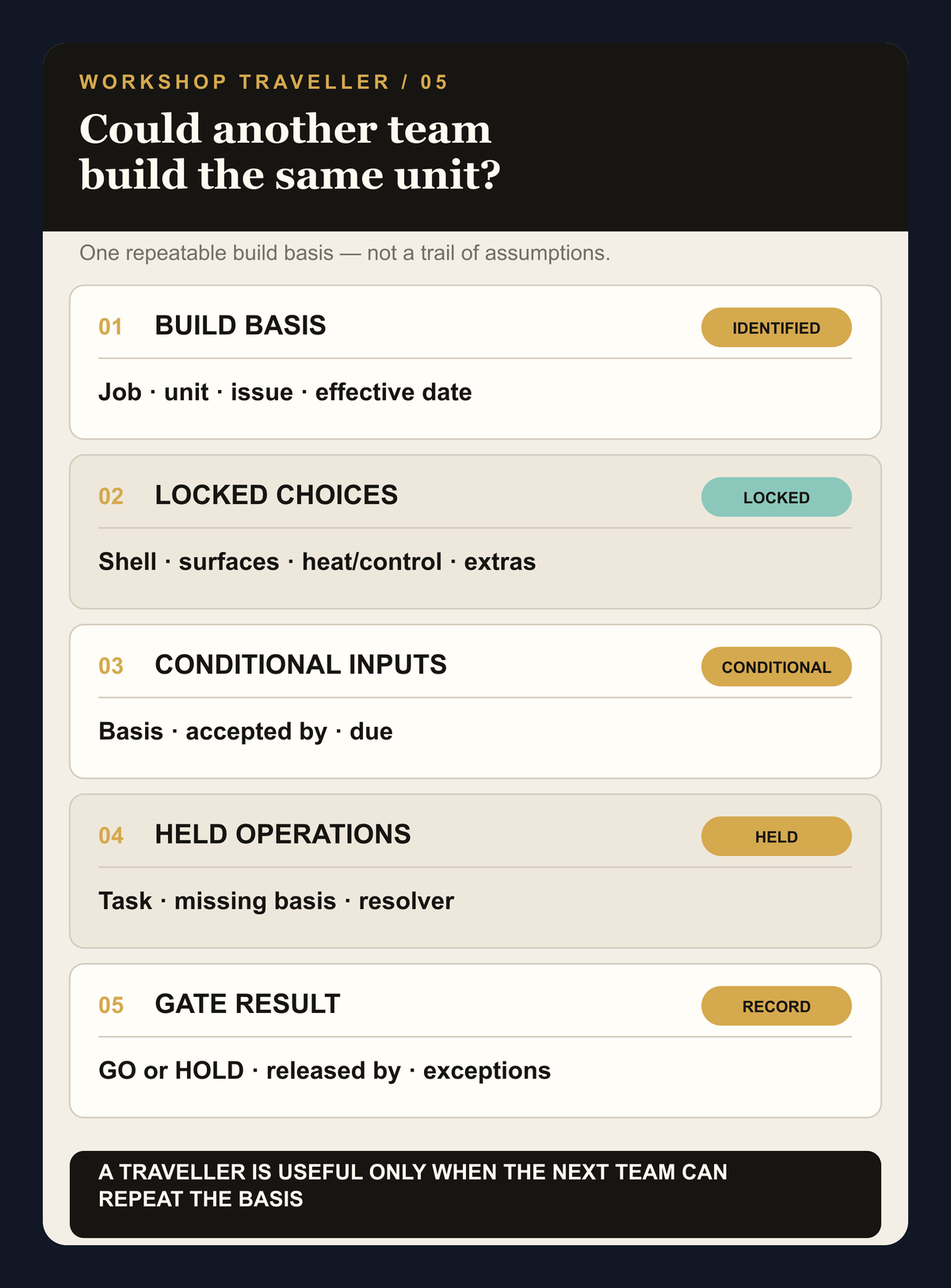
The traveller asks whether another workshop team could repeat the selected unit from one current basis. It records a release method; it does not prove that a particular order has passed it.
How should confirmed data and assumptions be separated?
Translate incoming information into three workshop states: LOCKED, CONDITIONAL and HELD. LOCKED belongs to the issued build basis. CONDITIONAL carries a stated external input, a named accepter and an expiry or due date. HELD prevents the dependent operation until someone resolves the missing basis.
The handover test is simple: can a colleague who missed every meeting set out the same unit using only the issued dossier? If the answer depends on oral history, the gate is still carrying hidden intent. That is too fragile for cutting, ordering or assembly.
Pijus Kazlauskas offers adjacent workshop context in Inside the Lithuanian workshop where every sauna is built by hand. Use it to understand the setting, not as evidence of present capacity, conformity or quality for this job. The operative dossier still needs job-specific support.
Paste this factory-gate block into the job traveller:
“BUILD BASIS: job [code], unit [code], issue [code], effective [date].”
“LOCKED CHOICES: shell [reference], surfaces [reference], heat and control pack [reference], extras [reference].”
“CONDITIONAL INPUTS: basis [text], accepted by [person], due or expiring [date].”
“HELD OPERATIONS: task [text], missing basis [question], resolver [person].”
“GATE RESULT: GO or HOLD, released by [person], exception notes [text].”
The question “What Should Your Sauna Manufacturer Confirm Before Production?” is settled when every workshop commitment points to one issued basis, one status and one accountable releaser.
The trade-off is early certainty versus early motion. A gate consumes attention before visible making begins, yet bypassing it moves ambiguity into timber cuts, reserved equipment and promised dates. Keep the dossier lean, but never leaner than the facts needed for a repeatable build.
Consider a hypothetical resort that chooses brushed bronze during a sample review while the purchasing list still reserves black boards. The crew frames the shell and then discovers the colour split. Nothing is wrong with either finish. The failure is that the changed choice never crossed a formal workshop gate.
Who can authorise production?
Authority comes from the agreed supply governance, not from a job title alone. The releaser may be a client representative, project manager, architect or contractor, depending on the appointment. The sauna maker should retain who opened the gate, which issue they accepted and any conditions attached to that act.
My manufacturer judgement is that workshop readiness exists only when another crew can repeat the chosen unit from the same dossier. If two active inputs point in different directions, the maker should place the affected task on HOLD and request a resolved basis.
Decision: “Factory gate GO for job [code] on build-basis issue [code]. Locked choices are [list], while conditional items [list] don't block the named operations. Held work is [none or list], and any later alteration reopens this gate.”
STOP: keep the affected workshop operation on HOLD when any release field lacks one supported entry. Check the unit code, shell size, handedness, aperture, heat and control pack, surface choice, connection provision and release authority. Assign a resolver and issue a new build basis before material commitment.
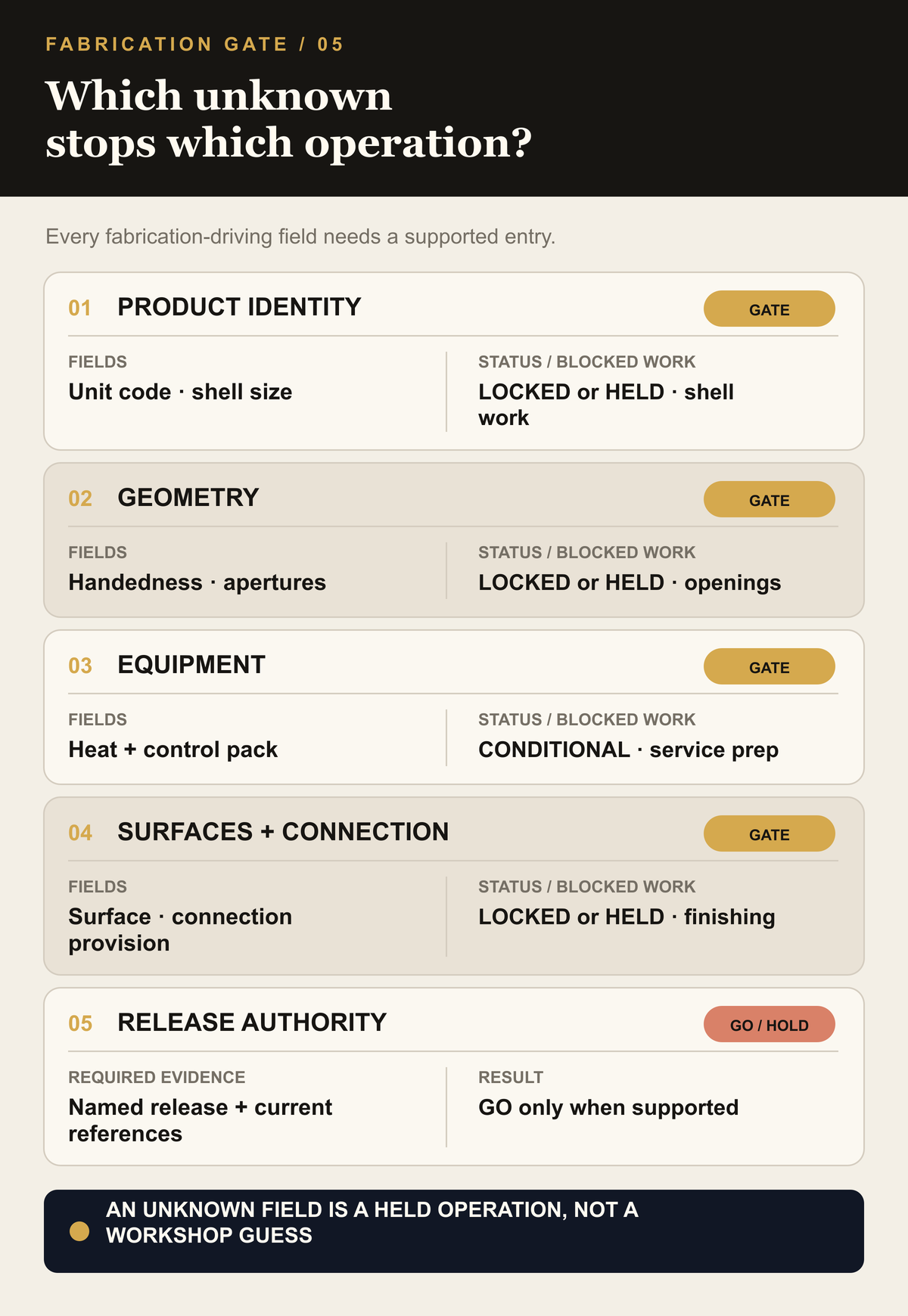
The gate turns an unknown fabrication-driving field into a named held operation instead of a workshop guess. The responsible resolver still follows the project's appointments and evidence.
Give the dossier to a colleague who did not attend the design calls. Ask them to name the unit, operative issue, fixed choices, conditions and held tasks. A correct answer from the bundle alone is the final readiness test.
Frequently asked questions
Is a signed quotation enough to start sauna production?
Not on its own. A signed quotation can settle price and commercial scope while leaving fabrication issue, coded choices, connection provisions or later alterations unclear. Treat it as input to the build basis. The appointed releaser should open the gate for the exact unit the workshop will make.
Should site dimensions appear in the release packet?
Include only measurements that drive the supplied shell or a workshop-made connection provision. State where each figure came from, when it was issued and who owns it. Don't imply a whole-site survey unless that service was appointed and performed. Designers and contractors retain their defined measurement scopes.
Can production begin with minor items still open?
Yes, but only after the maker identifies the affected operation and proves it can remain untouched. Mark the item CONDITIONAL or HELD, name its resolver and state the due point. Calling something minor is meaningless when it governs an aperture, reserved item or visible surface.
Who owns a change made after production release?
The requester should use the agreed alteration route, while the sauna maker checks consequences for the supplied unit, committed material, reserved equipment, timing and completed workshop steps. The gate then reopens for the affected scope. No role label automatically transfers every technical or commercial consequence.
Does factory confirmation approve the completed sauna project?
No. A factory gate covers the build basis for the supplied unit and the information available before workshop commitment. Permission, foundations, incoming services, placement, installation, testing and final acceptance remain with their appointed competent parties. State that boundary so readiness to fabricate isn't mistaken for approval of completed works.
1reading now
Written by
 Giedrius PatlabaCEO & co-founder, Wood Architects163 pieces · 31 followers
Follow Giedrius to see new posts in your feed, on your phone or by email.
- views