What Burn-Risk Evidence Should a Hotel Request for a Sauna Heater?

Key Takeaways
Identify the exact heater, controller, sensor, accessories and current manual before reviewing burn risk.
Use model-specific safety distances and instructions. Never copy a universal clearance or temperature.
Ask for the manufacturer's risk analysis and technical documentation within the applicable legal framework.
Review contact risk, guarding, controls, warnings and surrounding interfaces as separate questions.
Reopen the assessment whenever the heater, layout, guard, control or operating procedure changes.
Close the chain with installed-condition verification, staff procedures and recorded acceptance.
Hotel teams sometimes reduce heater safety to one clearance diagram. That is necessary information, but it is not a complete burn-risk review. Guests, cleaners and maintenance staff encounter the heater through different routes, controls and operating conditions. The evidence request must therefore connect the exact product to the actual room and service model.
What Burn-Risk Evidence Should a Hotel Request for a Sauna Heater?
A hotel should request the exact heater, controller, sensor and accessory identities, the current manufacturer manual, model-specific safety distances, warnings and guarding instructions, and the manufacturer's risk analysis and technical documentation within the applicable legal route. The project team should then assess foreseeable contact, guest circulation, controls, combustible interfaces, cleaning and maintenance in the installed layout. No generic temperature, copied clearance or decorative guard proves that every burn risk is controlled.

This photograph shows a visible upper heater rim and stone surface only. It proves no model, temperature, safety distance, guard requirement, performance or compliance.
Freeze the exact product identity first
Start with a controlled identity block: heater manufacturer, exact model and power variant, controller, sensor, optional accessories, current manual revision, electrical supply assumptions and the drawing location. If a protective guard or railing is supplied or recommended, identify that exact item too.
This discipline matters because instructions are model specific. A manual for a related heater can look convincing while containing different installation conditions. The project's return schedule should link every clearance, warning and control requirement to the exact manual page or controlled product document. If the selection changes, reopen the review.
A current official manual is technical evidence for the specified product, not a universal sauna rule. The current Harvia installation and use manual checked for this article, for example, contains model tables, safety distances, installation instructions and warnings for its identified products. Those values must not be transferred to another model.
What should the manufacturer's safety file contain?
For electrical equipment within its scope, Annex I of the Low Voltage Directive 2014/35/EU sets essential safety objectives. These cover identification and instructions, direct or indirect contact, dangerous temperatures, non-electrical dangers and foreseeable overloads. Annex III section 2 requires technical documentation to include an adequate analysis and assessment of the risks.
At Wood Architects, we fit Harvia and HUUM heaters and assemble and check saunas before shipment. Brand reputation never replaces the exact model, current manual and applicable technical evidence. The Directive sets safety objectives. It does not prescribe a universal hotel-sauna guard, clearance or surface-temperature limit. The project risk assessment remains separate.
A useful manufacturer return should identify foreseeable hazards, protective measures built into the product, residual risks communicated through warnings or instructions, required installation conditions, maintenance and inspection needs, and any restriction on accessories or surroundings. Sensitive technical-file content may not all be distributed as a marketing pack, but the project still needs enough traceable evidence to verify the specified use.
Review four burn-risk paths
Do not treat “burn risk” as one row. Separate at least four paths:
Direct contact: a guest, child, cleaner or technician touches a hot surface or stones.
Fall or loss of balance: someone contacts the heater while entering, leaving, moving between benches or reacting to heat.
Control and operation: settings, remote starting, delayed starting or unclear status create unexpected exposure.
Interface and maintenance: guards, timber, floor, cabling, sensors, stones and service access differ from the documented condition.
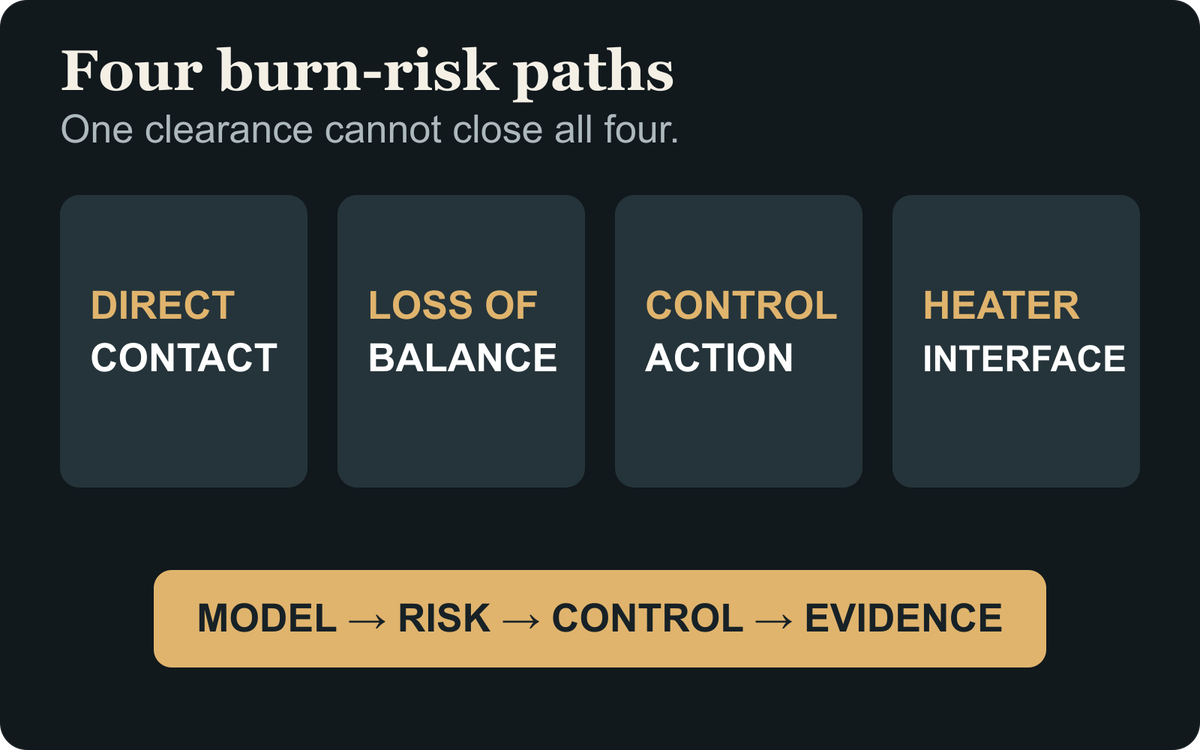
Assess direct contact, loss of balance, control behaviour and installed interfaces separately. Each needs its own evidence and owner.
Walk each path for normal use, foreseeable misuse, cleaning, inspection and fault response. The hotel guest profile and supervision model matter, but avoid unsupported medical statements or invented thresholds. The competent project team should define its risk criteria using the exact product information and applicable rules.
Safety distances are model and configuration specific
Request every relevant distance from the current manual and reproduce it on the coordinated installation drawing. Identify what the dimension is measured from and to, which model variant it covers, and whether a guard, recess, wall, bench, ceiling or sensor condition changes the requirement. Where the manual requires a specific accessory or arrangement, show it by identity.
Then verify the proposed and installed condition. A dimension on a heater sketch can be lost when bench depth changes, a guard is added, flooring rises, cladding thickens or a service route moves. Record the measured or otherwise verified as-built condition against the correct manual revision.
Never publish one “safe sauna-heater clearance” as general advice. Even within one manufacturer's range, values and permitted configurations can differ. The defensible answer is the exact product document plus a coordinated project drawing and site verification.
A guard is an interface, not a decoration
A guard may reduce the likelihood of accidental contact or a fall toward the heater, but its geometry, material, fixing, stability and distance from hot surfaces require design. It must not contradict the heater instructions, trap a user, create a new hot contact point, obstruct required airflow or make maintenance unsafe.
Ask who designs and supplies the guard, what instructions or assessment support it, how it connects to the cabin, what loads or foreseeable use it must withstand, and how it is inspected. If it is a project-specific item, keep that design responsibility explicit. Do not use an attractive image as evidence that the interface is safe.
Controls and remote operation need their own review
Record who can operate the heater, where status is visible, how settings are limited, and what conditions must be checked before energising. If remote or delayed operation is possible, follow the exact manufacturer's conditions and review how the hotel confirms that the room is ready, free from prohibited items and not occupied in an unsafe way.
Warnings should be available to the people who need them and in a form they can understand. Guest instructions, staff operating procedures and maintenance information are different layers. A label cannot replace a safe design, and staff training cannot repair an installation that conflicts with the product manual.
Build one burn-risk evidence matrix
I would give each hazard or interface one row with: exposed person, foreseeable scenario, exact product, manual clause, required condition, proposed response, residual warning or procedure, evidence, owner, verification method, installed result and acceptance. Add a change trigger for heater, controller, guard, bench, floor, sensor or operating-procedure revisions.
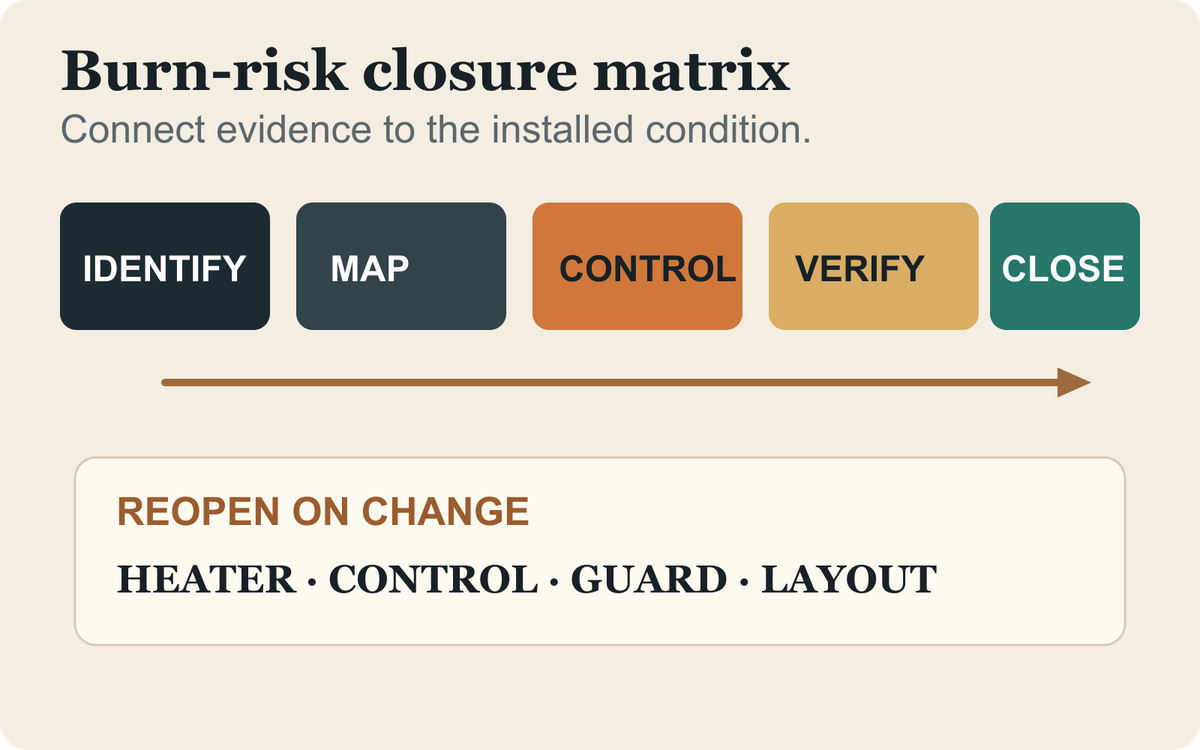
Close each burn-risk path by connecting the exact product instruction to the project response, installed verification and responsible acceptance.
Before manufacture, coordinate the exact heater and interfaces. Before handover, verify product identity, manual revision, safety distances, guard and control configuration, warnings and staff procedures. After opening, retain an inspection and incident route that can trigger review. The matrix is useful only if it follows change.
Pijus Kazlauskas's article Why the best luxury outdoor saunas are built around HUUM heaters offers market and product-selection context. It is not technical evidence for this article, does not establish any model-specific distance, and does not share authorship of this safety framework.
What should a hotel reject?
Reject a heater proposal without exact model and manual revision. Reject a generic clearance copied from another product. Reject a guard shown only in a render. Reject remote operation without the manufacturer's conditions and a hotel operating control. Reject a safety file that never reconciles the product with benches, doors, circulation, cleaning and maintenance.
Most importantly, reject “the heater is certified” as the final answer. Product conformity, correct installation and safe hotel operation are connected but separate decisions.
Is there one safe clearance for every sauna heater?
No. Safety distances depend on the exact heater model, variant, installation configuration and manufacturer's current instructions. Retrieve them from the controlled manual, show them on the coordinated drawing and verify the installed condition. Never copy a figure from a different heater or general article.
Does a timber guard eliminate burn risk?
No. A guard may reduce foreseeable contact, but it introduces its own geometry, fixing, material, temperature, airflow, stability and maintenance questions. It must be compatible with the exact heater instructions and project risk assessment. Its presence does not prove that all contact or fall scenarios are controlled.
What evidence is needed for remote heater operation?
Use the exact heater and controller instructions, identify every required interlock or precondition, and document who verifies the room before operation. The hotel also needs clear authority, status indication, fault response and staff procedures. Do not infer remote-start permission from a generic controller feature.
Can a heater manual replace the project risk assessment?
No. The manual provides product-specific conditions, warnings and instructions. The project assessment must apply them to the actual room, circulation, benches, controls, user groups, cleaning and maintenance. Conversely, a project assessment should not override or silently relax the manufacturer's required installation conditions.
When must the burn-risk review be reopened?
Reopen it when the heater, power variant, controller, sensor, guard, bench, floor level, surrounding finish, door route, operating procedure or guest-use model changes. Also reopen it after an incident or new manufacturer instruction. Record the new evidence, owner and acceptance rather than relying on the earlier sign-off.
Conclusion
A hotel needs more than a heater certificate and one clearance sketch. Freeze the exact product, retrieve the current instructions, separate the risk paths, coordinate every interface and verify the installed condition. When product evidence, project design and hotel operation are kept distinct but connected, burn risk becomes a traceable management task rather than an assumption.
1reading now
Get an email when Giedrius publishes