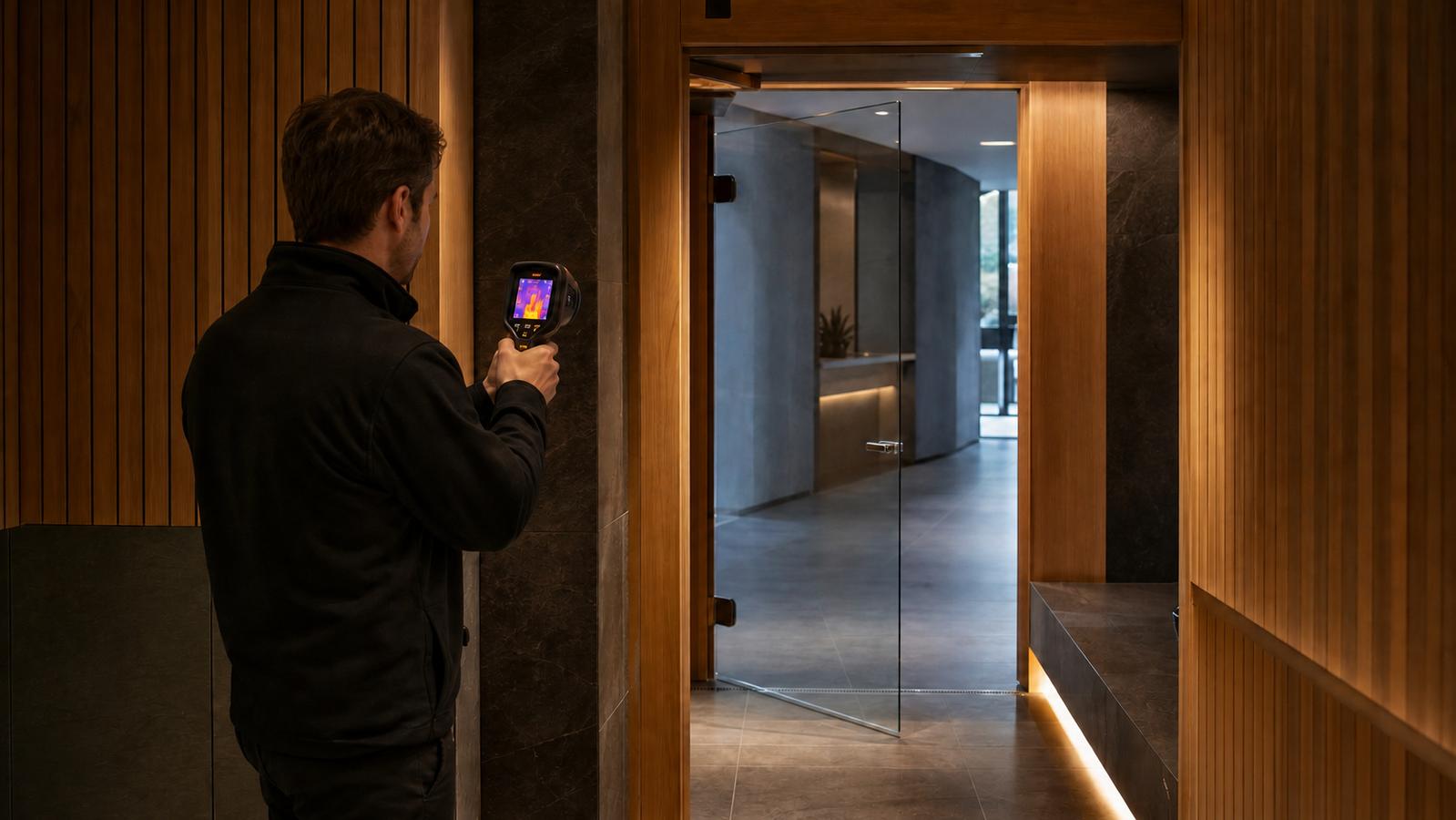
How Should a Hotel Measure Sauna Recovery After Door Openings?
Key Takeaways
Recovery starts from an agreed ready condition, not an arbitrary controller reading.
Script the door position, event timing and sequence before the test begins.
Use the same sensor, sampling clock, controls and ventilation state for every run.
Report the temperature response, recovery time and recovery energy together.
Separate one-door recovery from repeated commercial traffic.
Stop the comparison when staff intervention or an uncontrolled door event changes the run.
A sauna can look ready on its controller and still recover poorly under real traffic. We preassemble and check each sauna in Klaipėda, where doors, glazing and controls meet before shipment. The commissioning method below turns one scripted door event into a repeatable recovery record.
How Should a Hotel Measure Sauna Recovery After Door Openings?
A hotel should measure sauna recovery by starting from a defined ready condition, applying a scripted door event and recording the response on one synchronised clock. Fix the door position and event sequence, sensor identity and position, controller mode, ventilation state and electrical boundary. Report the lowest recorded condition, time to satisfy the agreed recovery rule and measured recovery energy. Separate single-opening tests from repeated traffic. Exclude or flag any run changed by staff intervention.
Why does a door-opening test need more than a stopwatch?
The door event changes air exchange. The recovery result depends on what happened before, during and after it.
A short opening and a held-open door are different tests. One guest entry and a sequence of arrivals are different tests. A controller that changes mode during the event can create another difference. So can ventilation, ambient conditions or a moved sensor.
The endpoint can drift too. One team may stop when the controller display returns to its set point. Another may use a separate room sensor. A third may stop when the heater switches state. The reported durations look comparable. Their finish lines are not.
For recovery testing, ISO 50015:2014 remains useful current guidance after review in 2025. It gives general principles for measuring and verifying energy performance, not a universal sauna-recovery protocol. The useful discipline is to define the method, conditions and data before claiming a result.
The U.S. Department of Energy's measurement and verification guidance says baseline physical conditions can include equipment, occupancy, loads and control strategies. Door traffic is the operating event here. It belongs in the evidence, not in a footnote.
What should the hotel freeze before the first door event?
Write the script while the sauna is empty and stable. Freeze the conditions that decide whether the next run means the same thing.
Boundary | Record | Reason to stop |
|---|---|---|
Ready state | Agreed sensor condition and pre-event rule | The run begins before readiness is met |
Door event | Position, opening and closing events, sequence | The event departs from the script |
Cabin and climate | Cabin configuration, surrounding condition and exposure | The physical context changes |
Sensors | Identity, position, sampling clock and raw trace | A sensor moves or a clock drifts |
Controls | Set point, operating mode, ventilation and auxiliaries | Staff or automation changes the mode |
Recovery | Agreed end rule and meter boundary | The finish depends on judgement |
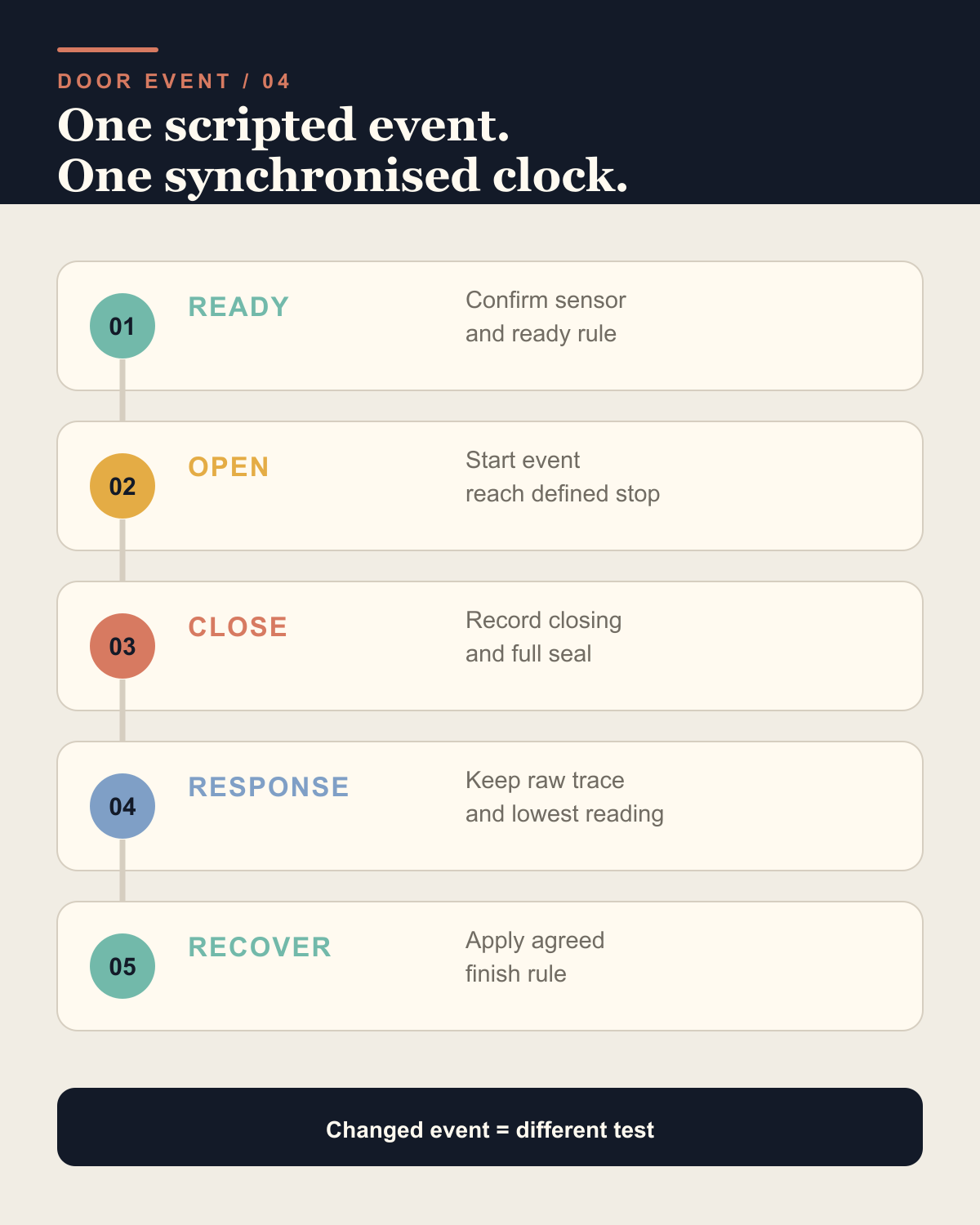
The event sequence keeps the door action and the recovery trace on one clock. A changed event creates a different test.
Ventilation state must remain visible because airflow forms part of the operating condition. For the separate design question, read Where Should the Vents Go in Your Outdoor Sauna?. The recovery test records the installed mode. It doesn't prescribe one universal arrangement.
How should the door event be scripted?
Define observable actions. Avoid phrases such as “open normally” or “simulate busy use”. They leave the operator to invent the test during the run.
Use this script template:
“Ready condition confirmed at [sensor and rule].”
“Door starts opening at [time event].”
“Door reaches [defined position or stop].”
“Door starts closing at [time event].”
“Door is fully closed at [time event].”
“No staff or control intervention occurs unless logged.”
“Recovery ends at [agreed sensor and end rule].”
For repeated traffic, list each opening and closing event in order. Don't average a busy sequence into one invented “typical” opening. The sequence is the load.
Which recovery results should the hotel report?
Report three outputs together: response, time and energy. The response shows what changed at the chosen sensor. The time shows how long the agreed recovery took. The energy shows consumption inside the stated boundary during that recovery window.
Keep the raw trace. A summary can hide oscillation, a controller change or a second unplanned opening. The full record lets engineering explain the result instead of defending a single number.
Use a compact recovery statement:
“After [door-event script], [identified sensor] reached [recorded response] and satisfied [recovery rule] after [measured time], using [measured energy] inside [electrical boundary], with [exceptions or none].”
Don't call a controller display “room recovery” unless that is exactly the named measurement. Don't call one sensor “guest comfort” without a separate assessment. The metric should say only what the evidence supports.
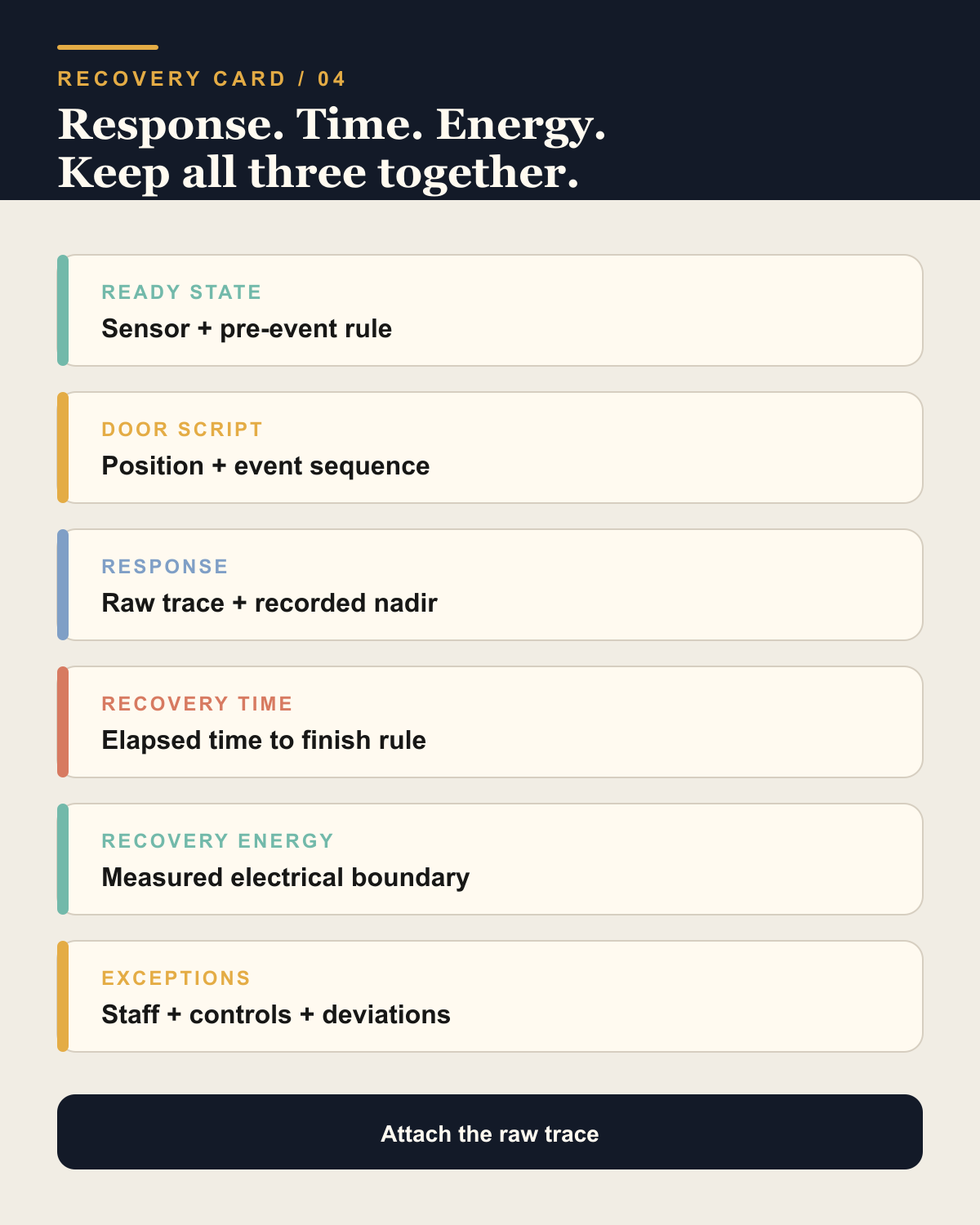
The recovery card joins the door script to the measured response. It prevents a clean-looking duration from losing its operating context.
How should the hotel test commercial traffic?
Start with one controlled opening to prove the measurement method. Then run a separate sequence that represents the hotel's chosen traffic case. Keep the two result families apart.
A repeated sequence should preserve the same cabin, starting condition, controls, sensors and meter boundary. Only the door-event script should change. That isolation helps the hotel see whether the new result comes from traffic rather than a changed test.
The DOE describes Option B as measuring relevant performance and operational parameters at system level. A door-recovery test uses the same practical logic. Measure enough of the system to explain the operating event, without presenting the exercise as a formal savings protocol.
If the sauna doesn't satisfy the recovery rule before the next scripted event, keep that outcome. Don't extend the window until the graph looks successful. The failed service condition is part of the decision.
What invalidates a recovery comparison?
A changed door script, moved sensor, different control mode, altered ventilation state or missing time base invalidates a direct comparison. So does a staff intervention that isn't isolated and labelled.
STOP: don't rank recovery when the two runs use different door events or finish rules. Repeat the test under one script, or report the runs as separate operating cases.
You don't need to model a full season. Print the event sequence, run one controlled opening and attach the raw trace to the recovery card. The signed card is what commissioning can accept.
Frequently asked questions
Where should the temperature sensor sit for a recovery test?
Use the position defined by the hotel's test plan or responsible technical team, then record it precisely. There is no universal point that represents every bench and surface. The comparison is valid only when the same identified sensor and position are used across runs.
Should a hotel measure one door opening or repeated traffic?
Measure them as separate cases. One controlled opening proves the test method and supports product comparison. A repeated sequence tests the hotel's chosen traffic pattern. Mixing both into one average hides whether recovery failed because of the product, controls or event load.
Should recovery end when the controller reaches its set point?
Only when the controller sensor and its end rule are explicitly the agreed measurement. Otherwise use the named test sensor and keep the controller reading as supporting data. A display value shouldn't silently become proof that the selected room condition has recovered.
Does a faster recovery always use more energy?
Not necessarily, and the relationship shouldn't be guessed from time alone. Measure elapsed recovery time and energy inside the same electrical boundary. Keep the response, controls and delivered condition beside both values before deciding which result better fits the hotel's service.
Can a factory door-recovery test predict hotel performance?
A factory test can compare products under one controlled script. The installed hotel's climate, ventilation, controls, door behaviour and guest traffic can change the result. Treat factory and site recovery as separate evidence sets unless their boundaries and operating conditions genuinely match.
1reading
Written by
 Giedrius PatlabaCEO & co-founder, Wood Architects163 pieces · 30 followers
Follow Giedrius to see new posts in your feed, on your phone or by email.


