The One Second Where Shopify and NetSuite Disagree — And Cost You a Sale

There's a specific second where most Shopify-NetSuite integrations quietly break: a customer places an order at the exact moment your inventory sync job is running. Shopify still shows the item in stock, NetSuite has already committed it to another order, and now you've sold something that doesn't exist. Nearly half of growing ecommerce businesses name systems integration as their single biggest hurdle when scaling — and this exact race condition is usually why.
Why It Breaks at Month-End, Not Launch
Most teams don't find out until month-end close, when the controller finds orders that never made it to NetSuite, a refund posted twice, or a SKU sitting at negative stock on the warehouse floor. By then it's not a sync bug anymore — it's a trust problem with customers who got an order confirmation for something you couldn't ship.
The Fix Isn't "Sync Faster"
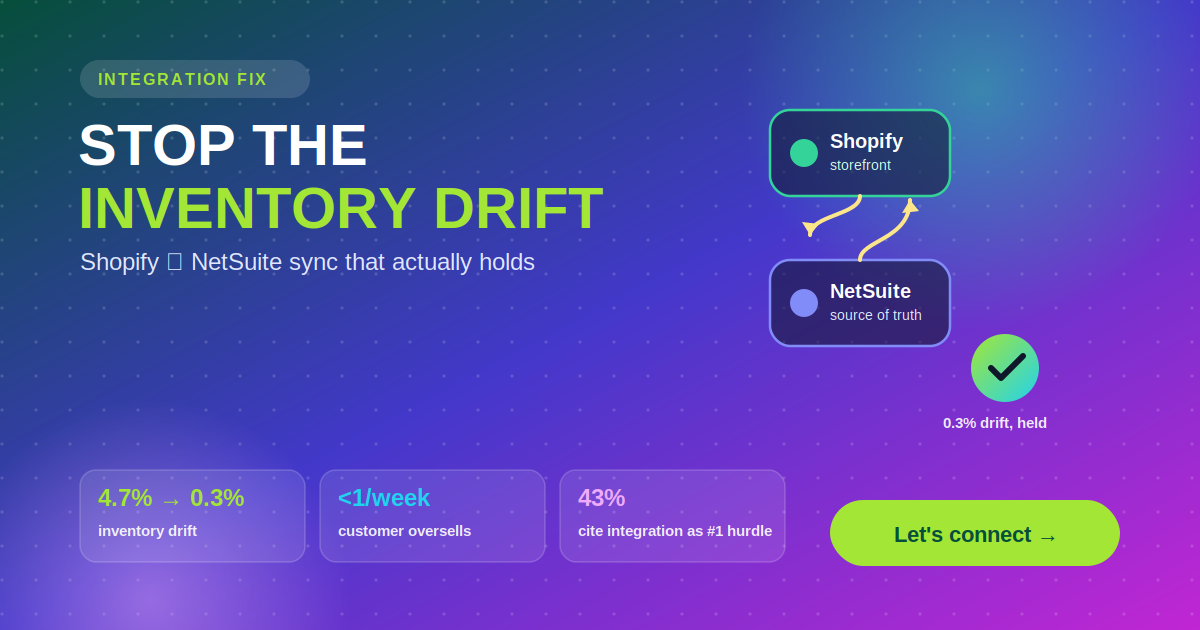
Live sync alone still drifts — one real case tracked drift at 4.7% across 1,800 SKUs even with real-time sync running. What actually holds inventory accurate is live sync plus a nightly reconciliation pass that catches what the real-time layer missed — the same setup that took that drift down to 0.3% and cut customer-facing oversells to less than one a week.
What This Work Actually Covers
That's the part of NetSuite-Shopify integration work most people skip, because it's not the part that demos well. It's also exactly the work I do:
Bidirectional inventory sync — NetSuite as the single source of truth, changes flowing out to every Shopify sales channel (storefront, POS, wholesale) instead of Shopify quantities silently overriding your ERP.
Order and fulfillment flow — Shopify orders landing in NetSuite as sales orders automatically, fulfillment and shipping status flowing back without someone re-typing it.
Multi-location mapping — each Shopify location or warehouse mapped correctly to its NetSuite counterpart, so the system knows which warehouse actually has the stock, not just that stock exists somewhere.
The reconciliation layer everyone forgets — a nightly job that catches drift before it becomes a negative-stock SKU or a duplicate refund, so problems surface as a 10-SKU diff instead of a month-end fire drill.
Not Sure If This Is Your Problem?
If your Shopify and NetSuite are technically "connected" but you're still finding discrepancies, manually reconciling counts, or explaining oversells to customers, that's not a sign you need a bigger platform — it's a sign the integration was built for the demo, not for what actually happens at scale.
If you want a second opinion on where your setup stands, feel free to connect and discuss it — no cost, no obligation, just a conversation about what's actually going on with your sync.
1reading now
- views
Get an email when Akash publishes