How Can a Hotel Verify Its Sauna-App Energy Data?
Key Takeaways
Verify sauna-app energy against an independent meter on the same electrical boundary.
Align timestamps, time zones, resets and included loads before comparing totals.
Compare cumulative change first, then inspect interval differences.
Keep controller states, bookings and manual overrides beside the energy record.
Investigate gaps and definition changes before calculating a variance.
Never call app data billing-grade without device-specific proof.
A polished app can make an uncertain number look settled. In our Klaipėda workshop, a physical check closes the gap between a screen and the product in front of us. Hotels need the same discipline with energy data. The reconciliation sheet below ties each app value to an independent meter, clock and operating event.
How Can a Hotel Verify Its Sauna-App Energy Data?
A hotel can verify sauna-app energy data by reconciling it with an independent meter on the same electrical boundary. Record both cumulative readings at the same start and finish, align time zones and intervals, and document resets, gaps and excluded loads. Compare the change in energy before comparing dashboard charts. Then inspect differences against controller state, schedules, bookings and manual overrides. The app is verified only for the tested field, period and boundary, not as a universal billing or savings record.
Why can two correct systems show different energy?
They may be measuring different things. The independent meter may include the heater and controls. The app may report a controller estimate, a heater-only register or a derived value. The labels can look identical while the boundaries differ.
The clocks can differ too. One system may store local time, another Coordinated Universal Time. Daylight-saving changes, delayed uploads and missing intervals can shift the same event into another reporting window. A daily total then disagrees even when both source readings are internally consistent.
Start with definitions, not percentages. Ask the provider what produces the app field, which loads it represents, whether it is measured or calculated, when it resets and what happens when connectivity fails. Keep the answer with the export schema.
The U.S. Department of Energy's EMIS guidance, checked on 25 August 2026, describes comparing meter data with schedules, occupancy and system trends. It also shows that models can compare expected and actual use. That supports contextual verification. It doesn't prove the accuracy or definition of a specific sauna app.
What must match before the hotel compares values?
Freeze the comparison boundary on paper. If any item remains unknown, investigate it before calculating a variance. More decimal places won't repair two different definitions.
Alignment check | Independent meter | Sauna app |
|---|---|---|
Electrical boundary | Named included circuits and loads | Documented source field and included loads |
Energy definition | Cumulative register and unit | Measured, calculated or derived field |
Clock | Timestamp, time zone and clock source | Timestamp, time zone and aggregation rule |
Data quality | Reset, outage and configuration log | Gap, backfill and connectivity behaviour |
Operating context | Linked facilities log | Controller states and schedule events |
As of 12 September 2025, the EU Data Act applies. The European Commission's Data Act explanation says the connected-product sharing rules cover readily available raw and pre-processed data, including relevant metadata. It also says inferred or derived data and content are outside that Chapter II scope.
That distinction matters during procurement. Access to sensor data doesn't automatically mean access to every dashboard calculation. Ask for the exact exportable fields, metadata and retention terms. Keep legal, security and personal-data review with the hotel team responsible for those areas.
How should the reconciliation run?
Use the cumulative register as the anchor. Take a start reading from the independent meter and export the app's corresponding source value. Repeat at the finish. Subtract start from finish in each system. Only then move into interval charts.
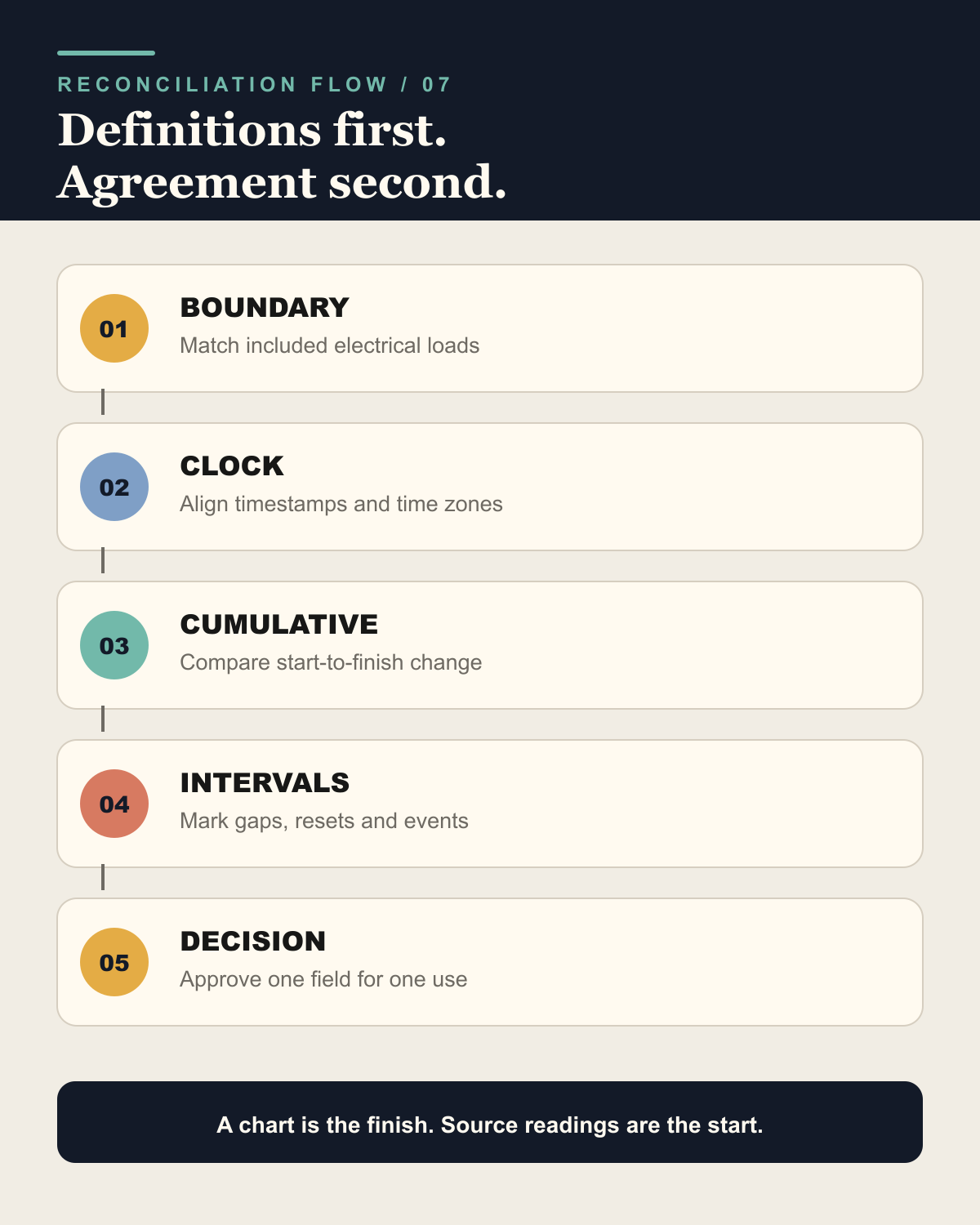
Reconcile definitions first, cumulative change second and interval shape third. Sign the result only after gaps and resets are explained.
1. Lock the boundary and clock
Photograph the meter label and capture both system clocks. Record time zone, daylight-saving setting and any known delay. Confirm that the app field and independent meter include the same loads. If they don't, stop or build an explicit adjustment from another measured source.
2. Compare cumulative change
Use source readings for the same start and finish instants. Keep the calculation visible. Don't begin with a monthly dashboard percentage, because aggregation and missing data can hide the original register movement.
3. Inspect intervals and events
Overlay or align the interval records. Mark heat-up, ready-state holding, guest sessions, door events, cleaning, shutdowns and overrides. A difference that follows one repeated event is easier to diagnose than a difference hidden inside a period total.
4. Classify every discrepancy
Use a short cause list: boundary mismatch, clock mismatch, missing interval, reset, calculated field, rounding, configuration change or unexplained. Don't force every difference into rounding. Keep unexplained cases open.
The DOE's Option B guidance says relevant performance and operational parameters may be measured periodically or continuously at system level. A reconciliation exercise is smaller in scope. The same discipline applies: define the relevant factors and preserve the measurements that explain the result.
What belongs on the 30-day check sheet?
The series uses a 30-day worksheet as a practical review frame, not as a universal technical requirement. A property may need a shorter or longer period to capture its operating pattern. The sheet should show daily status and unresolved exceptions, not only a final average.
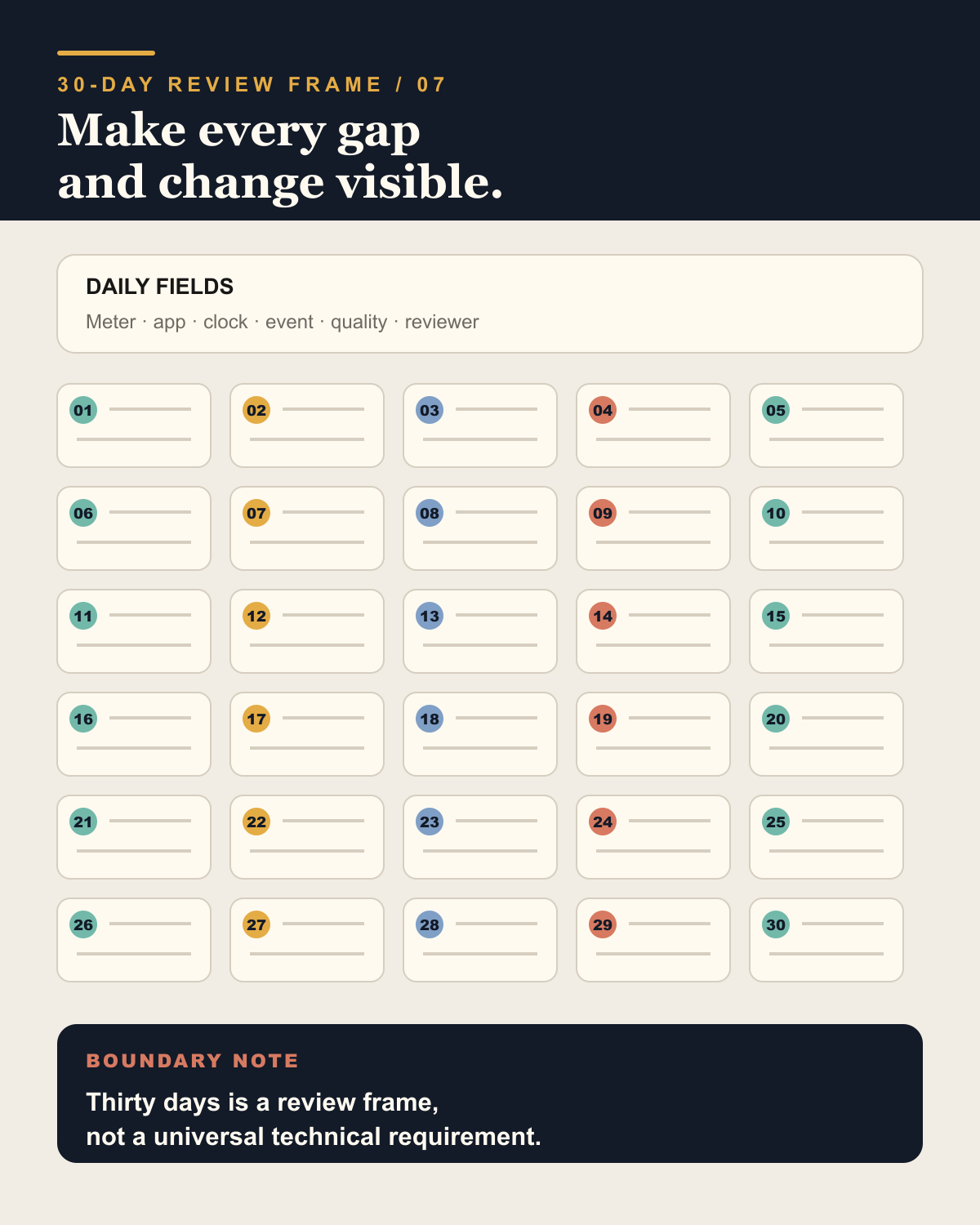
The 30-day sheet makes missing days and definition changes visible. It is a review frame, not a claim that every hotel needs exactly 30 days.
“Independent meter start and finish: [time-stamped source readings].”
“App source field start and finish: [export and field definition].”
“Electrical boundary match: [confirmed or named difference].”
“Clock and time-zone alignment: [confirmed or corrected].”
“Missing, reset or backfilled data: [day and explanation].”
“Operating events and manual overrides: [linked log].”
“Daily status: [matched, explained, unresolved or excluded].”
“Reviewer and decision: [name, date and next action].”
When is the app evidence good enough for operations?
Accept it for the use you tested. A field that reconciles well enough for operational scheduling may still be unsuitable for billing, contractual savings or regulatory reporting. Write the approved use beside the result and keep excluded uses visible.
For the wider evidence culture, read How Do You Spot a Reliable Sauna Manufacturer?. Traceable documentation, named responsibility and verifiable claims matter before anyone trusts a dashboard. This article tests one narrower claim: whether a chosen app field agrees with independent evidence.
“Approve [app field] for [named operational use] on [electrical boundary], subject to [known limitations]. Keep billing, guaranteed savings and other untested uses excluded.”
STOP: don't call the app accurate when the electrical boundary, field definition or clock remains unknown. Don't call it billing-grade because its chart agrees for one period. Those are different claims with different evidence.
You don't need to audit every feature. Pick the one energy field management intends to use and walk it through the reconciliation flow. The useful object is a signed sheet that says what the field means, where it agrees and what it still cannot prove.
Frequently asked questions
Can a hotel trust energy data shown in a sauna app?
Trust it for a named use after verifying the field against an independent meter and documenting the boundary, clock and gaps. A polished dashboard isn't evidence of measurement quality by itself. Keep the source definition and reconciliation result beside any operational report built from the app.
Why does the sauna app total differ from the physical meter?
Common causes include different included loads, time zones, aggregation windows, resets, missing uploads and calculated rather than measured fields. Start by aligning definitions and cumulative start and finish readings. Don't assign the difference to rounding until the boundary, clock and data-quality records have been checked.
Does the EU Data Act give hotels every sauna-app calculation?
No. The Commission says Chapter II covers readily available raw and pre-processed connected-product data, with relevant metadata. It also says inferred or derived data is outside that scope. Procurement should ask which exact fields are exportable and keep legal, security and contract review with the appropriate hotel specialists.
How long should a sauna-app verification run?
Long enough to capture the operating states the hotel intends to rely on, including heat-up, holding, sessions and shutdowns. The 30-day sheet in this article is a practical frame, not a universal rule. Extend or repeat the review when the period lacks representative use or contains unresolved gaps.
Can verified app data be used for guest or tenant billing?
Not from operational reconciliation alone. Billing can require specific meter, installation, verification and legal evidence. Agreement with an independent meter during one review doesn't establish that status. Keep billing excluded unless the exact device and local requirements prove the intended charging use.
1reading
Written by
 Giedrius PatlabaCEO & co-founder, Wood Architects163 pieces · 30 followers
Follow Giedrius to see new posts in your feed, on your phone or by email.