Why Your Next Fertiliser Order May Not Arrive

Picture the call every distributor dreads. It's spring. Your customers are ready to plant. And your supplier tells you the container isn't coming — not late, not expensive, not coming — because the fertiliser it was carrying never left the Gulf.
This isn't science fiction. It's one shipping lane away.
The chokepoint nobody in agriculture talks about
Everyone in food talks about weather, water and prices. Almost no one talks about the Strait of Hormuz — a waterway barely 33 kilometres wide at its narrowest, through which flows roughly a fifth of the world's traded liquefied natural gas and a major share of the Gulf's ammonia and urea exports.
Here's the chain most people miss: natural gas is the feedstock for nitrogen fertiliser. The Gulf is one of the planet's largest producers of it. So a disruption in Hormuz isn't just an energy story — it's a fertiliser story. If that strait tightens, the price and availability of the single most-used nutrient on Earth move within days, and the effects ripple straight into ports, blenders and farm sheds thousands of kilometres away. The U.S. Energy Information Administration has long flagged Hormuz as one of the world's most critical — and most vulnerable — transit chokepoints.
Why farms are more exposed than they think
Now layer on the quieter crisis underneath. After decades of intensive, nutrient-heavy farming, many soils are running on borrowed time — depleted of organic matter and biological function, producing this year's crop largely on last year's residual reserves. That works right up until the inputs stop. A field with healthy, living soil can absorb a bad supply year. A depleted one cannot — it needs the bag to arrive, on schedule, every season, or yields fall off a cliff.
So the real exposure isn't one shortage. It's a shortage hitting soils that have no buffer left. That is how a shipping-lane incident on the other side of the world becomes empty shelves in a farm store — and a very bad harvest.
The supply nobody can blockade
Here is the part that should change how serious buyers think about resilience.
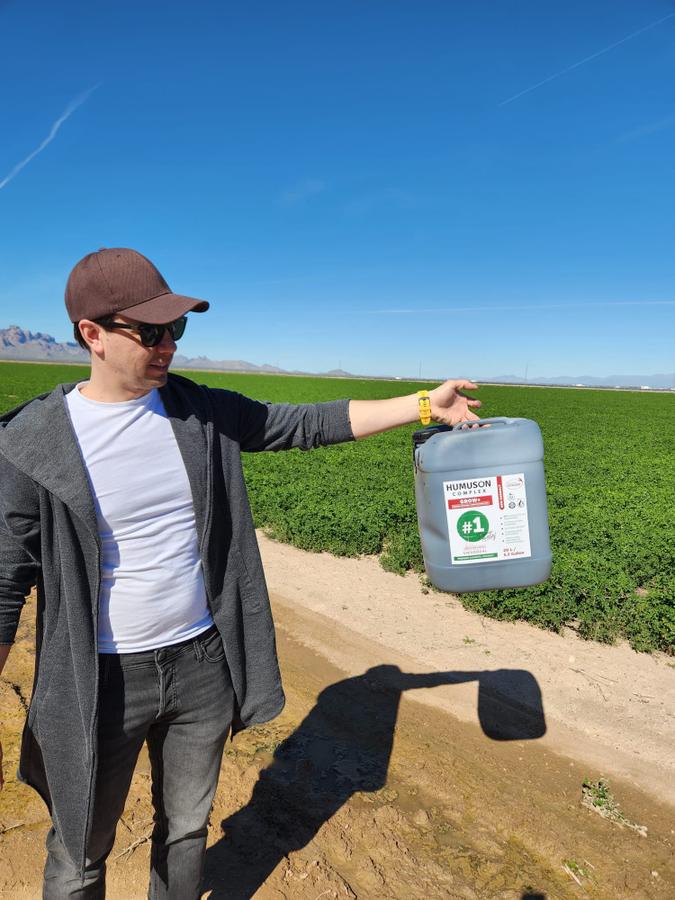
Humuson Complex is made from sapropel — a freshwater lake sediment that has concentrated more than 40 organic, organic-mineral and inorganic compounds over thousands of years. It is produced and manufactured entirely within the European Union, under Regulation (EU) 2019/1009 — with no Russian, no Belarusian, and no Hormuz-routed inputs anywhere in its supply chain.
Read that again, because in a supply shock it's everything. This is a soil input that does not depend on Gulf gas, does not cross contested straits, and cannot be switched off by a geopolitical event 4,000 kilometres away. It is, in the most literal sense, shock-proof supply.
Do more with less — exactly when it matters
And it doesn't just replace risk; it stretches whatever you can still get. Humuson improves nutrient-use efficiency by at least 25%, meaning every scarce, expensive bag of conventional fertiliser a farmer does secure goes considerably further. In a shortage, that isn't a nice-to-have. It's the difference between a crop and a loss. It also reactivates the soil biology that lets a field feed itself — rebuilding exactly the buffer that depleted soils have lost.
The distributors who move first win the shortage
Shortages don't reward the fast. They reward the prepared. When the container doesn't come, the distributor who already secured a domestic, EU-made, blockade-proof soil input is the one still selling — and the one every grower in the region suddenly needs.
You see the risk. You can hedge it now. The solution exists, it's certified (OMRI-listed in the US; separately, Ecocert-certified in the EU; USDA and WSDA recognised), and you can secure it here — before the spring call you don't want to get.
This is the same supply-security logic behind our earlier piece on what one subsidised nutrient did to the world's soil.
If you're a distributor, importer or institutional buyer thinking about supply security for the season ahead, let's talk — now, not after the shock.
1reading now
Get an email when Aurimas publishes