Why More Fertiliser Won't Fix Your Failing Soil

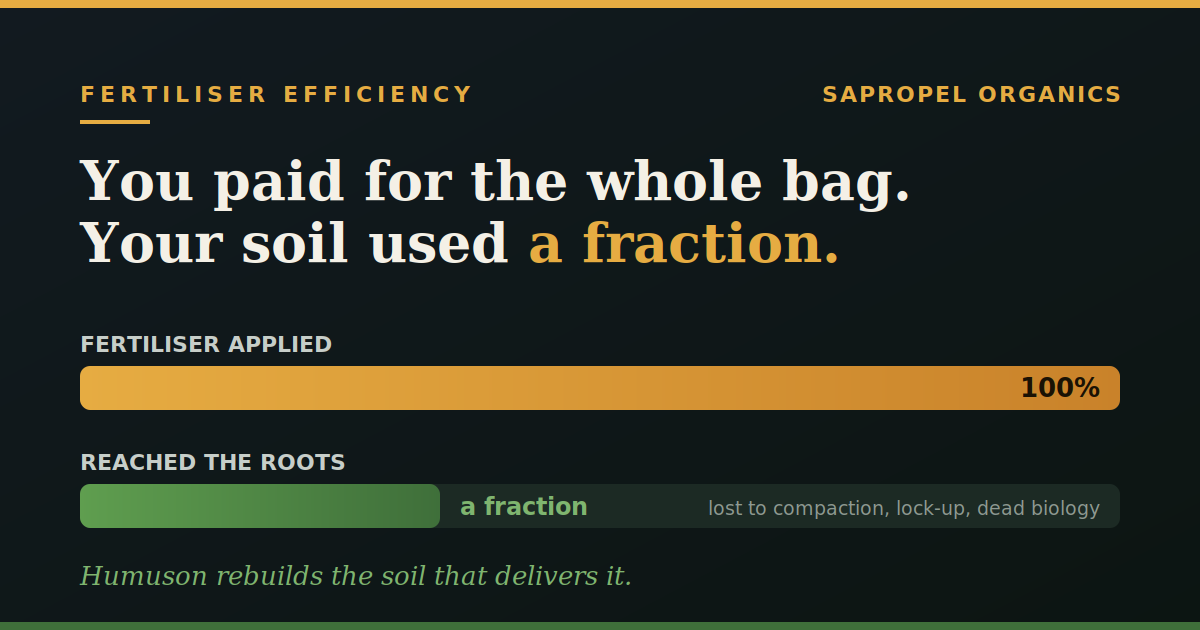
Here is one of the most expensive mistakes in modern farming: when a crop underperforms, the reflex is to apply more fertiliser. But fertiliser rarely stops working on its own. The limiting factor is usually the soil that receives it — specifically, its ability to hold nutrients and deliver them in a form the plant can absorb. If the soil cannot do that, more fertiliser simply adds cost.
Fertiliser does not fail. Nutrient absorption does.
A nutrient only benefits the crop if the root can take it up. Between the granule and the root sits a series of barriers: compaction that restricts roots, water and oxygen; nutrients that are chemically fixed and insoluble; weak microbial activity that fails to cycle them; a pH that pushes key elements out of range; and too little organic matter to hold and exchange nutrients in the first place. None of these are fertiliser problems. They are absorption problems — the nutrient budget may be adequate, but uptake has collapsed.
The reserve already in your soil
This is the part most growers overlook. A large share of the fertiliser applied over years does not leave the field — it accumulates in the soil in insoluble, plant-unavailable forms. Phosphorus is the classic case: applied phosphate rapidly binds with calcium, iron and aluminium into "legacy" reserves that crops cannot access, and micronutrients follow the same path. Season after season, this locked reserve grows. It is not lost. It is simply waiting for a soil biology capable of releasing it. The scale of this locked reserve is well documented: the FAO Global Soil Partnership identifies nutrient imbalance and the decline of plant-available nutrients as among the leading threats to the world's soils.
How sapropel improves absorption
This is the mechanism behind Humuson Complex. Made from sapropel — a freshwater lake sediment rich in humic and fulvic acids and more than 40 organic, organic-mineral and inorganic compounds — it acts directly on nutrient availability and uptake.
Its fulvic acids chelate mineral ions, keeping them mobile and available at the root surface, while its humic fraction raises the soil's cation-exchange capacity, improving how well the soil holds and exchanges nutrients. At the same time, it reactivates the microbial community that mineralises organic-bound and insoluble reserves — the biology that converts fixed nutrients back into absorbable forms. In practice, this improves nutrient-use efficiency by at least 25%: the crop absorbs more of the fertiliser you apply, and begins to draw on the reserve already locked in the soil.
To be precise about scope: Humuson is not a mechanical remedy for severe compaction, nor a standalone pH corrector. What it restores is the biological and physico-chemical system that governs nutrient absorption — the foundation most of these limitations grow from.
Why this lowers cost per tonne
The economics follow directly. Improving absorption is not an added input on top of fertiliser — it is what makes the fertiliser you already buy pay off, and it unlocks nutrients you paid for in previous seasons that are still sitting in the soil. A grower compensating for poor uptake by applying ever more product is feeding a system that cannot assimilate it. Restore absorption first, and every unit of applied and legacy nutrient does more work.
The takeaway
Adding more fertiliser treats the symptom. Healthy, biologically active soil is what makes nutrients absorbable in the first place — including the reserve that has accumulated over many years in insoluble form. Before applying more, it is worth restoring the soil's capacity to absorb what is already there. That is the same principle behind our earlier piece on soil biology and fertiliser efficiency.
If you work in agronomy, soil health or input distribution and want an input that improves nutrient absorption rather than just adding more, let's talk.
1reading now
Get an email when Aurimas publishes