How Should a Hotel Set Alerts for Abnormal Sauna Energy Use?
Key Takeaways
Alert on a meaningful operating deviation, not a borrowed kWh threshold.
Compare energy with schedule, runtime, service state and data quality.
Use three response levels: review, investigate and stop or escalate.
Every alert needs an owner, evidence window and next action.
Tag missing or modelled data so it cannot masquerade as a real reading.
Tune rules from the hotel's verified baseline and recorded outcomes.
An alert earns its place only when someone knows what to do next. In our Klaipėda factory, we check the supplied sauna as one system, not as a collection of attractive components. The three-level method below joins energy data to schedule, service condition and human ownership.
How Should a Hotel Set Alerts for Abnormal Sauna Energy Use?
A hotel should set abnormal sauna energy alerts from its own verified operating baseline, then qualify each deviation with schedule, runtime, service state and data quality. Don't copy a universal kWh or percentage threshold. Use three response levels: review an isolated deviation, investigate a repeated or service-relevant pattern, and stop or escalate when operation is unexplained, unsafe or unsupported by trustworthy data. Every alert must name an owner, evidence window, next action and closure record.
Why does a single energy threshold create noise?
The same energy value can mean three different things. It may describe a legitimate busy session, a longer ready-state period or a sauna running after the approved schedule. The meter sees electricity. It doesn't see why the hotel used it.
This is where alarm fatigue begins. A threshold copied from another property ignores cabin, controller, season, service hours and guest pattern. A threshold taken from one quiet week may punish the first busy weekend. A high limit may stay silent while the sauna runs at the wrong time.
For anomaly logic, the U.S. Department of Energy's EMIS guidance describes comparing metered use with predicted use and notifying the user when a defined threshold is passed. It also shows that models may use time, weather and occupancy context. It does not provide a hotel-sauna alarm threshold.
The same DOE page warns through its data-handling examples that missing data may be backfilled and should be tagged as modelled rather than metered. That distinction is essential. An alert based on a filled gap should never look identical to one based on a physical meter reading.
What should every alert contain?
Build the alert as a small evidence packet. A red icon without context merely transfers the analysis to a tired person on another shift.
Field | Question it answers | Failure to avoid |
|---|---|---|
Energy and time | What changed, and over which interval? | A total without a time boundary |
Operating state | Was the sauna heating, ready, occupied or off? | Energy detached from service |
Schedule | Was this operation expected now? | A busy period labelled as waste |
Context | Were there bookings, door events or maintenance? | A symptom without likely causes |
Data quality | Is the value metered, missing, stale or modelled? | False confidence in a bad signal |
Ownership | Who reviews, acts and closes the alert? | A notification nobody owns |
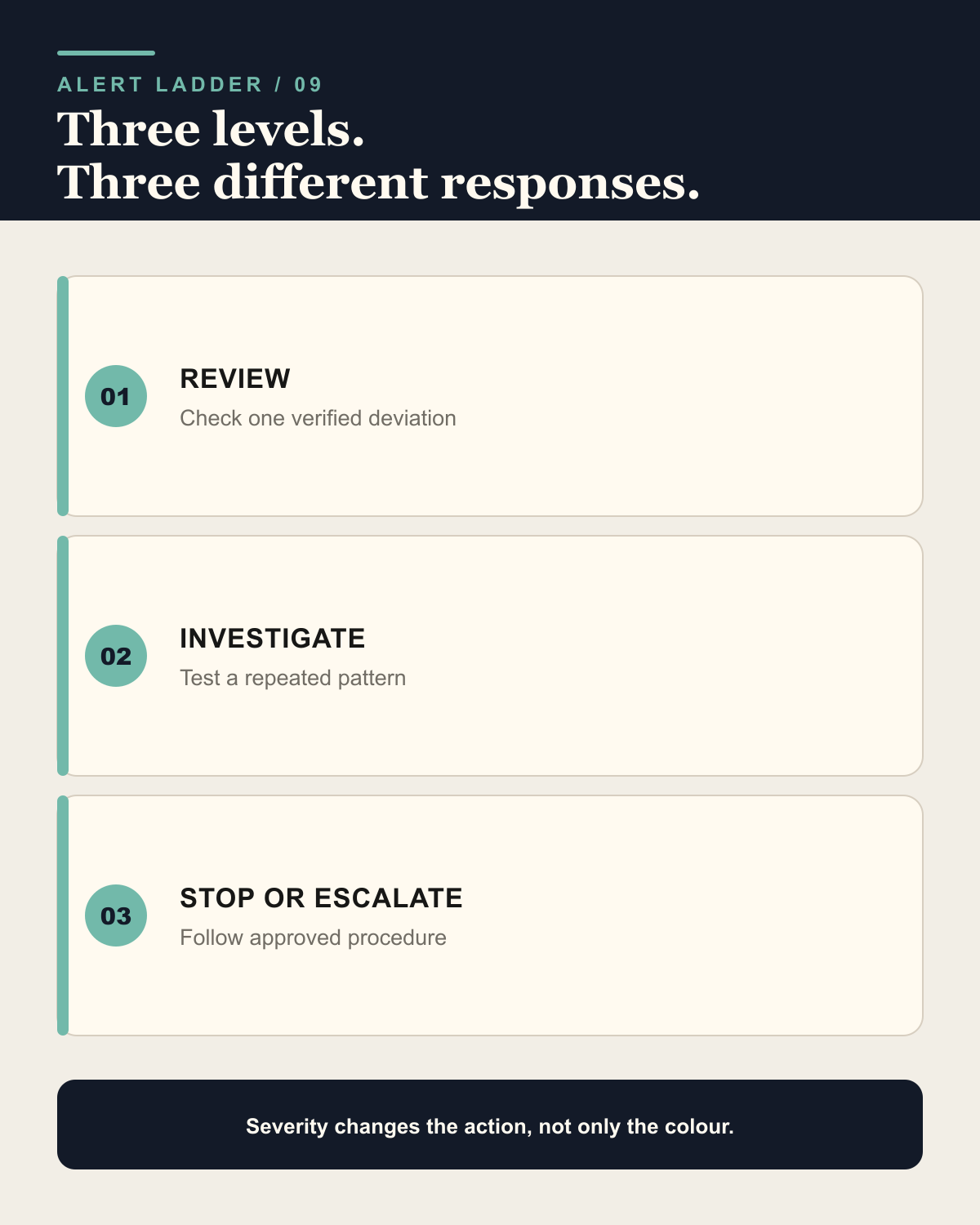
The ladder changes the response, not only the colour. Each level has a named owner, evidence need and next action.
Use this copyable alert line:
“Sauna [asset ID] used [metered energy] during [time window] while the approved state was [schedule state]. Data quality is [metered, stale, missing or modelled]. Owner [role] must [review, investigate or stop and escalate] and close the record with [evidence].”
That sentence forces six facts into view. It also exposes missing data before the alert reaches a phone. If the system cannot fill those fields, it isn't ready to decide severity automatically.
How should the three alert levels work?
1. Review an isolated deviation
Use the first level when one interval differs from the approved baseline but service and safety remain normal. The owner checks the meter trace, schedule and data quality. No maintenance conclusion follows yet. The outcome is either a documented explanation, a corrected data issue or a reason to watch the next comparable period.
2. Investigate a repeated or service-relevant pattern
Use the second level when the deviation repeats under comparable conditions, affects the guest promise or aligns with another verified symptom. Open a task. Attach the relevant meter window, controller state, schedule and maintenance context. The point is to test a cause, not to forward the same notification again.
3. Stop or escalate unexplained operation
Use the third level when the sauna is energised outside authorised operation without explanation, a documented controller or safety fault appears, or the data needed to judge safe operation is unavailable. The response follows the hotel's approved safety and equipment procedures. An energy alert alone must not invent a controller action.
The DOE's guidance says automated fault detection can identify operator overrides, incorrect sequences and performance degradation. It also warns that large fault lists can overwhelm staff, so faults are prioritised by factors such as cost, equipment criticality and comfort impact. That supports a response ladder. It does not support generic sauna severity numbers.
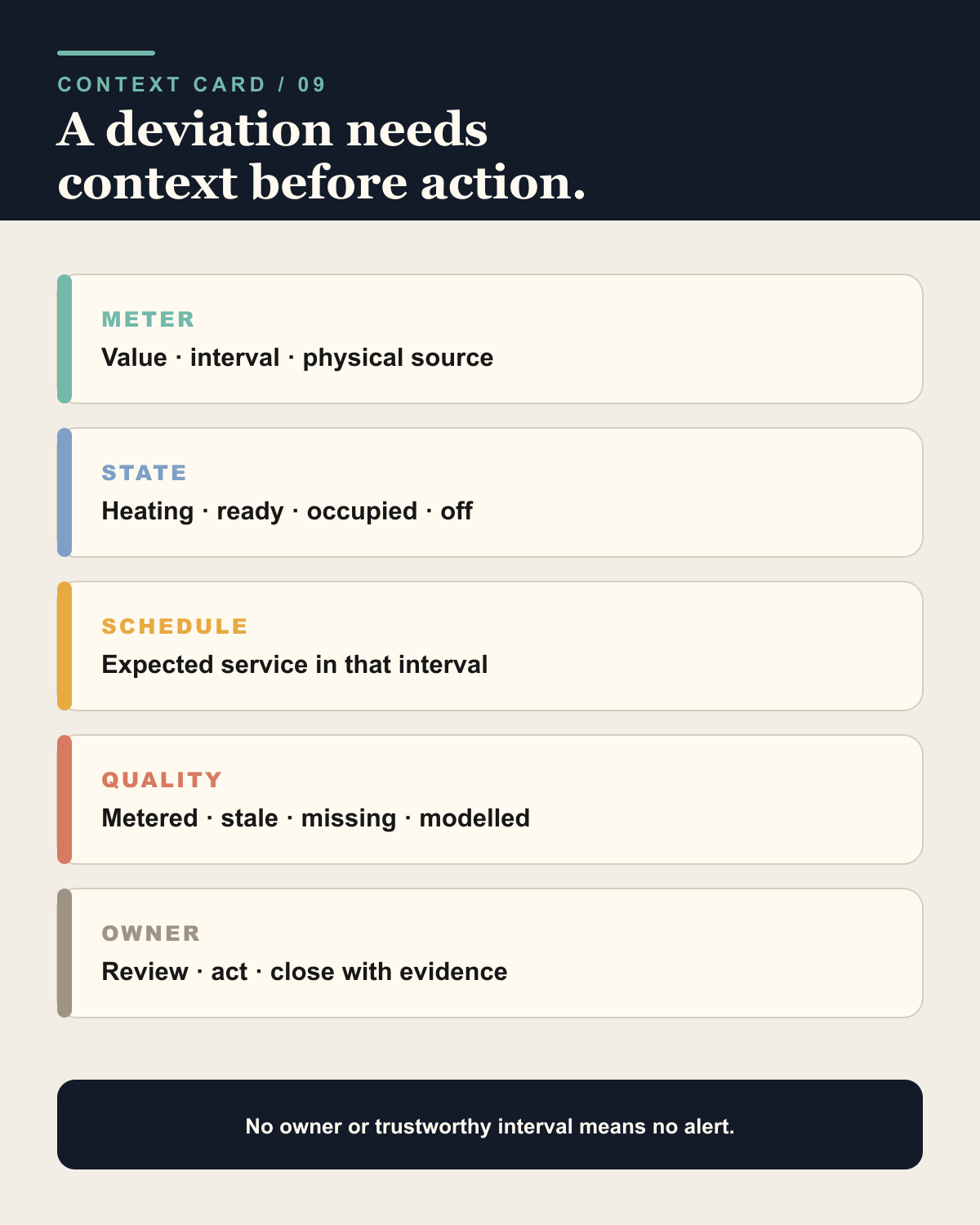
An energy deviation becomes actionable only after the hotel adds operating context and assigns the next decision.
How should a hotel tune the thresholds?
Start from clean, comparable operating periods. Separate heat-up, ready-state holding and occupied use. Mark maintenance, schedule changes, known interruptions and data gaps. Compare like with like. Keep the measurement boundary and operating conditions visible.
Set the first rule where the hotel wants a human review, not where software can produce an impressive decimal. Then replay historical data. Count useful findings, explainable notifications, missed events and alerts without owners. Tighten or widen the rule only with a written reason.
Keep alert tuning out of controller safety logic. Energy analytics can call attention to a pattern. They must not redefine the heater's protective behaviour. Harvia's current Xenio WiFi material, for example, ties remote use to named equipment and safety arrangements. Its public material does not create a universal energy-alarm output for every sauna.
For the physical inspection route behind an alert, read What Maintenance Does Your Thermowood Sauna Need?. An energy anomaly should trigger a documented check, not a remote diagnosis. Alert ownership, metering and escalation still need to be priced as explicit scope before handover.
What should the weekly alert review produce?
Review the small set of alerts that triggered, not a dashboard of everything measured. For each one, record whether the signal was true, whether the level was right, what action occurred and whether the alert closed. Group repeated false positives by cause. Fix the rule, point mapping or schedule source.
Use this review checklist:
“Was the value physically metered and time aligned?”
“Did the schedule and operating state describe the same interval?”
“Was the alert level proportionate to the verified condition?”
“Did a named person take the defined action?”
“What evidence closed the alert?”
“What rule, data source or procedure changed?”
STOP: don't automate a shutdown, restart or maintenance conclusion from an energy deviation alone. Stop the rule when its meter source, time boundary, operating state or equipment response is undocumented.
You don't need dozens of alerts. Put one verified off-schedule rule into the signed weekly review and assign one owner. A closed record is worth more than a red dashboard nobody trusts.
Frequently asked questions
What counts as abnormal sauna energy use?
Abnormal use is a verified deviation from the hotel's approved pattern under comparable conditions, not a universal kWh number. The comparison should include time window, service state, schedule and data quality. A busy session, changed timetable or maintenance run may explain a higher value.
Should a hotel use a fixed percentage for sauna energy alerts?
Not without site evidence. A percentage only becomes meaningful after the hotel defines a stable baseline, comparable operating periods and a response owner. Test the proposed rule against historical data, record false positives and missed events, then approve the threshold for that asset and service pattern.
How long should a sauna energy anomaly last before alerting?
There is no universal duration. The useful window depends on the measurement interval, schedule, heat-up pattern and decision being protected. Set it from verified local data. A short spike may need review, while sustained unexplained operation outside the authorised schedule may require immediate escalation.
Can a BMS alert diagnose a faulty sauna heater?
It can identify an unusual pattern or relay a documented controller fault. It cannot diagnose a heater from energy data alone. Maintenance needs the exact equipment record, controller state, installation evidence and approved test procedure. Keep “deviation detected” separate from “component failed” in every notification.
Who should receive abnormal sauna energy alerts?
Send each level to the role that can perform its defined next action. A routine review may belong to energy or facilities staff. A repeated service issue may need engineering. A safety or unexplained-operation escalation follows the hotel's approved procedure and exact equipment instructions, not a generic mailing list.
1reading
Written by
 Giedrius PatlabaCEO & co-founder, Wood Architects163 pieces · 30 followers
Follow Giedrius to see new posts in your feed, on your phone or by email.