How can a Shopify store take a team t-shirt order in every size in one go?

A rugby union team can name 15 players and up to eight replacements, a squad of 23, and every one of them needs a shirt in their own size. On a standard Shopify product page each size is a separate variant, so the person ordering picks a size, sets a quantity, adds it to the basket and starts again, four or five times over.
How can a Shopify store take a team t-shirt order in every size in one go?
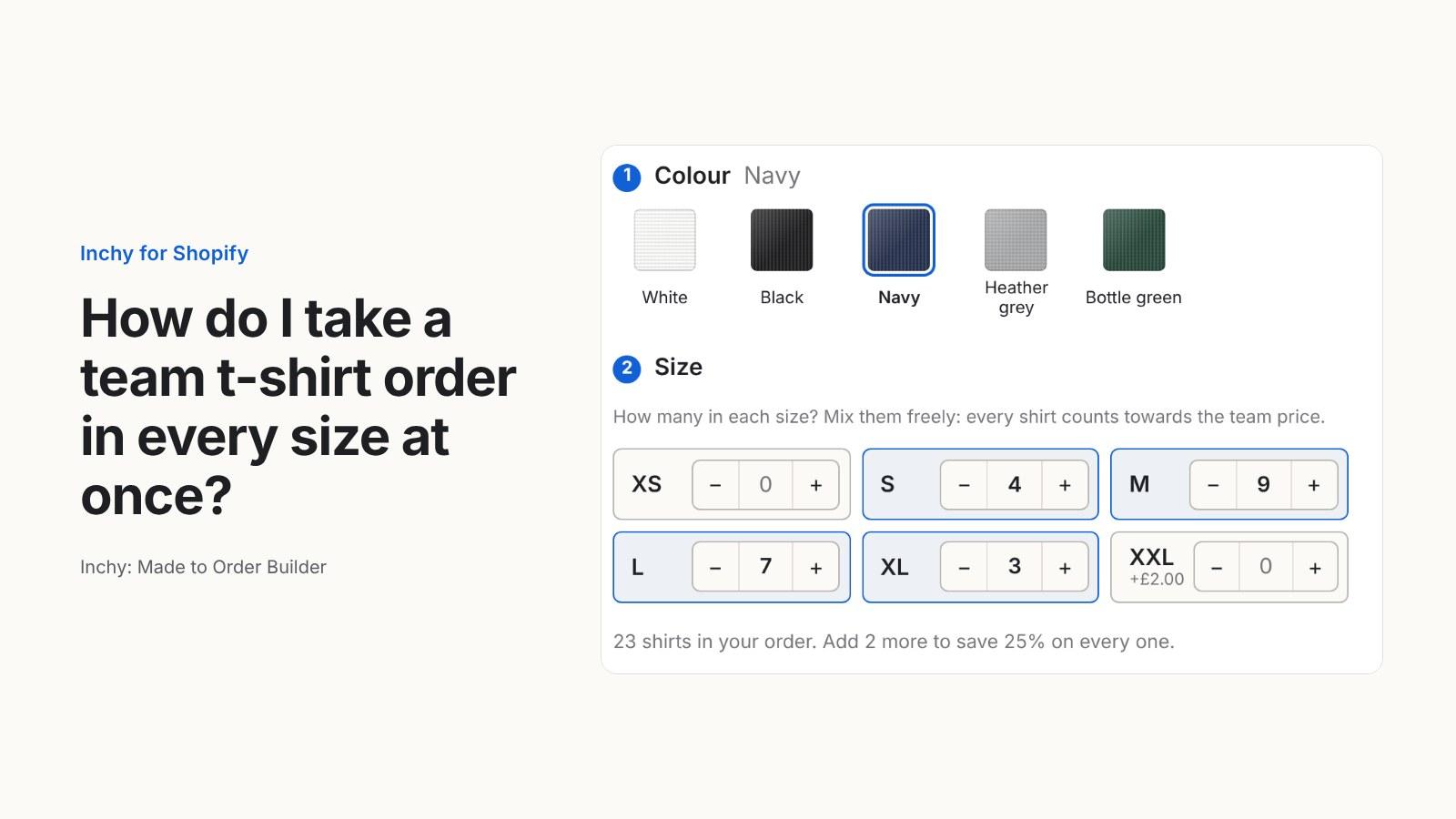
Put every size on one product page. The customer sets how many shirts they need in each size, for example 4 S, 9 M, 7 L and 3 XL, uploads the logo once and picks the colour and print once. Every shirt counts towards the team price, each size goes into the basket as its own line with the same logo and text, and a size that costs more, such as XXL, is charged its own price. Inchy, a Shopify app for t-shirts and team wear, works this way as a product page block.
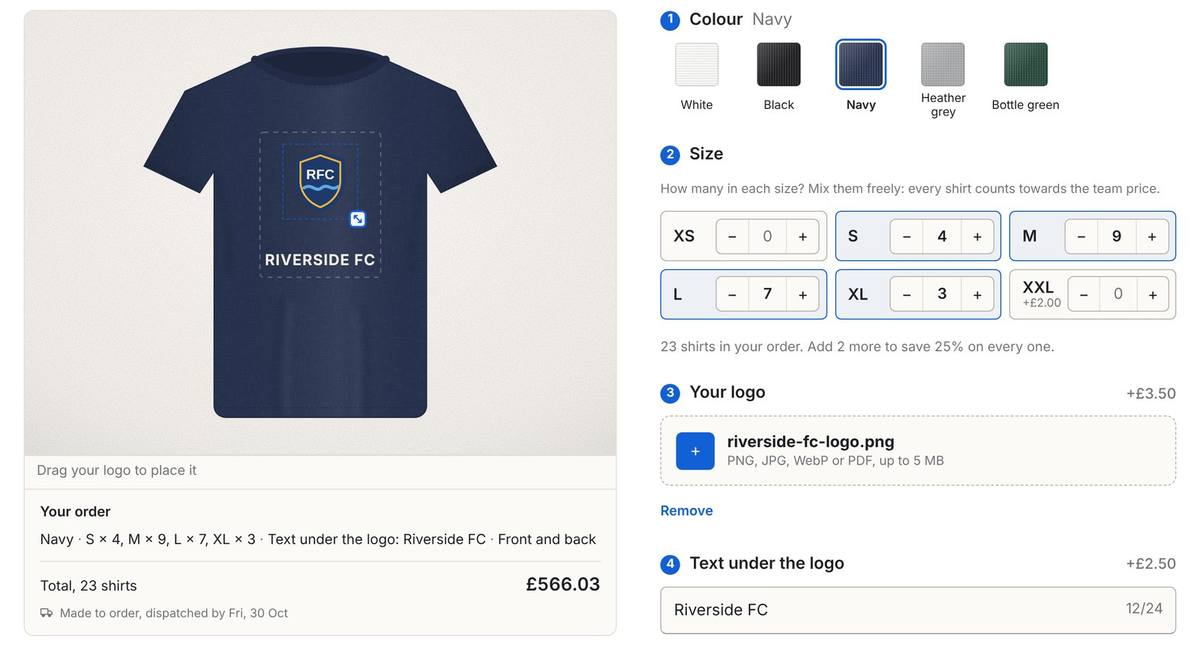
One product page, every size: 23 navy shirts with the club crest and name, £566.03 in total.
It is a big trade. Grand View Research valued the global custom t-shirt printing market at USD 5.2 billion in 2024 and projects USD 9.8 billion by 2030.
Why is a team order awkward on a normal Shopify product page?
Shopify treats each size as a variant, and a standard product form adds one variant at a time. The number of variants is not the problem: six sizes in five colours with two print options is 60 variants, far below Shopify's limit of 2,048. The trouble is everything around it.
Shopify allows three options per product. Size, colour and print use all three, so the logo and the text under it have nowhere to go.
The customer repeats the same logo and text for every size, and one typo on one line means one size printed wrong.
A quantity price has to count the whole team, not one size at a time. Four small and nine medium is 13 shirts, not two small orders.
Nobody in the workshop wants to piece a team order back together from five basket lines.
How should the team price work?
Set price tiers by quantity and show them on the page with the old price struck through. In the demo, 5 shirts save 10%, 12 save 15% and 25 or more save 25%. You set your own tiers; these are sample numbers. You can build a team order yourself on the live demo.
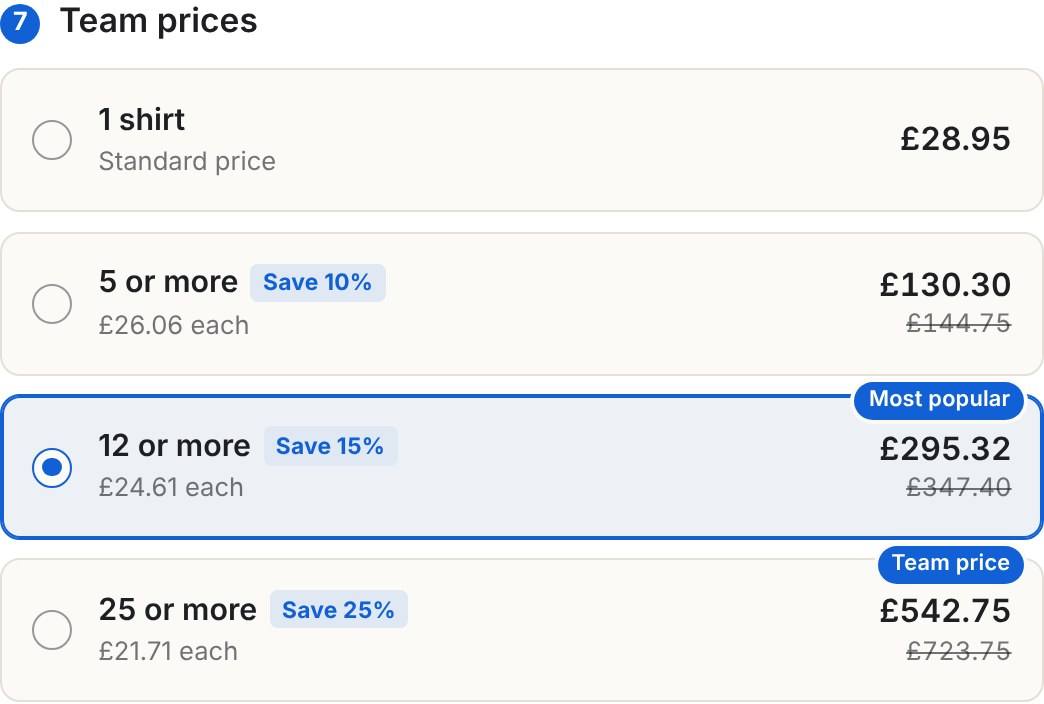
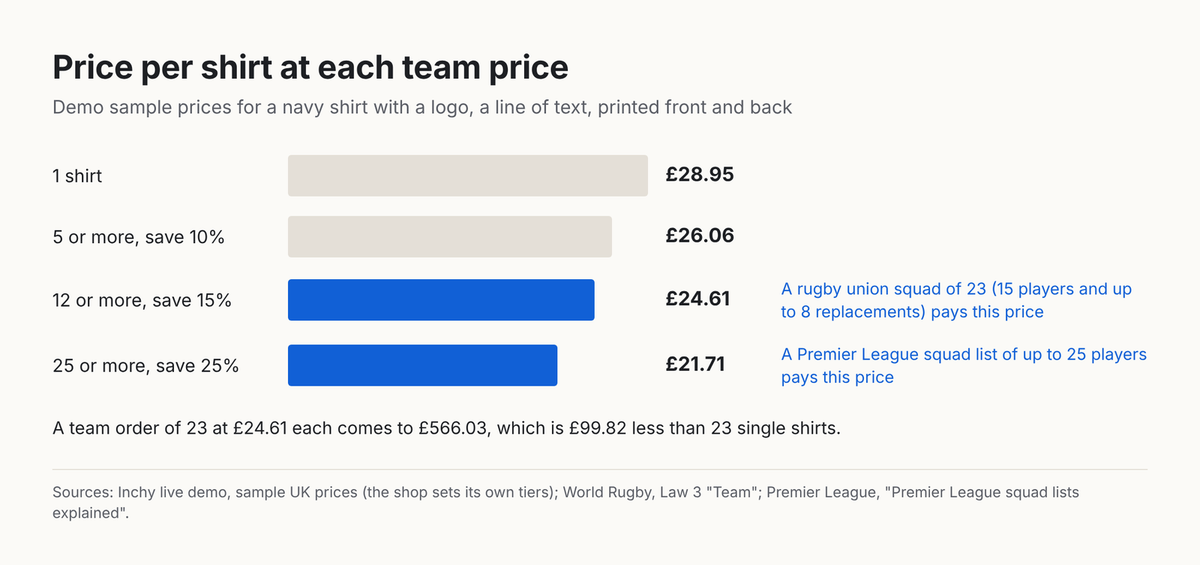
For a navy shirt with a logo, a line of text and printing front and back, the demo's single price is £28.95. At 12 or more it is £24.61 each, and at 25 or more £21.71. A team of 23 pays £566.03, which is £99.82 less than 23 single shirts. Real squad sizes land on these tiers: a rugby union squad of 23 sits in the 12 or more band, and a Premier League squad list of up to 25 players reaches the top one.
The builder also tells the customer how close they are. With 23 shirts in the order, the demo says "Add 2 more to save 25% on every one." In the demo, 25 shirts including two XXL come to £545.75, which is less than the 23 cost.
What happens to bigger sizes that cost more?
They are charged exactly, on their own line. In the demo, XXL carries an extra £2.00. With 25 shirts in the order, the XXL line shows 2 × £23.21 while every other size is £21.71 each, and the XXL shirts still count towards the team price.
What do the basket and the workshop see?
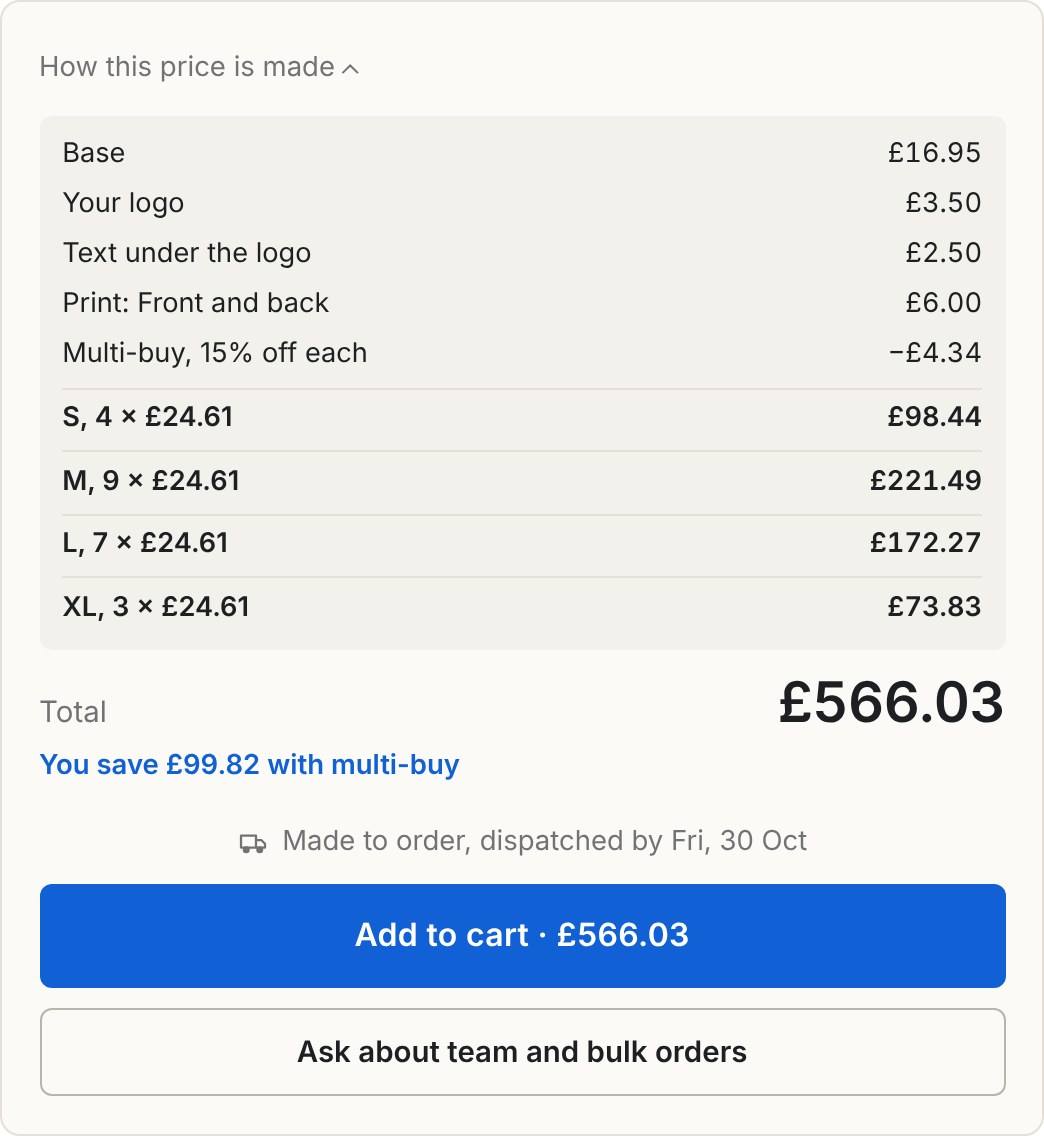
Each size goes into the basket as its own line with the logo and the text, so the order reads like a cutting list: S 4, M 9, L 7, XL 3. The breakdown on the product page shows the same lines before the customer pays, and the checkout charges the same total; why checkout prices can differ from the product page explains how.
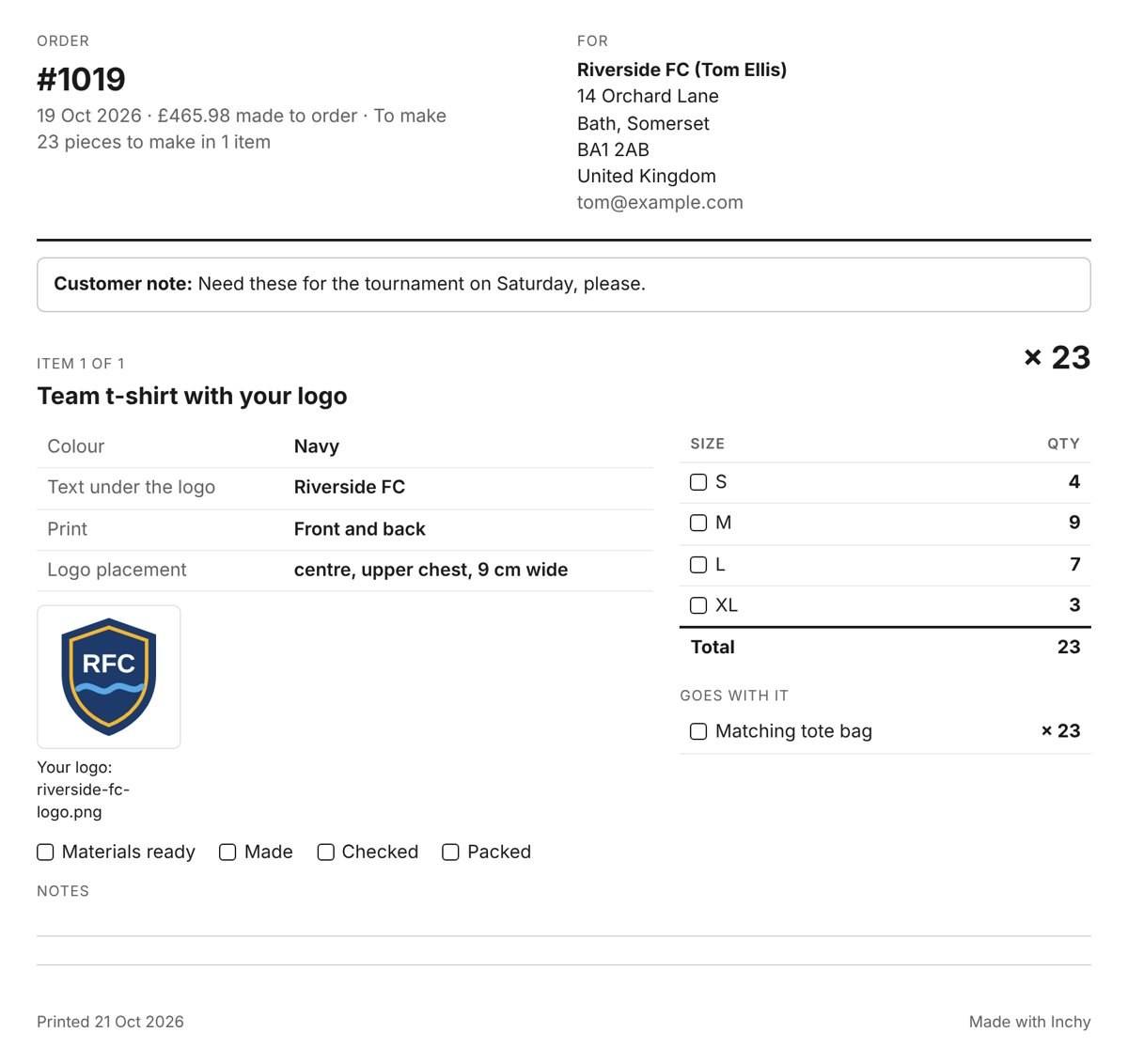
On the Shopify order, the production sheet lists every size with a box to tick, the logo file, the colour, the text and where the logo goes, for example "centre, upper chest, 9 cm wide". On the daily work list the whole team order fits on one line: "23 in total: S × 4, M × 9, L × 7, XL × 3". There is more on that in how to print a production sheet for made to order orders.
Can customers ask for a quote on big team orders?
Yes. Under the basket button the demo shirt has "Ask about team and bulk orders", which opens a short form asking how to reach the customer and the best way to talk. Orders above an amount you set can go to the quote form instead of the basket, and requests arrive in the app and by email.
Questions and answers
Can customers mix sizes freely?
Yes. They set a number for each size on one page, and every shirt counts towards the team price.
Can I set my own quantity tiers?
Yes. The 10%, 15% and 25% tiers are the demo's sample numbers. You choose the quantities and the savings.
What logo files can customers upload?
The demo takes PNG, JPG, WebP or PDF files up to 5 MB. The logo appears on the shirt straight away and can be dragged into place. More in what a custom t-shirt builder with logo upload should do.
Does the team saving hold at checkout?
Yes. The price, including the saving, is worked out again at checkout from your rules, so the basket matches the page.
Can I sell a matching tote bag with the shirts?
Yes. Add-ons sit in the product form. With Bundle kits, part of the Made to measure plan, you can sell a set for less: the demo sells a matching tote and gift wrap together for 20% less.
If you print team wear, set up your own shirt with your own price tiers and run a team order through your shop; Inchy's Team wear plan is $19.99 a month with unlimited products, billed by Shopify. See Inchy and try the live builder. Start the 7-day free trial on the Shopify App Store.
Sources
World Rugby, Law 3: Team: no more than 15 players in the playing area, up to eight replacements, squads of 23.
Premier League, squad lists explained: a squad of up to 25 players.
Shopify Help Center, Adding variants: up to 2,048 variants and up to three options per product.
Grand View Research, Custom t-shirt printing market: USD 5.2 billion in 2024, USD 9.8 billion projected by 2030.
Inchy live demo: sample UK prices, team tiers and messages, read on 21 October 2026.
Written with AI. Every figure is checked against the sources listed above.
1reading now
Get an email when Inchy: publishes