Where European shoppers are actually going (and how they decide)

Online shopping in Europe is growing about 8% per year. In-store shopping is growing about 3%. But this is different in every country and for every product. Eastern Europe is growing fastest. The UK has the most online shopping. For home and made-to-measure products like curtains and blinds, most people still buy in shops. They just research online first. The old straight sales funnel does not work anymore. People go in circles before they buy.
Online shopping in Europe is growing. But not as fast as people think.
In 2025, online sales in Europe will grow about 8% per year. In-store sales will grow about 3% per year. So online is winning, but slowly.
The bigger story is that growth is very different in different parts of Europe. Eastern Europe is growing at 18% per year. Western Europe is growing at only 6% per year. The reason is simple: in Western Europe, almost everyone already shops online. There is not much room left to grow. In Eastern Europe, many people are just starting to shop online. So growth is fast.
Some countries have more online shoppers than others. Here is the picture in 2024-2025.
United Kingdom: 26% of all shopping is online. This is the highest in Europe. It is expected to reach 31% by 2028.
Netherlands: About 18% of shopping is online. Dutch people are very used to digital payments.
Germany: About 16% of shopping is online. 66% of all Germans shopped online in 2025.
Sweden, Denmark, Norway, Finland: All have high online shopping. The market is mature, so growth is slow.
France: About 14% of shopping is online. France is the biggest e-commerce market in total euros.
Belgium: About 12% of shopping is online. Smaller market, but digitally smart.
Poland: About 11% of shopping is online. The fastest growing market in our list.
This is where the general numbers stop being useful. People do not buy a t-shirt the same way they buy a sofa. Home and garden is a special category.
In 2024, online sales of DIY, home, and garden products in Europe reached €66 billion. That is 17% of the total market (€388 billion). In 2023, it was only 15.2%. So online is growing fast in this category. The market is expected to reach €78 billion online by 2026.
But here is the important part: 83% of all home and garden buying still happens in physical shops. Most of the market is offline.
4. What about made-to-measure curtains and blinds?
Made-to-measure is even more offline than general home and garden.
In 2024, about 65% of all curtain and blind sales happened in physical shops. Only 35% happened online. Why?
Customers want to feel the fabric with their hands.
Colours look different in person than on a screen.
Measuring a window correctly is hard. People want help.
Installation is often needed.
The product is expensive, so customers want to be sure.
At the same time, the market is changing. In the UK, home renovation is booming. More people want motorised blinds and smart shading. Made-to-measure blinds with good thermal insulation are growing fast because they save energy.
5. How do people decide what to buy now?
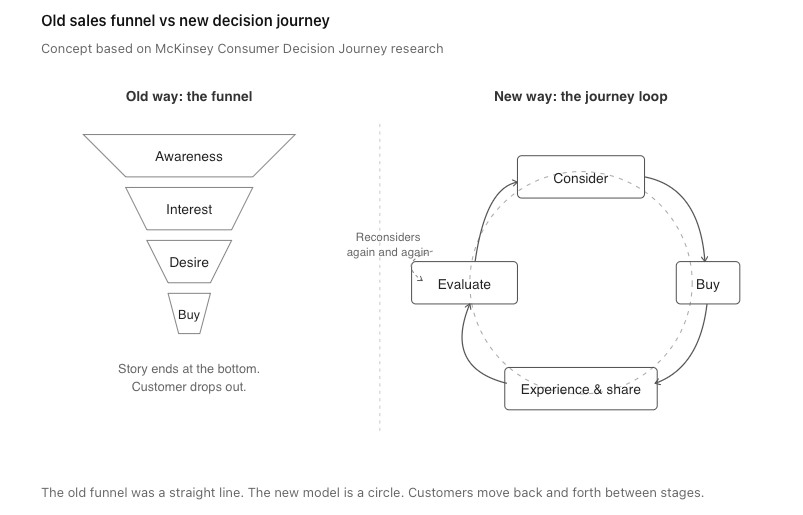
Before the internet, salespeople used a model called the sales funnel. The idea was simple: many people see your advert (top of the funnel), some get interested, fewer think about buying, and a small number actually buy (bottom of the funnel). It was a straight line.
This does not work anymore. Today, customers do not move in a straight line. They go in circles.
A customer might see an ad on Instagram, search Google, read a review, ask a friend, watch a YouTube video, visit a shop, leave the shop, come back next week, then finally buy. After they buy, they post about it on social media. That post becomes part of the next customer's research.
Research from McKinsey shows that the number of brands a customer thinks about often grows during their research, not shrinks. This is the opposite of a funnel.
Old sales funnel vs new decision journey
Concept based on McKinsey Consumer Decision Journey research
Old way: the funnelAwarenessInterestDesireBuyStory ends at the bottom.Customer drops out new way: the journey loopConsiderBuyExperience & shareEvaluateReconsidersagain and again
The old funnel was a straight line. The new model is a circle. Customers move back and forth between stages.
6. What is ROPO (Research Online, Purchase Offline)?
ROPO is short for "Research Online, Purchase Offline". It is what most home and made-to-measure shoppers do today.
Here is how it works. A customer wants new blinds for their living room. First, they Google "made-to-measure blinds". They look at three or four websites. They read reviews. They watch a YouTube video. They save photos on Pinterest. Then they drive to a local shop, feel the fabric, ask questions, and place the order.
About 64% of Germans research products online before buying in a shop. For home and furniture, the number is even higher. For made-to-measure window treatments, almost everyone does it.
This is why a strong online presence is important even if you sell mainly through a shop. If a customer cannot find you online, you are not in the running.
When Russia invaded Ukraine in 2022, energy prices in Europe went up a lot. Households had to spend much more on gas and electricity.
In 2022, the average yearly energy bill was about €3,400 in Germany, €3,000 in the UK, €2,800 in France, and about €2,000 in Italy and Spain. Low-income families in the UK and Germany were hit the hardest.
Because of this, people changed how they shop:
They spent more on food, energy, and transport (basic needs).
They spent less on extra things (clothes, entertainment, dining out).
Many switched to cheaper brands and discount supermarkets.
They delayed big purchases or bought smaller amounts.
But home spending stayed strong. Many people work from home now. They want their home to be comfortable and useful. Furniture that does more than one job (like sofa beds, fold-down desks, storage units) sells well. So do energy-saving products like good blinds and insulated curtains.
The simple story: when the world feels uncertain, people spend money on their home.
8. What this means for made-to-measure retailers
If you sell made-to-measure curtains, blinds, or other custom home products, here is what to take from all this:
The market is splitting in two. Standard products are moving online fast. Custom, high-touch products are still bought in shops. But the journey to the shop now starts online.
The old sales funnel does not work for you. Customers do not go from "I saw your ad" to "I bought" in a straight line. They loop. They research for days or weeks. Your job is to be visible during the whole loop, not just at the end.
Your online presence matters even if you sell offline. If a customer cannot find you on Google, see your reviews, or look at your products online, they will not come to your shop.
Eastern Europe is the growth market. Poland and the wider east are growing fast. Many local retailers there still have weak websites. This is an opportunity.
Energy-saving is a selling point. After the energy crisis, customers care about products that save them money on heating bills. Thermal curtains and good blinds fit this story well.
Trust signals are important. When money is tight, people are slower and more careful. Strong reviews, fabric samples, clear pricing, and easy quotes help win the customer.
1reading now
Watch & subscribe
Darius Baltunis also publishes on YouTube
187 subscribers
One click subscribes you on YouTube - you stay here on PUBlish.
Get an email when Darius publishes