How the Hormuz Crisis Rewrote the 2026 Fertiliser Market

The fertiliser market in 2026 is not following a normal cycle. Normally, prices drift on gas costs, seasonal demand and freight. This year, one structural disruption is driving everything — and the effects are still unfolding.
What actually happened
When conflict broke out in the Persian Gulf in early 2026, fertiliser shipments through the Strait of Hormuz collapsed toward zero. That single chokepoint carries close to a quarter of the world's traded nitrogen fertiliser and roughly 11% of its phosphate exports, so the disruption hit global supply almost immediately. The WTO's data blog on the crisis documents just how sharply trade in these products was affected.
The price shock
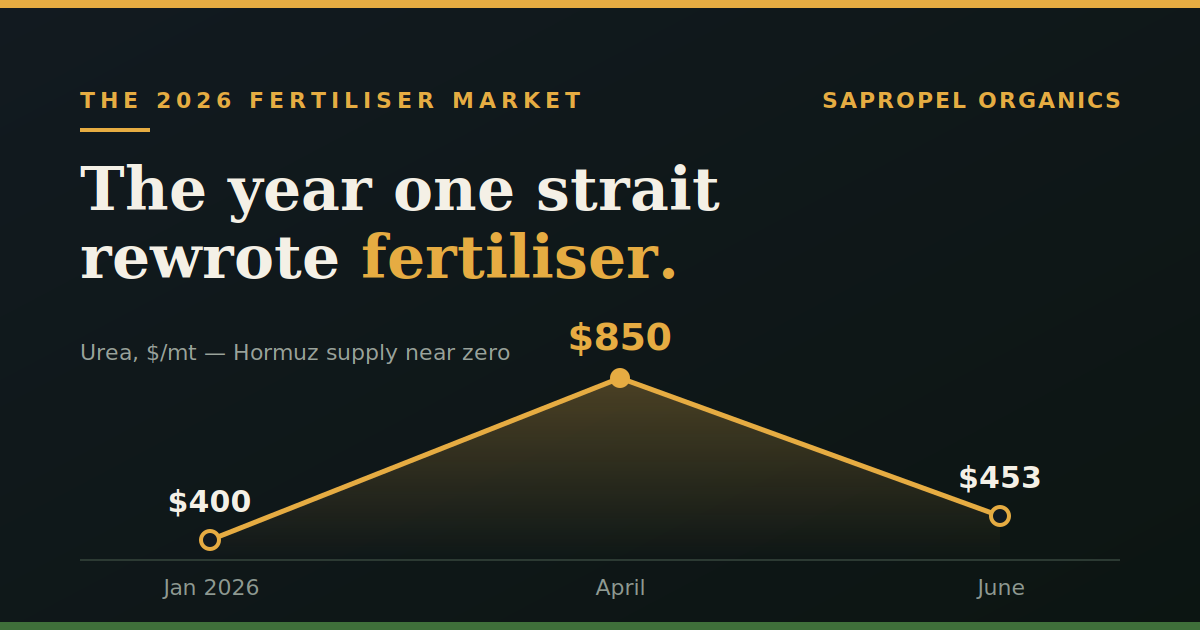
The market repriced fast. Urea, trading near $400/mt in early 2026, spiked above $850/mt by April — its highest in four years — before partially correcting to around $453/mt by June as alternative routes and pre-season stockpiles absorbed some of the shock. DAP climbed from roughly $580/mt toward $770/mt. The World Bank warns that fertiliser prices could rise more than 30% across 2026 if the Hormuz disruption persists — a direct hit to every grower's input budget.
Why this is structural, not temporary
It's tempting to treat this as a spike that will pass. The fundamentals say otherwise. Gulf economies — Saudi Arabia, Qatar, the UAE and Oman — supply roughly a quarter of global nitrogen exports, and there is no quick substitute for that volume. Export restrictions introduced since early 2026 now touch as much as 15% of global fertiliser trade. And with Gulf supply constrained, the world is leaning harder on Russia, already the largest single-country exporter — concentrating supply in precisely the geographies buyers have spent years trying to de-risk.
History also matters here. Fertiliser markets have always been slow to rebuild capacity — new nitrogen plants take years to commission, not months — so even a partial reopening of Hormuz would not restore normal pricing overnight. The supply gap, once opened, tends to persist far longer than the headlines that created it.
The real cost lands downstream
Behind the price charts are farmers who simply can't buy what they need. Reporting around the crisis indicates a large share of U.S. farmers were unable to secure all the fertiliser required for the 2026 crop, and in Sub-Saharan Africa the effect on food security is already measurable. When the input becomes unaffordable or unavailable, the shortfall shows up months later as a smaller harvest — and a tighter food supply.
The strategic lesson: diversify away from the chokepoint
Every serious buyer is drawing the same conclusion: supply that depends on a single strait, or a single dominant exporter, is a strategic vulnerability, not just a price risk. The answer isn't to wait for Hormuz to reopen. It's to add supply that sits outside the chokepoint entirely.
That is exactly where Humuson Complex fits. Made from sapropel — a freshwater lake sediment concentrating more than 40 organic, organic-mineral and inorganic compounds — it is produced entirely within the European Union, with no Russian, no Belarusian and no Hormuz-routed inputs anywhere in its supply chain. It doesn't just sidestep the chokepoint; it improves nutrient-use efficiency by at least 25%, so the conventional fertiliser a grower can still secure goes measurably further, while rebuilding the soil biology that lets a field feed itself.
The takeaway
The single most important variable for the rest of 2026 remains whether the Strait of Hormuz reopens. But the deeper lesson outlasts this crisis: resilience comes from soil inputs that no blockade, sanction or single supplier can switch off. This is the same supply-security argument we made in our earlier piece on the fertiliser shock ahead.
If you're a distributor, importer or institutional buyer rethinking where your supply comes from, this is the moment to build a hedge that doesn't run through Hormuz.
1reading now
Get an email when Aurimas publishes