What Support Information Should a Sauna Manufacturer Hand Over?

What Support Information Should a Sauna Manufacturer Hand Over?
A sauna manufacturer should hand over one stable information pack that lets an operator identify the installed product, describe a fault consistently and route the question to the right technical party. Include rating-plate images, model and serial or batch details, current manuals, the accepted opening-state record, support contacts and a fault-report template. Keep the sauna body, heater, control, local connection and site conditions distinct. This pack is not a commissioning certificate, spare-parts list or promise of a particular outcome.
Key Takeaways
Freeze installed-product identity while labels and records are easy to reach.
Give every support case the same minimum information structure.
Separate product systems before assigning the next technical question.
Reference accepted opening records without repeating commissioning tests.
Keep one current route for manuals, questions and authorised intervention.
Stop handover when a future reporter would still need to guess.
Consider this hypothetical first week. A hotel reports that the sauna is not heating as expected. Reception sends a room photograph, maintenance finds two model names and the electrician receives no control identifier. Each person describes the same event differently. Nothing has yet been diagnosed, but the missing handover information has already delayed the next competent question.
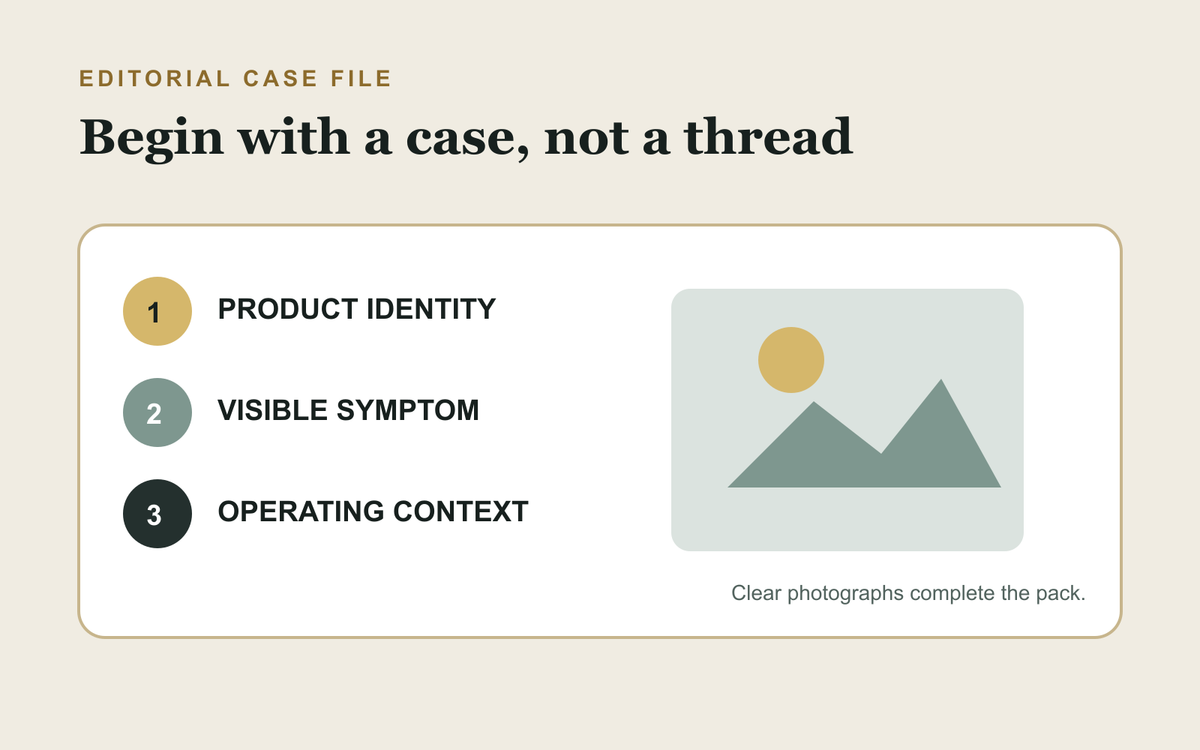
This editorial case file shows the minimum information categories. It is not a real customer report and promises no response time or outcome.
What belongs in the installed-product record?
Record the sauna as a system, then identify the replaceable or independently supported equipment inside it. The file needs the project reference, exact sauna description, heater identity, control identity, sensor identity where applicable, manuals, rating-plate photographs and the location of every physical identifier. Add the accepted local installation and opening-state records as references, not as rewritten summaries.
Harvia's June 2026 serial-number guidance explains that identification sits on a product type plate and that heaters, control units and control panels can have different identifier locations. That is Harvia-specific guidance. It illustrates why one typed marketing name cannot reliably identify every installed component.
Wood Architects fits Harvia and HUUM heaters. Our first bounded manufacturer judgement is to keep the heater and control identifiers beside the sauna-body record without collapsing them into one label. Multiple equipment families make precise identity more useful, but they do not let us infer a fault or support outcome.
Support starts with identity.
Do not turn this record into another commissioning form. The commissioning record answers whether defined checks were accepted before opening. The support pack merely points to that record as the known baseline. It answers what was installed and where the accepted starting state can be found.
What makes a support case readable after opening?
Use one fault-report template across operations, maintenance and technical contacts. Capture the asset reference, date and time observed, exact symptom, what the operator was trying to do, any displayed code copied exactly, photographs or short video where safe, relevant environmental or site context, and actions already taken. Record facts, not conclusions.
HUUM's April 2026 warranty terms provide a product-specific example of claim information. They list product name, model, serial or batch number, a defect description, photographs, use environment or conditions and proof of purchase among the possible inputs. Those fields do not decide whether another product is covered. They show how identification and observation travel together.
Harvia's current product support page routes users through manuals, frequently asked questions, warranty information, authorised service and a support request. It asks for an accurate description of the product and question. That route promises no timing or resolution. It supports a more modest conclusion: readable information helps the next party understand what is being asked.
One case, one readable record.
Avoid free-form messages spread across inboxes. Give the case one identifier and attach later observations to the same record. Preserve the original wording of an error code and distinguish “observed” from “assumed”. If a photograph contains a rating plate, keep it with the case rather than retyping only the convenient line.
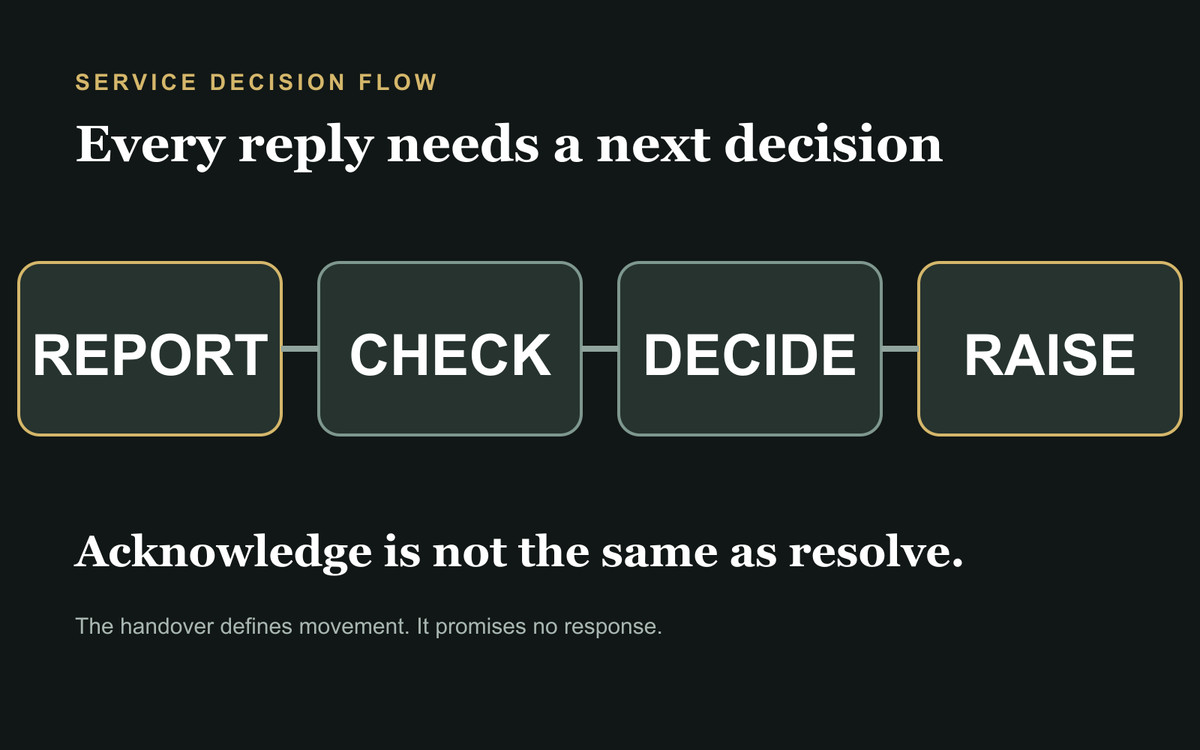
The flow gives each reply a next decision. It does not set a response target or decide whether a claim is covered.
How should the information route separate systems?
Start with the observed symptom, then separate the question into the sauna body, heater, control, local electrical connection or site condition. This is triage, not diagnosis. A door movement question and a displayed control code may belong in the same case, yet they can require different technical owners and different records.
Wood Architects pre-assembles and checks the specified sauna at our facility before shipment. Our second bounded judgement is to preserve that recorded factory state and the accepted local record as separate references. A later site observation should not silently rewrite either one. The comparison can narrow a question, but only the competent technical party decides what it means.
The trade-off is between completeness and reporting effort. A form with fifty compulsory fields may discourage use. A message with only “not working” creates repeated questions. Make the core fields short and mandatory, then add conditional fields for the affected system. The reporter needs a usable front door, not a technical examination.
Copy into the support handover | Required entry | Release check |
|---|---|---|
Installed identity | Exact equipment identifiers and plate images | Can support match the installed item? |
Known baseline | Links to accepted factory and local records | Are the records separate and retrievable? |
Fault report | Symptom, code, context, media and prior actions | Are observations separated from assumptions? |
Technical route | Current contact and intervention boundary by system | Does every reply have a next decision? |
These four lines answer “What Support Information Should a Sauna Manufacturer Hand Over?” without duplicating physical stock or commissioning acceptance.
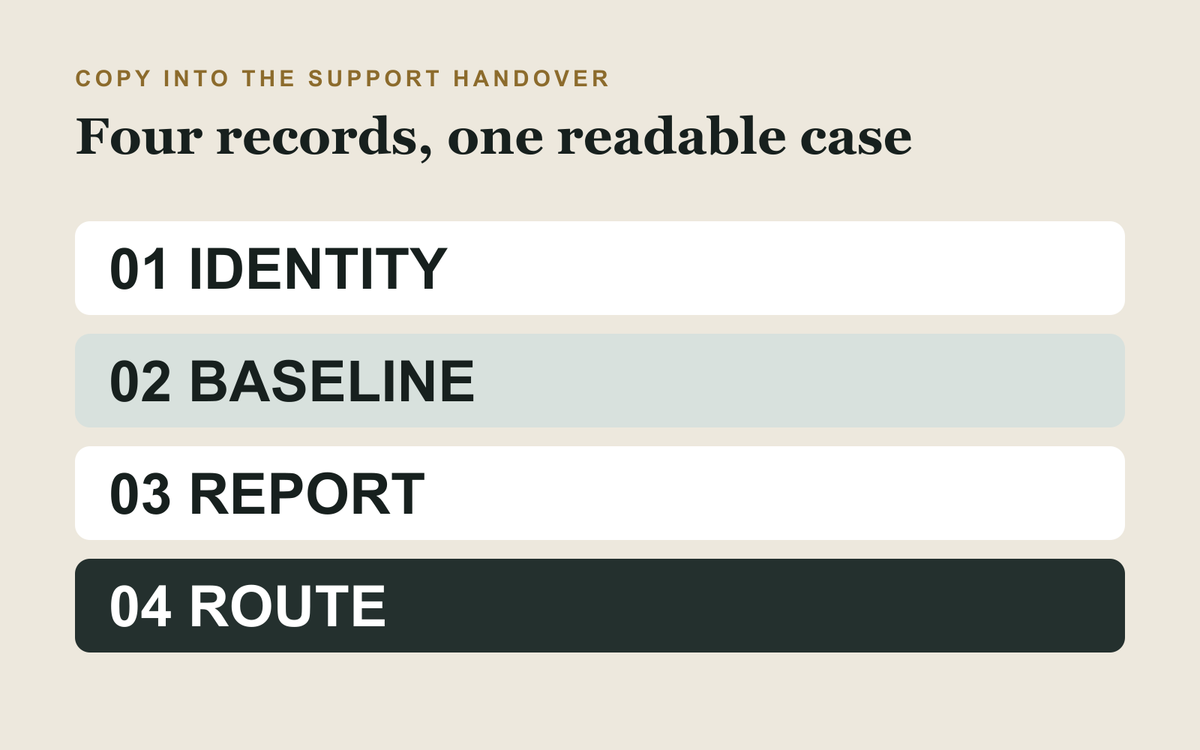
The copyable card makes a future support case readable. It proves no diagnosis, response time, coverage or remedy.
What does a failed support handover look like?
Picture a cold Monday opening. The display shows a code, but the photograph crops out the control label. The folder contains a heater brochure rather than the installed rating plate. The opening record sits with another contractor. A well-meaning employee resets the control before recording the screen. Support receives five messages and no stable starting point.
Test the information route with a desk exercise before handover. Give an uninvolved hotel colleague a fictional symptom and the prepared pack. They should identify the asset, open the right manual, complete the minimum report and locate the appropriate contact without searching private messages. Stop before any physical inspection, reset or electrical action.
Route the question before touching the equipment.
STOP: do not release the support handover while an installed heater or control cannot be identified, the accepted baseline is missing, the report template mixes observations with diagnosis, or the hotel cannot locate the current technical route. More documents do not solve an unreadable information chain.
The physical spare-parts decision belongs in a separate inventory. The commissioning decision belongs in the accepted opening record. This handover connects the people asking for help to the information needed for the next safe, competent decision.
Frequently asked questions
Is a manual enough for after-sale support?
No. A manual explains a product, but it may not identify the exact installed unit or preserve the observed event. Pair the current manual with rating-plate images, model and serial or batch details, the accepted baseline reference, a fault-report template and the current technical contact for that system.
Should the support pack repeat the commissioning record?
No. Keep the commissioning record as the accepted opening-state source and link to it from the support pack. Rewriting results in another document creates version risk. The support handover needs to show where the baseline lives, while the commissioning record retains the actual checks, dates and acceptance evidence.
Does a complete report prove a warranty claim?
No. Complete information helps identify the product and question, but coverage remains governed by the relevant product terms and facts. A report should not promise a diagnosis, remedy or decision. Its job is narrower: preserve observations and give the authorised technical route enough context to assess the next step.
Who should update the information after equipment changes?
The project team should name a record owner before handover. After an authorised equipment change, that owner replaces obsolete identifiers, manuals and plate images, links the change record and confirms the current contact route. Keep prior versions traceable rather than leaving two apparently current product identities in circulation.
How does this help assess a sauna manufacturer?
A usable support handover is one practical selection question, not proof of overall reliability. Ask how installed identity, manuals and technical routing will be delivered before choosing. For the broader evaluation boundary, read How Do You Spot a Reliable Sauna Manufacturer? by Giedrius Patlaba.
1reading now
Get an email when Giedrius publishes