How Should a Hotel Archive Outdoor Sauna Handover Evidence?

Key Takeaways
An archive needs an index, identifiers, versions, owners and acceptance status, not only folders.
Agree the required evidence and naming rules before handover begins.
Keep superseded records visible and clearly marked instead of silently overwriting them.
A photograph becomes useful evidence only when linked to the correct unit, date, record and decision.
Acceptance should record what was reviewed, by whom, when and with which unresolved items.
Manufacturer documents prove only their stated product facts, not the completeness of the hotel's archive.
A hotel may receive drawings, manuals, photographs, commissioning records and correspondence from several parties. Saving them is not the same as controlling them. This guide turns the handover package into an auditable archive with clear versions, ownership, acceptance and transfer, without inventing a universal certificate list.
How Should a Hotel Archive Outdoor Sauna Handover Evidence?
A hotel should archive outdoor sauna handover evidence through one controlled index. Every record needs a unique identifier, unit reference, title, owner, date, version, status and acceptance link. Required evidence and naming rules should be agreed before handover. Superseded files should remain traceable rather than being overwritten. Acceptance must record who reviewed what, when and with which unresolved items. The archive owner should then verify access, transfer and future change control after handover.
Why is a folder tree not an archive?
A folder tree shows where somebody saved a file. It may not show whether that file is current, which sauna unit it describes, who issued it, whether the hotel reviewed it or what replaced it. Similar names such as final, final revised and final latest create uncertainty precisely when an operator needs a dependable answer.
An auditable archive adds a control layer. The index connects the file to its subject, origin, version and status. It also records the acceptance event and any later replacement. The original file remains intact while the index explains how it should be used.
The archive is not a claim that every record is correct. It is a traceable account of what was received, reviewed, accepted, superseded or rejected. Technical validity remains with the competent person responsible for that evidence.
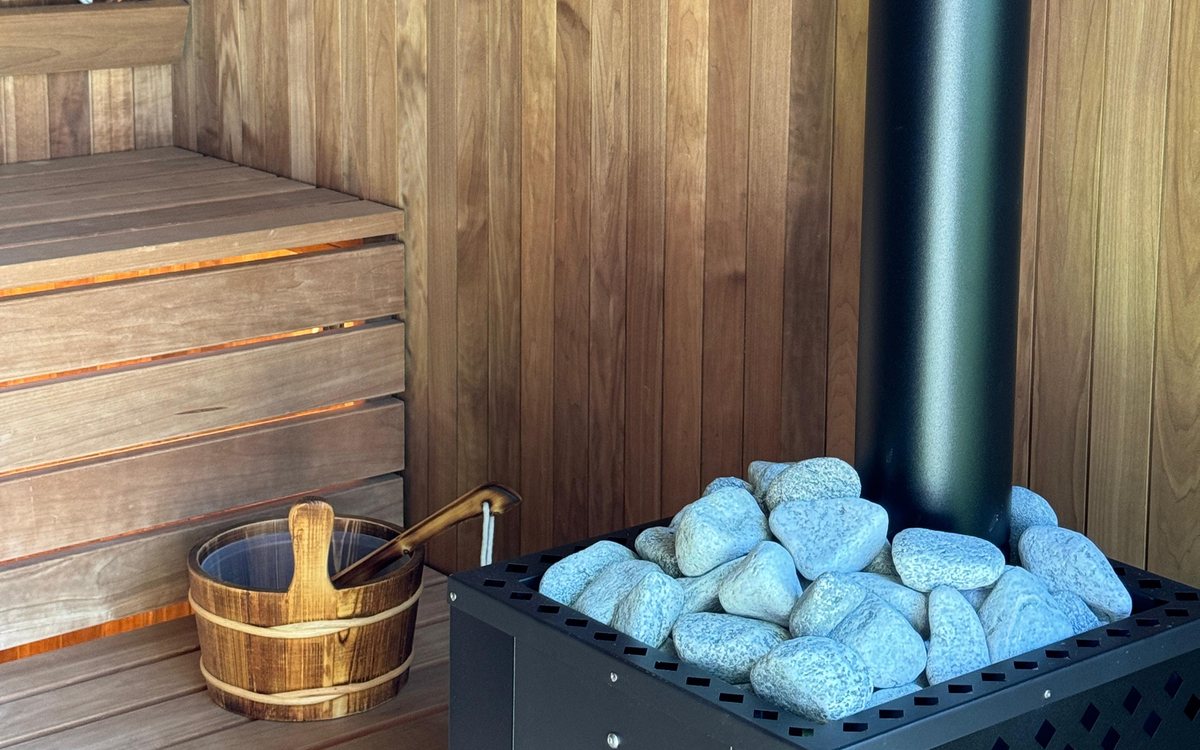
This photograph shows only visible interior condition. It becomes handover evidence only when tied to the correct unit, date, version and archive index. It does not prove cleaning, sanitisation, acceptance, compliance or readiness for use.
Which fields make a record traceable?
Start with a unique record ID and a stable unit ID. Add a plain-language title, record type, source organisation, responsible owner, issue date, received date, version and file name. Then add review status, acceptance reference, superseded-by reference and access classification where needed.
The UK's National Archives describes its own use of references to uniquely identify digital records, new references for versions or manifestations, provenance metadata and a strong audit trail for metadata changes. We use that public practice as an analogy for a hotel archive, not as a universal rule or legal sauna handover scheme.
Avoid creating metadata that nobody can maintain. Choose the smallest set that answers operational questions. Which unit does this concern? Is it current? Who owns the content? Was it accepted? What replaced it? Where is the controlled file?
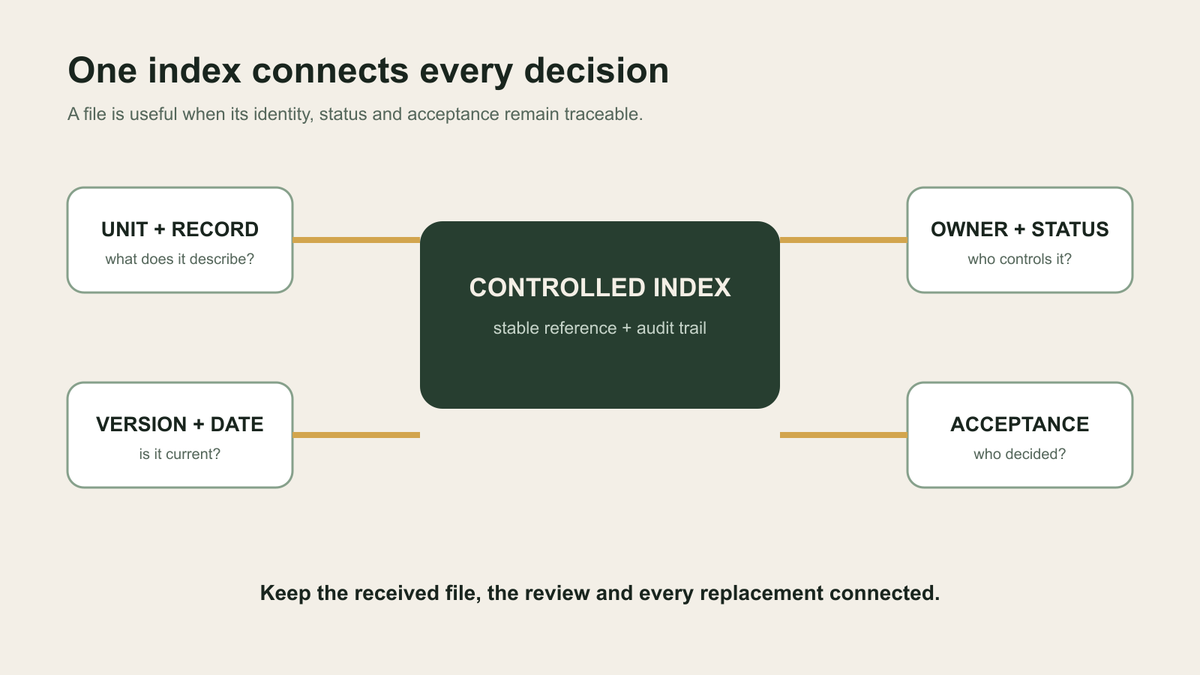
The index links every file to a stable unit, a controlled version, a named owner and an explicit acceptance event.
How should versions and replacements work?
Never make a revised file indistinguishable from the one it replaces. Give the new version its own controlled entry. Mark the previous version as superseded and link both directions. Record why the change occurred and who authorised the status update.
Keep the received original in a protected location. If a working copy is renamed or converted for access, retain the relationship to that original. A cryptographic checksum can help show whether the stored file has changed. The National Archives describes SHA-256 checksums as a way to monitor file integrity during digital preservation. A checksum does not prove that the content is technically correct or accepted.
Version control should also cover the index itself. Record who changed a status, when and why. Limit editing rights, while keeping usable read access for the people responsible for operation and maintenance.
What does acceptance need to show?
Acceptance is a decision, not a folder name. The record should identify the evidence reviewed, the reviewer, the date, the outcome and any condition or outstanding item. A rejected or incomplete record should retain its history and link to the replacement when one arrives.
Define the acceptance authority before the handover package starts to accumulate. The hotel may assign different competent reviewers to different evidence types. This article does not prescribe those technical roles or create a certificate list. It describes how the archive records their decisions.
The UK Building Safety Regulator's golden-thread guidance offers a useful information principle: controlled information should be digital, secure, available, usable and treated as a single source of truth with version control. That guidance applies to higher-risk buildings in England. It is not a general legal requirement for every hotel sauna, but its information-management logic is valuable.
What can a hotel copy into its evidence index?
Use this minimum structure, then add only fields required by the project's agreed handover plan.
OUTDOOR SAUNA HANDOVER EVIDENCE INDEX

Project ID: [record]
Sauna unit ID: [record]
Archive owner: [name and role]

RECORD ID: [unique value]
Title and record type: [record]
Source organisation and owner: [record]
Issue date and received date: [record]
Version and file name: [record]
Controlled file location: [link]
File checksum: [value and method]

REVIEW STATUS: [received / under review / accepted / rejected / superseded]
Reviewer and review date: [record]
Acceptance reference: [link]
Outstanding item: [record]
Supersedes or superseded by: [record ID]

TRANSFER CHECK
Hotel read access verified by: [name and date]
Edit rights verified by: [name and date]
Backup or retention owner: [name]
Next change-control review: [date or trigger]
How should handover move from submission to controlled archive?
Use a visible sequence. Receive the file without altering it. Validate that it opens and matches the index entry. Route it to the named reviewer. Record acceptance, rejection or an outstanding item. If replaced, retain the relationship between versions. Then transfer the controlled archive and test that the hotel can retrieve it.
The UK's Construction Design and Management guidance is a scope-specific example. For projects where its health and safety file duties apply, it describes reviewing, updating and handing over the file, with the client retaining it and providing it to later duty holders. The actual duties depend on the project and jurisdiction. The archive workflow below is an information-control pattern, not a legal determination.
Stage | Control question | Recorded outcome |
|---|---|---|
Receive | Does the file match the indexed subject and unit? | Received entry |
Validate | Does it open and retain its expected identity? | Technical file check |
Review | Who is competent and authorised to decide? | Named review |
Close | Accepted, rejected or outstanding? | Status and decision link |
Transfer | Can the hotel retrieve and control it? | Access readback |
Change | What replaces this record later? | Version and audit trail |
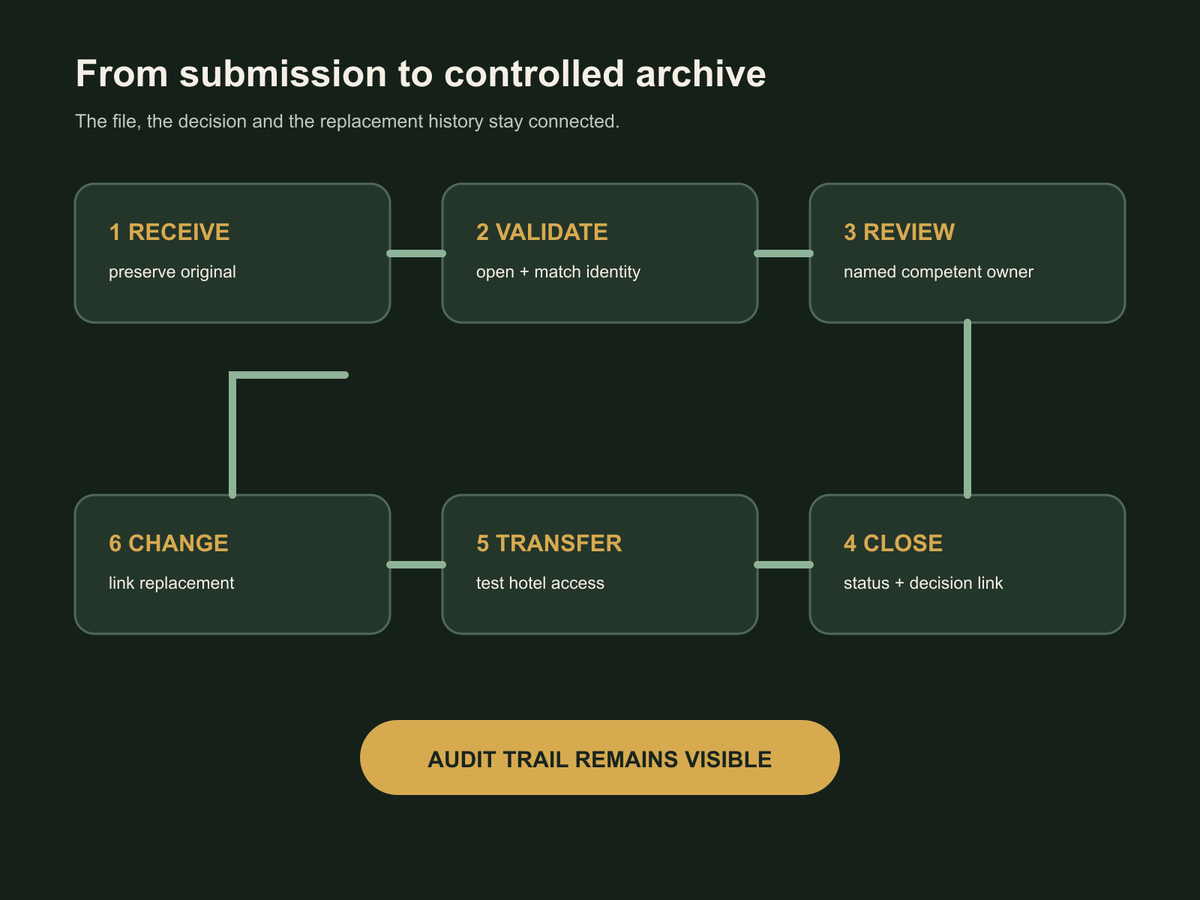
A controlled archive preserves the file, the review decision and every later replacement as connected records.
Where does the sauna manufacturer fit?
I am Giedrius Patlaba, CEO of Wood Architects. Our public product page states that our panoramic cube saunas are delivered fully assembled. That manufacturer fact can define part of the delivery boundary. It does not prove that a hotel's handover archive is complete, accepted, compliant or correctly indexed.
The manufacturer should issue the agreed product records with identifiable versions and a clear subject. The hotel should control receipt, review, acceptance and future access. Competent specialists remain responsible for the technical decisions within their scope.
Archive requirements are easier to enforce when they are fixed before award. How Should a European Hotel Compare Two Outdoor Sauna Quotes? explains how to compare supplier scope. This article does not compare quotes. It begins after the required handover evidence has been defined.
Choose one existing handover file and try to answer five questions without asking its sender: which unit, which version, which owner, which acceptance decision and what replaces it. Every missing answer is a precise archive improvement.
Frequently Asked Questions
Should the hotel overwrite an outdated handover file?
No. Preserve the received record, mark its status as superseded and link it to the replacement. The new version needs its own controlled entry and acceptance decision. This keeps the audit trail visible and prevents an old link from silently presenting changed content.
Does a checksum prove that evidence is correct?
No. A checksum helps detect whether a digital file has changed. It does not prove technical accuracy, completeness, compliance or acceptance. Keep the checksum with the file identity, then record the competent review and acceptance decision as separate archive fields.
Can photographs be used as handover evidence?
Yes, when the project requires them and each image is tied to a unit, subject, date, source, version and review decision. A photograph shows limited visible conditions at one moment. It cannot independently prove hidden work, technical performance, cleanliness or compliance.
Who should own the archive after handover?
The hotel should name a role with authority to maintain access, status, version links and change control. Technical reviewers still own decisions within their competence. The archive owner controls the record system, not the truth of every specialist claim stored inside it.
Is one shared cloud folder enough?
Only if it is supported by a controlled index, permissions, version rules, acceptance records and tested retrieval. A shared folder alone rarely explains current status or replacement history. The hotel should verify read access, editing authority, retention ownership and future change control.
1reading now
Get an email when Giedrius publishes