What Must a Seasonal Sauna Reopening Review Include?
Key Takeaways
Reopening is an operating release, not a spring cleaning date.
Review the cabin, power, access and support systems as separate gates.
Apply water-system controls only where water-bearing equipment is actually present.
Use the selected manufacturers' instructions before testing equipment after dormancy.
Record defects, specialist actions and the person accepting each release.
Keep the sauna closed while any safety-critical gate remains unresolved.
Picture a holiday park on the first clear weekend of spring. The cabin looks dry, housekeeping has cleaned the benches and the booking page is already live. Yet the isolation record is missing, an outside light has failed and nobody knows whether a dormant water-bearing support system was reviewed. The room looks open before the operation is ready.
What Must a Seasonal Sauna Reopening Review Include?
A seasonal sauna reopening review needs four separate releases: the cabin and access route, the electrical and control equipment, any water-bearing support system, and the operator's staffing and emergency arrangements. Each release needs a visible check, the selected manufacturer's instructions, any required competent-person input and a dated record. Cleaning alone isn't acceptance. If one safety-critical item remains unknown today, keep the sauna unavailable until the locally responsible team resolves it.

This editorial scene separates a closed operating state from a completed reopening review. It does not depict a real property, product or approved inspection.
Why is reopening different from routine maintenance?
Routine maintenance happens inside an operating cycle.
Seasonal reopening follows a period when weather, isolation, access, stored materials and support equipment may all have changed. The useful question isn't whether one surface looks clean. It is whether each system can return to its intended use under the current site plan.
As checked on 22 August 2026, Great Britain's Health and Safety Executive's maintenance guidance says work equipment needs maintenance that keeps it safe, with manufacturer instructions, suitable access, isolation where required and competent work. It also notes that shutdown periods can create maintenance opportunities. This is GB workplace guidance, not a universal European reopening certificate.
At Wood Architects, we assemble and check each sauna at our Klaipėda facility before shipment. That is a product-side check against the supplied configuration. It cannot approve a seasonal access route, confirm local electrical condition, review site water systems or decide whether hotel staff are ready.
Factory acceptance has a boundary.
A reopening review crosses that boundary deliberately. The manufacturer supplies the relevant product instructions and known configuration. The local facilities team checks the property. Competent specialists handle work outside the operator's capability. The hotel or park records the final operating decision.
Which systems changed while the sauna was closed?
Start with what could have changed, not with a generic checklist. Walk the approach in the conditions guests will use. Check doors, glazing, visible damage, lighting and the area around the heater against the selected product information. Confirm that stored furniture, landscaping work or winter barriers haven't narrowed the route or hidden a service point.
Our cube line uses full-height panoramic glazing and 128 mm walls. Those are confirmed product facts. They tell an inspector to identify the glazed face and the actual wall interfaces on the selected unit. They don't prove remaining service life, weather resistance, reopening approval or the condition of a particular installation.
Then separate dry cabin checks from water-system checks. HSE's current page on other systems that can create a legionella risk identifies risk factors such as water storage or recirculation, suitable temperatures, contamination and aerosol creation. Apply that reasoning only where the site genuinely has water-bearing support equipment capable of creating that exposure.
For relevant systems, HSE's L8 guidance describes a GB framework built around risk assessment, a control scheme, competence, monitoring and records. It isn't a sauna standard and it doesn't make every dry cabin a water-system risk. Local rules and competent advice decide what the actual property needs.
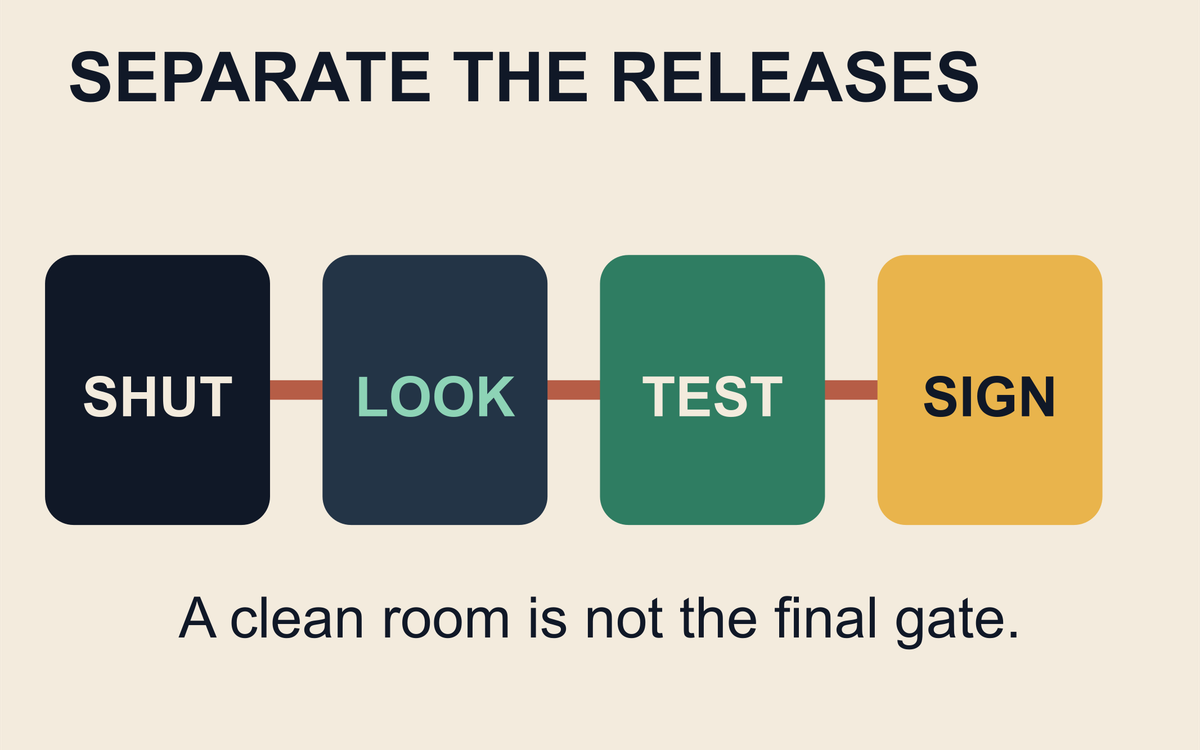
The four-stage mechanism keeps inspection, testing and release distinct. It gives no universal test method, interval or legal assignment.
The trade-off is speed versus certainty. Reopening every amenity on one marketing date is simple to communicate. Releasing systems separately gives specialists time to resolve real defects. A short hold on one gate is usually easier to manage than an incident after bookings begin.
What fails when appearance becomes the release test?
Consider a scenario involving a dormant water-bearing support system beside the sauna. The cabin is dry and clean, but stored or recirculated water has not been reviewed before the system produces an aerosol. The cited HSE material establishes that pattern for relevant water systems. It does not prove that every sauna, shower or property carries the same risk.
Appearance also misses control state. A display may light while a sensor, isolation record or protective function remains unresolved. A clear path at midday may become dark or slippery during the first evening session. A tidy plant room may still contain a tagged fault that housekeeping was never meant to judge.
Use a hold note whenever the observed state and the required proof differ. Write the defect, the affected gate, the person asked to resolve it and the evidence needed for release. Don't convert “looks fine” into “passed”.
The reopening record should be short enough to use and precise enough to challenge. A photograph can show a visible condition. It cannot prove electrical safety, water quality, competence or correct operation. Those conclusions need the appropriate test, document or specialist.
Who signs the seasonal operating release?
There may be several contributors, but the record needs one clear status for every gate. Avoid inventing a universal legal role. The actual appointments depend on the property, jurisdiction, work and selected equipment. Record the acting person and the basis for acceptance rather than borrowing a title from another country.
Gate | Copy into the review | Release basis |
|---|---|---|
Cabin and route | “Visible condition and guest route checked by ___.” | Dated walk-through and defect record. |
Power and controls | “Selected instructions reviewed and tests completed by ___.” | Required competent-person record. |
Water system, where present | “Water-system review applies / does not apply because ___.” | Local risk-control record. |
Operation | “Staff, emergency plan and booking release accepted by ___.” | Dated operating sign-off. |
For recurring timber care between operating seasons, read What Maintenance Does Your Thermowood Sauna Need? by Giedrius Patlaba. That article covers routine material care. It doesn't release dormant equipment, support systems or the site's operating plan.
This is the practical answer to “What Must a Seasonal Sauna Reopening Review Include?”
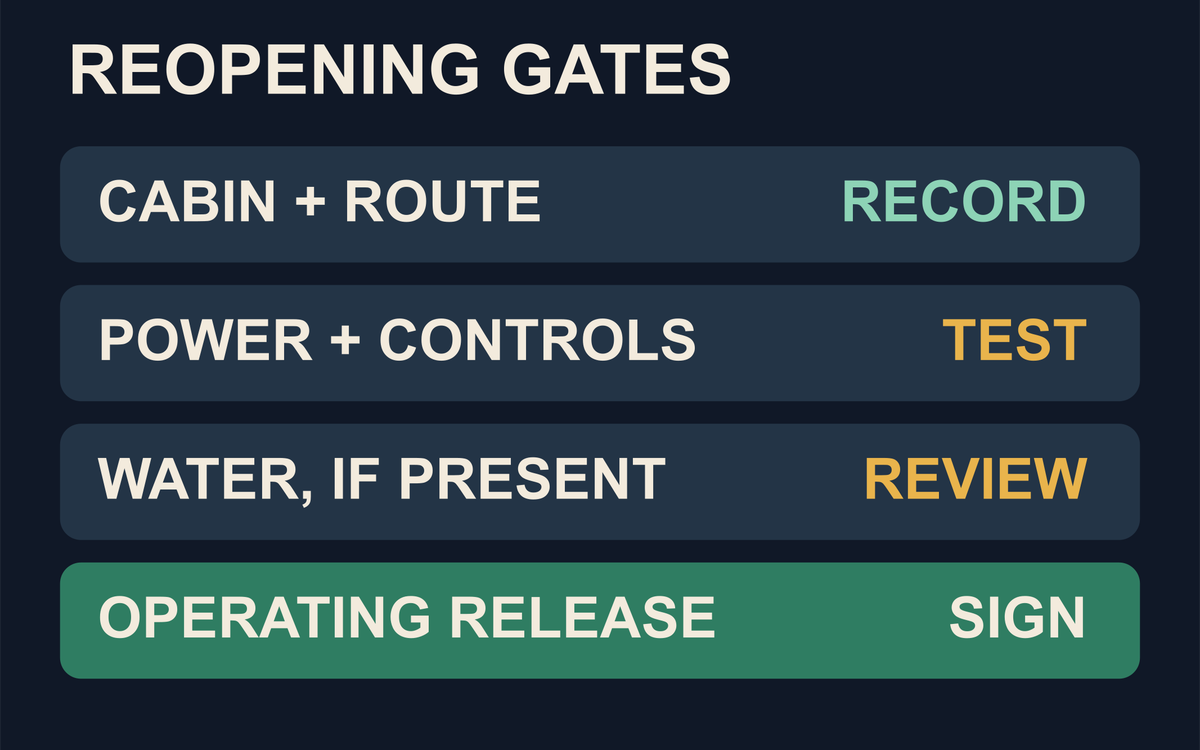
The card keeps four release gates visible and leaves project-specific names blank. It is not a certificate or a universal legal allocation.
STOP: keep the sauna closed when visible damage, an unresolved isolation, a required specialist check, a relevant water-system review or the operating sign-off remains incomplete. Record the hold and let the locally appointed person close the gap before bookings resume.
Bring one dated reopening sheet to the cabin. If any safety-critical row still says “unknown”, the booking calendar is ahead of the site.
Frequently asked questions
Is seasonal reopening the same as routine sauna maintenance?
No. Routine maintenance manages recurring care during use. Seasonal reopening confirms that the cabin, access, power, controls, relevant support systems and operating arrangements can return after dormancy. The two records can inform each other, but a completed maintenance task doesn't by itself release the whole amenity.
Does every seasonal sauna need a legionella review?
No. The issue applies to relevant water-bearing systems where the necessary risk factors exist, not automatically to a dry sauna cabin. Identify the actual showers, tanks, hoses, pools or other support equipment, then apply local water-safety duties and competent advice to those systems.
Can hotel staff complete every reopening check?
Only checks within their training, authority and the property's procedures. Electrical work, water-system controls or other specialist tasks may require competent people under local rules and selected-product instructions. Staff can coordinate the record without pretending that coordination proves technical competence.
What should the manufacturer provide before reopening?
Use the instructions, known configuration and service information for the selected sauna and installed equipment. The manufacturer can clarify product boundaries and documented tests. It cannot inspect an unseen route, assign local legal duties, certify unrelated water systems or release a hotel operation remotely.
What record should a seasonal sauna keep?
Keep a dated sheet showing each gate, observed condition, defect or hold, specialist input, acceptance basis and release person. Attach only relevant photographs or test records. The aim is a traceable operating decision, not a thick file that hides one unresolved safety-critical item.
1reading
Written by
 Giedrius PatlabaCEO & co-founder, Wood Architects163 pieces · 30 followers
Follow Giedrius to see new posts in your feed, on your phone or by email.