You can't just buy more wallpaper later

Two things make wallpaper different from paint and tiles. Both decide how many rolls you need - and getting the number wrong costs you a whole wall.
Here is how it usually goes.
You find a wallpaper you love. You measure the wall, work out the area, and order enough rolls to cover it. You start hanging. Near the last wall, you run out. No problem - you order one more roll.
It arrives. You hang it. And it is slightly the wrong colour.
Not by much. Just enough that you notice it every time you walk into the room.
That is the moment most people learn how wallpaper really works. Two things did this to you. The batch and the pattern.
The batch
Wallpaper is printed in runs. Each run is called a batch, and it has its own number printed on the label. The colour shifts very slightly from one batch to the next. On a tin of paint that would never matter. On a wall of patterned paper, with the strips side by side, it shows.
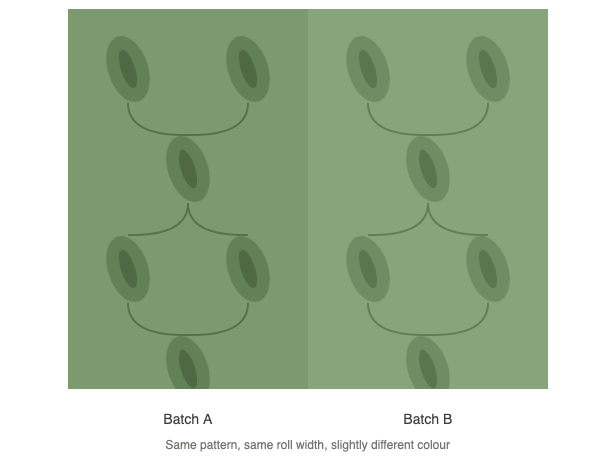
So the roll you order three weeks later is almost certainly from a different batch. It will be close. It will not be exact. And once a batch has sold out, there is no way to ask for "the same one as before."
This is why running out is so expensive. You are not simply buying one more roll. You are often re-buying the whole wall so that it matches.
The pattern
Most wallpaper has a pattern that has to line up at every seam. To make it line up, you cut each strip to match the one beside it. That means you lose a little off the top or bottom of every drop.
The bigger the pattern, the more you lose. A small repeat wastes almost nothing. A large repeat can cost you a good piece of every single roll.
This is the part that catches people out. They measure the wall area, divide by the area of a roll, and trust the number. But you cannot tile wallpaper that neatly. The offcuts above a door or below a window usually can't be reused, because the pattern lands in the wrong place. So working from area almost always tells you to buy too little.
The fix is simple
Stop thinking in area. Start thinking in drops.
A drop is one full strip from ceiling to skirting. Work out how many drops your walls need, how many drops you get from one roll once the pattern is taken into account, and you have your real number. Then buy it all at once, in one batch, with a roll to spare.
That spare isn't waste. It is your insurance. If the paper gets scuffed in a year, or a pipe leaks behind it, you have a matching piece sitting in the cupboard.
Don't just take it from us. PIERRE RICHARD CALICE runs "JANNELLI & VOLPI" in 6 Rue du Mail Paris. This is what he tells his clients:
"The key to a successful decoration project lies in accurately estimating the quantities of wallpaper needed. At Bellevue Décoration, we always advise our clients to allow for a safety margin of 5 to 15%, depending on the complexity of the pattern and installation requirements. We also advise you to order all your rolls at once. Manufacturers create their collections in production batches, and despite very strict quality controls, slight colour variations can occur from one batch to another. Placing a single order thus ensures perfect uniformity in your decoration."
His 5 to 15% is the professional's version of the spare roll. Same rule, from someone who does this every day.
"I'll just work it out myself"
You can. The width and the height are easy. The pattern repeat is where it slips, and that is the one number that decides whether you run out.
And the shop? A good one will help. But they are working from the figures you give them, they tend to round, and they are not the one standing in front of a half-finished wall when the batch runs dry. The risk is yours, so the number should be yours too.
If you run a wallpaper store on Shopify
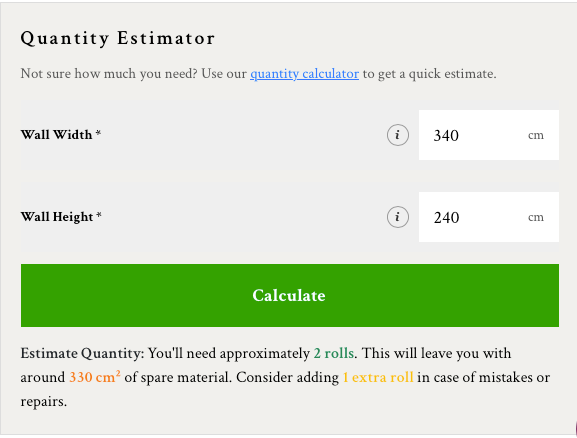
The calculator solves half the problem. It tells your customer they need six rolls. Plenty will still order four, then come back for two more. Different batch, wall doesn't match, and now it's your support inbox, your return, your refund.
So we make the full order the cheapest option. A simple quantity discount: more rolls, lower price per roll. The customer saves money for doing the right thing, and you stop paying for the wrong one.
And rolls are not the whole order. Nobody hangs wallpaper without paste. Most jobs also need lining paper, a seam roller, a sharp blade. If your store doesn't put those next to the rolls, the customer buys them at a hardware shop on the way home. The paper gets the click. The glue makes the margin.
One bundle fixes it. Rolls, paste, and tools in a single add to cart, with a small discount for taking the lot. Bigger basket for you, one delivery for them, and no Sunday morning discovery that the glue is missing.
We set this up with Kaching Bundles. Quantity breaks, bundles, and frequently bought together in one app. Vilnius team, more than 30,000 Shopify stores run their apps, and their setup video shows a deal going live in a few minutes.
Their new Kaching Ecom channel on YouTube is worth a follow too.
1reading now
Get an email when WallpaperCalc publishes