What Happens When Your Architect and Sauna Manufacturer Disagree?
Key Takeaways
Translate disagreement into one written requirement, constraint and evidence set.
The architect owns project design intent only within the granted appointment.
The manufacturer owns product facts and factory constraints within its supply scope.
A decision owner should test evidence, not choose the louder job title.
One accepted revision must replace both parties' conflicting working versions.
Stop affected work while two current instructions contradict each other.
Consider a hypothetical project where an architect asks the sauna factory to move a glazed opening. The requested opening move conflicts with the issued configuration. Both teams repeat their answer in longer emails, while the client sees a design preference and a production refusal. The real issue, evidence and decision authority still haven't been written together.
What Happens When Your Architect and Sauna Manufacturer Disagree?
When your architect and sauna manufacturer disagree, pause the affected release and translate both positions into testable statements. Record the architect's requirement, the manufacturer's product constraint, supporting evidence and the person authorised to decide. The manufacturer can explain configuration and factory consequences, while the architect can explain design intent within the appointment. Neither side should rewrite the other's scope, and one clearly accepted revision must be issued before work resumes.
What is the disagreement really about?
Most useful disagreements concern a requirement, an interface or an assumption. “The architect wants it” and “the factory cannot do it” are positions, not decision-ready reasons. Ask what outcome the project needs, which supplied-product constraint is affected and which current drawing or instruction each party used.
Separate preference from requirement. A visual alignment may be valuable without being mandatory. A factory constraint may be real without making the design outcome impossible. Once the team states each point precisely, it can search for an alternative that protects the required outcome without pretending every preference is fixed.
My manufacturer judgement is that the best first response is a bounded explanation, not a defensive no. We should identify the affected product arrangement, show the current information and describe what would need re-checking. We shouldn't decide whether the wider project must accept that consequence.
The trade-off is escalation time versus evidence quality. A quick senior call may lower the temperature, but memory can create a third version of the issue. A short written test takes longer. It gives the accountable decision owner something stable to accept, reject or revise.
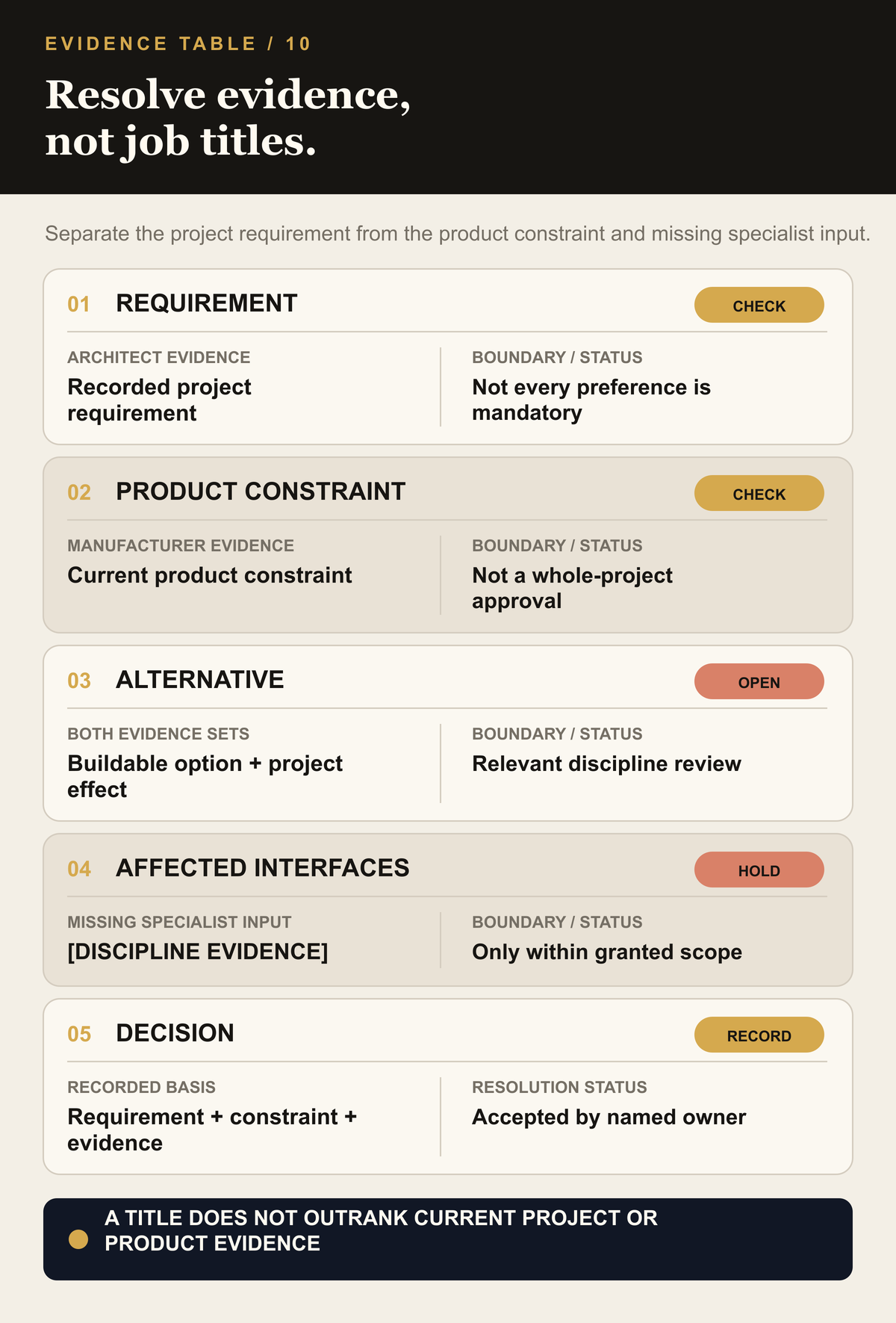
The table moves the discussion from job titles to current project, product and specialist evidence. It does not rank one role above another or grant whole-project approval.
Which evidence should each side bring?
The architect should bring the current design requirement, its reason, dimensional context and affected project interfaces. The manufacturer should bring current product information, the selected configuration, relevant factory limits and feasible alternatives. Other appointed specialists should add evidence only for the disciplines affected by the proposed resolution.
As checked on 25 August 2026, the current RIBA Plan of Work page describes stage outcomes, tasks and information exchanges, and its toolbox includes a Design Responsibility Matrix. That is professional-practice context. It isn't universal law, a sauna approval hierarchy or a substitute for project appointments.
Use the responsibility matrix or equivalent record to show who supplies each piece of evidence and who makes the project decision. The tool doesn't settle the answer. It prevents missing evidence and unspoken authority from hiding behind the disagreement.
Test | Evidence to record | Boundary |
|---|---|---|
Requirement | Current project outcome and stated reason | Not every preference is mandatory |
Product constraint | Selected configuration and factory consequence | Not a whole-project approval |
Alternative | Revised option and affected interfaces | Requires relevant discipline review |
Decision | Named authority and accepted revision | Only within granted project scope |
Test the requirement, not the job title.
Show the constraint, don't just repeat it.
One issue needs one current evidence set.
A compromise still needs an accountable decision.
These checks keep the conversation firm without making it personal.
Who makes the accountable decision?
The project's appointments and decision procedure determine the accountable person. That may be the client, lead designer or another authorised role, depending on the consequence. The decision owner should confirm that the necessary competent reviewers have answered before accepting one revision.
For a useful comparison discipline, see How Should a European Hotel Compare Two Outdoor Sauna Quotes? by Giedrius Patlaba. Its normalised comparison logic also helps here. Put requirements and evidence beside each other instead of comparing the authority of two email signatures.
Decision: “Accept revision [accepted revision] because it meets the recorded project requirement within the confirmed product constraint. Supersede the conflicting architect and manufacturer versions listed below.” That wording remains incomplete until the appointed decision owner, reviewers and document index are named.
“What Happens When Your Architect and Sauna Manufacturer Disagree?” should lead to a controlled answer, not a winner. The manufacturer retains its product boundary, while the architect retains project design responsibilities within the appointment. The authorised decision owner accepts the co-ordinated outcome.
What belongs in the disagreement log?
Record the issue reference, both current positions, requirement, constraint, source documents, open evidence, affected work and decision deadline. Add the accepted option, reviewers, authority and superseded versions. Keep commentary factual. The log is a co-ordination tool, not a place to assign blame.
A hypothetical spa project changed a glazed opening after a design meeting. The architect marked one revision, while the factory continued from another because its constraint note wasn't resolved. Both parties later produced a valid email. The failure was allowing two conflicting instructions to remain current without one accountable decision.
In that hypothetical, recovery starts by freezing only the affected release. The parties compare the same requirement and product configuration, then add missing specialist evidence. The authorised project role accepts one revision. Both earlier versions are marked superseded and redistributed through the agreed information route.
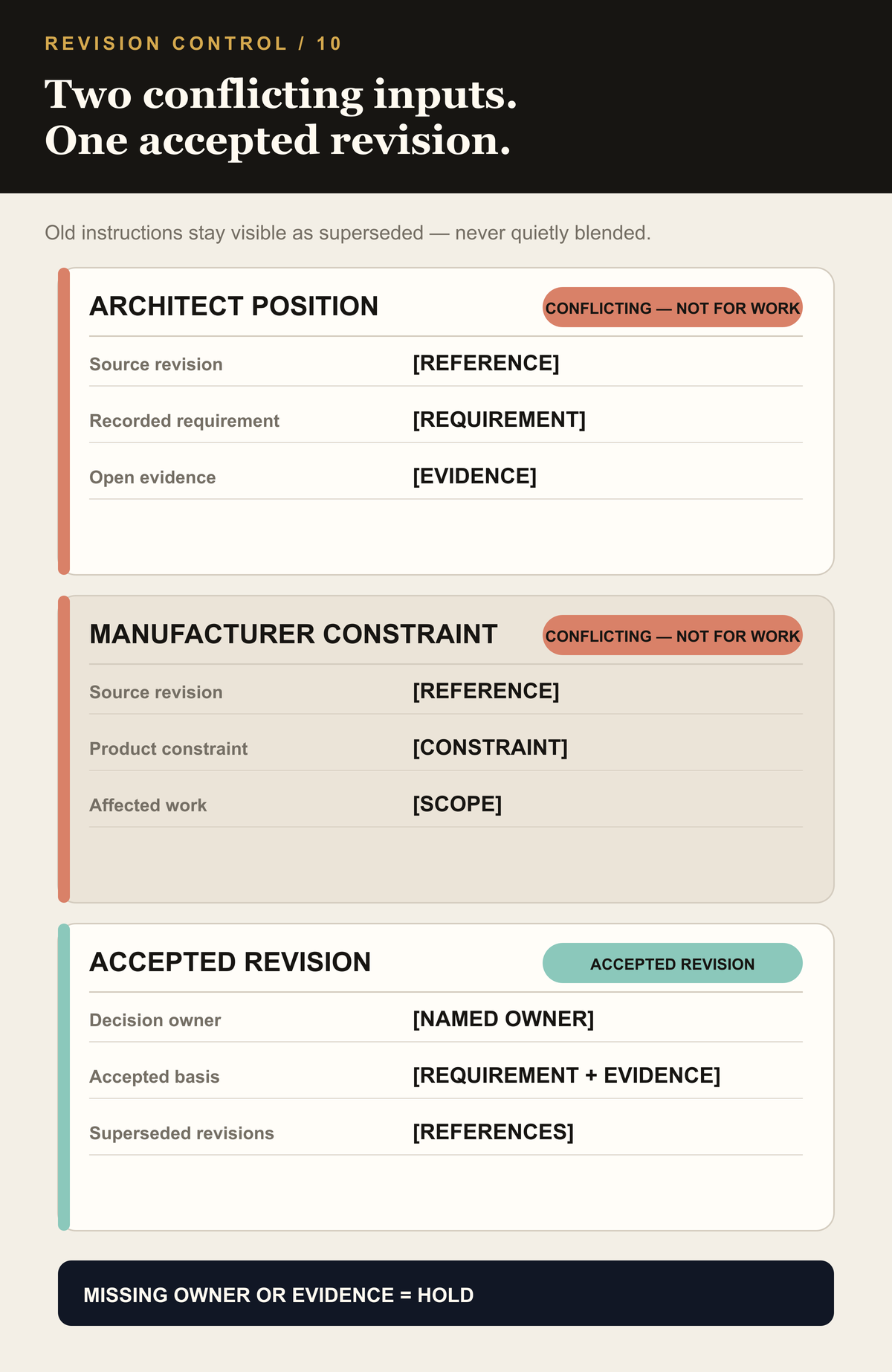
The record keeps both old positions visible as not for work and identifies the accepted revision, owner and evidence. Missing authority or evidence leaves the result on HOLD.
STOP: don't continue affected design, factory or site work while two current instructions conflict, the evidence set is incomplete or the decision authority is unnamed. Resolve and issue one accepted revision first.
Frequently Asked Questions
Should the architect's instruction always override the manufacturer?
No. The answer depends on the architect's appointment, the decision being made and the manufacturer's product constraint. An architect can direct project design within granted authority, but cannot make an unsupported product fact true. The team should test evidence and follow the project's authorised decision route.
Can the manufacturer refuse an architect's requested change?
The manufacturer can state that a requested configuration is unavailable, unsupported or requires another review within its product and factory scope. It should explain the bounded reason and feasible alternatives. The project team then decides the wider design response through the relevant appointments rather than treating refusal as project approval.
How quickly should the disagreement be escalated?
Escalate when the affected release is approaching, evidence is stalled or two instructions remain current. First write the requirement, constraint, evidence gap and requested decision. That preparation makes senior attention useful. Urgency shouldn't justify bypassing competent review or allowing an informal call to become an undocumented revision.
What if both positions appear technically credible?
Ask which option best meets the recorded project requirement within confirmed product and project constraints. Add evidence from every affected discipline, then have the authorised decision owner accept one revision. Credible alternatives are normal. The failure is leaving both active after the project needs one controlled answer.
Does the disagreement log create legal responsibility?
No, because it only records the issue, evidence, reviewers and project decision for co-ordination. It doesn't rewrite appointments, allocate liability or replace legal advice. The contract, appointments and applicable rules control those matters. Use the log to make the decision trail visible, not to invent authority.
1reading
Written by
 Giedrius PatlabaCEO & co-founder, Wood Architects163 pieces · 30 followers
Follow Giedrius to see new posts in your feed, on your phone or by email.