
When Should Your Hotel Override an Automated Sauna Schedule?
Key Takeaways
Override only for a named service need that the approved schedule cannot meet.
Check equipment state, room readiness and local safety conditions before any command.
Give every override an owner, start time, end time and automatic expiry.
Keep safety logic and documented controller limits outside the hotel's scheduling authority.
Record the reason, command result, energy window and hand-back to normal control.
Review repeated overrides as evidence that the base schedule may be wrong.
A late guest request can make an automated schedule feel inconvenient. The dangerous response is to treat an override as a harmless extra hour. We build and factory-check saunas in Klaipėda, so our judgement is simpler: an override is a controlled exception with an owner, an expiry and a witnessed return to normal operation.
When Should Your Hotel Override an Automated Sauna Schedule?
A hotel should override an automated sauna schedule only for a defined service or maintenance need that the approved programme cannot meet, and only when the exact controller documentation permits the requested action. Before the override, confirm room readiness, equipment state, local safety conditions, authority and an end time. Record the reason and command result, then return control automatically to the normal schedule. Repeated overrides are evidence to review the base schedule, not permission to leave manual control open.
What makes an override justified?
A justified override protects a real service decision. It may cover an approved event outside normal wellness hours, a supervised maintenance test or recovery from a verified scheduling fault. “Someone asked” is not enough. The request must identify the sauna, service window, accountable role and reason the normal programme cannot serve it.
The override also needs a clean ending. Write the expiry before the start. A command with no end time is not a temporary exception. It is an undocumented change to the operating plan.
The U.S. Department of Energy's EMIS guidance, checked on 25 August 2026, distinguishes monitoring and fault analytics from supervisory control. It describes supervisory control as the ability to send commands and change schedules, and notes that automated fault detection may identify operator overrides or incorrect sequences. That supports recording overrides as visible operating events. It does not prescribe a sauna schedule or remote-start sequence.
Which checks come before the command?
Use one decision path for every exception. First verify the request. Then verify the asset and room state. Next check the exact controller and safety documentation. Only an authorised operator may issue the command. The system must show whether the command was accepted, rejected or never delivered.
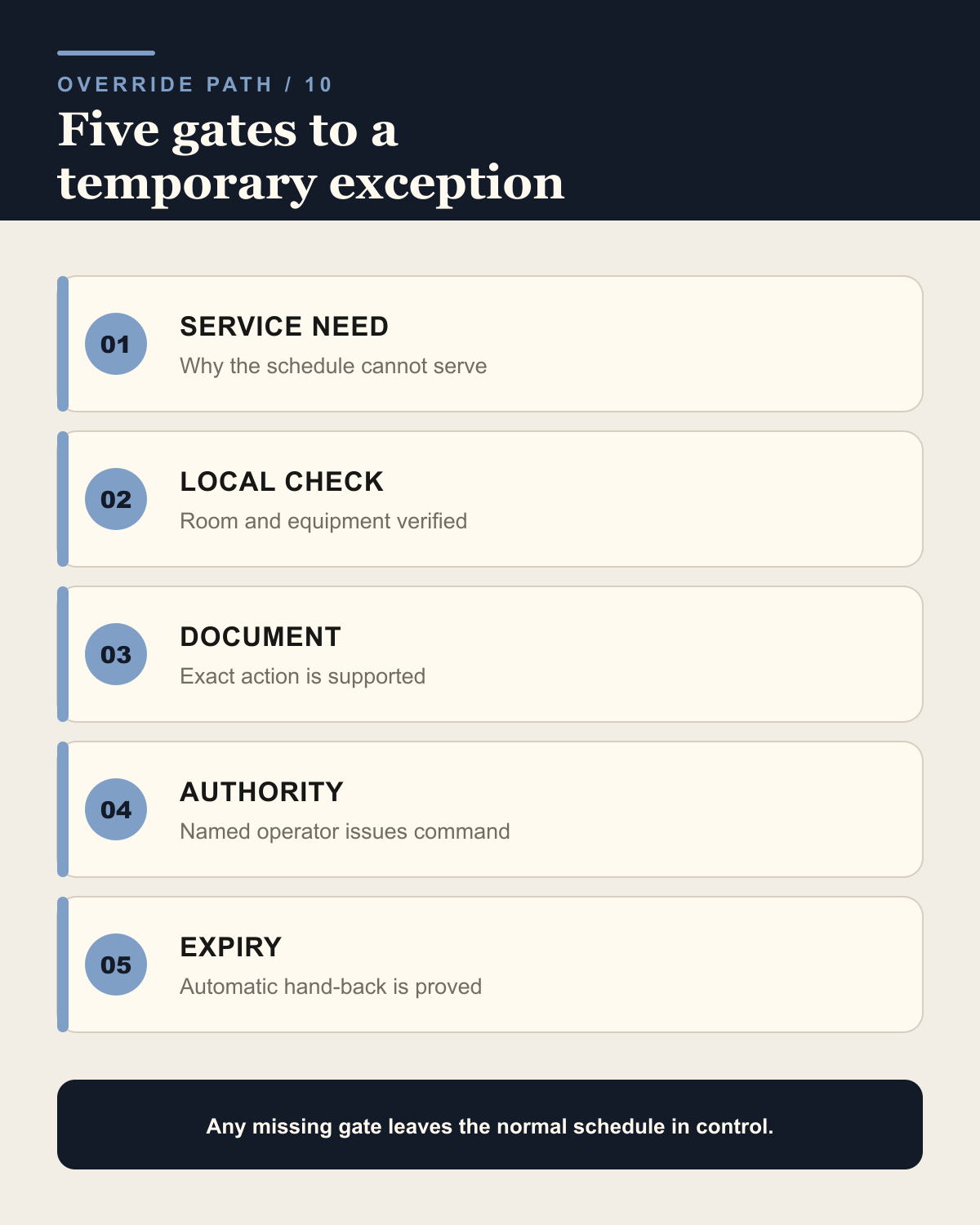
An override proceeds only when the service need, equipment state, authority and expiry are all known. Any missing gate keeps the normal schedule in control.
Use these six fields before action:
“Asset and requested service window: [identifier and times].”
“Reason the normal schedule cannot serve the request: [one sentence].”
“Local room and equipment state verified by: [name and time].”
“Exact controller instruction supporting the action: [document and section].”
“Authorised operator and command result: [name and accepted state].”
“Automatic expiry and normal schedule restored at: [times].”
Controller detail cannot be generalised. Harvia's current Xenio WiFi page describes app functions for product CX001WIFI and says available features depend on connected devices. It does not document a universal hotel BMS command sequence. Its door-switch support material says that arrangement is not suitable for public saunas and points professional use towards the manufacturer's SFE safety device.
The separate Harvia SFE instructions apply to named Xenio, Fenix and VKK equipment and call for installation by a qualified electrician. Those pages establish product-specific boundaries only. They do not justify transferring one controller's remote-use behaviour to another.
The public abstract for IEC 60335-2-53:2011 covers electric sauna heating appliances and refers to electronic interlocks. The public abstract is not detailed enough to design or approve an override sequence. The project needs the applicable full standard, local requirements and exact product instructions.
How should authority and expiry work?
Separate permission to request from permission to command. Reception may record a guest need. Duty management may approve the service exception. Engineering or another authorised role may verify the room and issue the supported command. The access model should reflect those different decisions.
Make expiry automatic where the documented control system supports it. The exception should end at the approved time and hand the asset back to its normal programme. If automatic hand-back cannot be proved, name the person responsible for closing the override and require a readback of the restored schedule.
Never let the scheduling layer bypass local protection. The consolidated Energy Performance of Buildings Directive, checked on 25 August 2026, describes building automation in terms that include monitoring, adjustment, communication and safe operation. It does not turn a building-level optimisation objective into authority to defeat appliance controls.
What should the override record contain?
The useful record joins intention, action and outcome. Save the approved reason and time window. Save the local pre-check and the identity of the operator. Save the command response, schedule state after expiry and the relevant meter window. If data was stale, missing or modelled, label it.
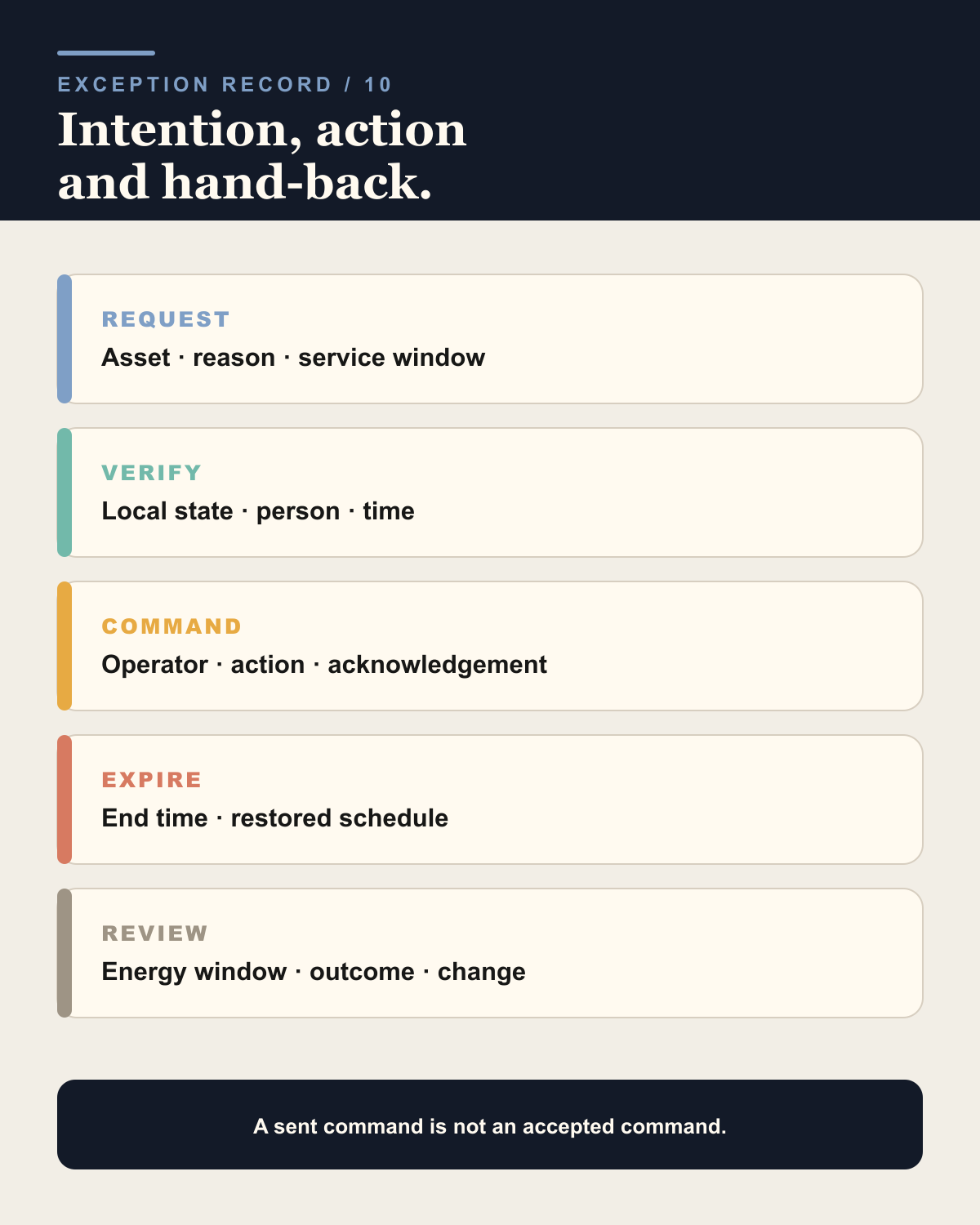
The record makes the exception temporary and reviewable. It links the service reason to the actual command and the return to normal control.
“Override [asset] from [start] until [expiry] for [approved service reason]. [Role] verified the local state at [time]. [Operator] issued [documented command], which was [accepted or rejected]. Normal schedule was read back at [time].”
This wording avoids a common trap. A command that left the BMS is not proof that the local controller accepted it. Capture both states where the equipment and integration provide them. If the acknowledgement is unavailable, record the uncertainty rather than turning it into success.
Keep commercial responsibility visible too. What Does an Insurer Ask Before Covering Your Commercial Sauna? frames the records, ownership and operating controls that sit around the equipment. Scheduling, remote access, commissioning and aftercare should appear as explicit supply boundaries.
When does repetition mean the schedule is wrong?
Review overrides by reason, day, duration, authorised role and service outcome. One approved event may remain an exception. The same late request every Friday is a scheduling input. Repeated maintenance overrides may point to a commissioning, training or reliability issue. Repeated unexplained commands need immediate governance review.
Don't optimise from energy alone. Ask whether the override delivered the intended guest service, whether it started earlier than needed and whether the asset returned to normal control. Compare equivalent service windows before changing the programme.
At the weekly review, choose one of three outcomes: keep the base schedule, amend it through the hotel's change process, or investigate the equipment, integration or procedure. Never normalise an exception simply because staff have become familiar with it.
STOP: don't override when the local state, exact controller support, authorised operator, command acknowledgement or expiry is unknown. Don't improvise a remote start from a generic app page or another product's behaviour.
You don't need a faster override button. Print the six-field record and test one witnessed exception from request to automatic hand-back. If the final schedule cannot be read back, the control loop is not closed.
Frequently asked questions
Can reception override a hotel sauna schedule for a guest?
Reception can capture the request if the hotel's procedure assigns that role. Permission to issue the operating command should remain with the authorised role named in the controls and safety plan. The request still needs a reason, verified local state, supported action, expiry and closure record.
How long should a sauna schedule override last?
There is no universal duration. Set the shortest window that serves the approved need and matches the exact controller's supported behaviour. Define the expiry before starting, then verify the normal schedule after it ends. An open-ended override is a schedule change, not a temporary exception.
Should an override automatically return to the normal schedule?
Yes, where the documented control system supports a tested automatic hand-back. The hotel should still read back the restored schedule and record the result. If automatic return is unavailable, assign a named person and deadline. Never assume a command expired merely because the requested service window ended.
Can a BMS override sauna safety controls?
No hotel scheduling objective should bypass the equipment's documented protection or local safety arrangement. The BMS may only issue commands supported by the exact controller and commissioned design. Product instructions, applicable rules and local protective devices remain authoritative when a scheduling request conflicts with safe operation.
What should a hotel do after repeated schedule overrides?
Group them by reason and comparable service window. Decide whether the base schedule no longer matches demand, staff are using the wrong procedure, or the integration is failing. Change the programme only through the hotel's approved process, with a recorded owner, test and effective date.
1reading
Written by
 Giedrius PatlabaCEO & co-founder, Wood Architects163 pieces · 30 followers
Follow Giedrius to see new posts in your feed, on your phone or by email.