Which EU Liability Rules Apply to Your Sauna After 8 December 2026?

Key Takeaways
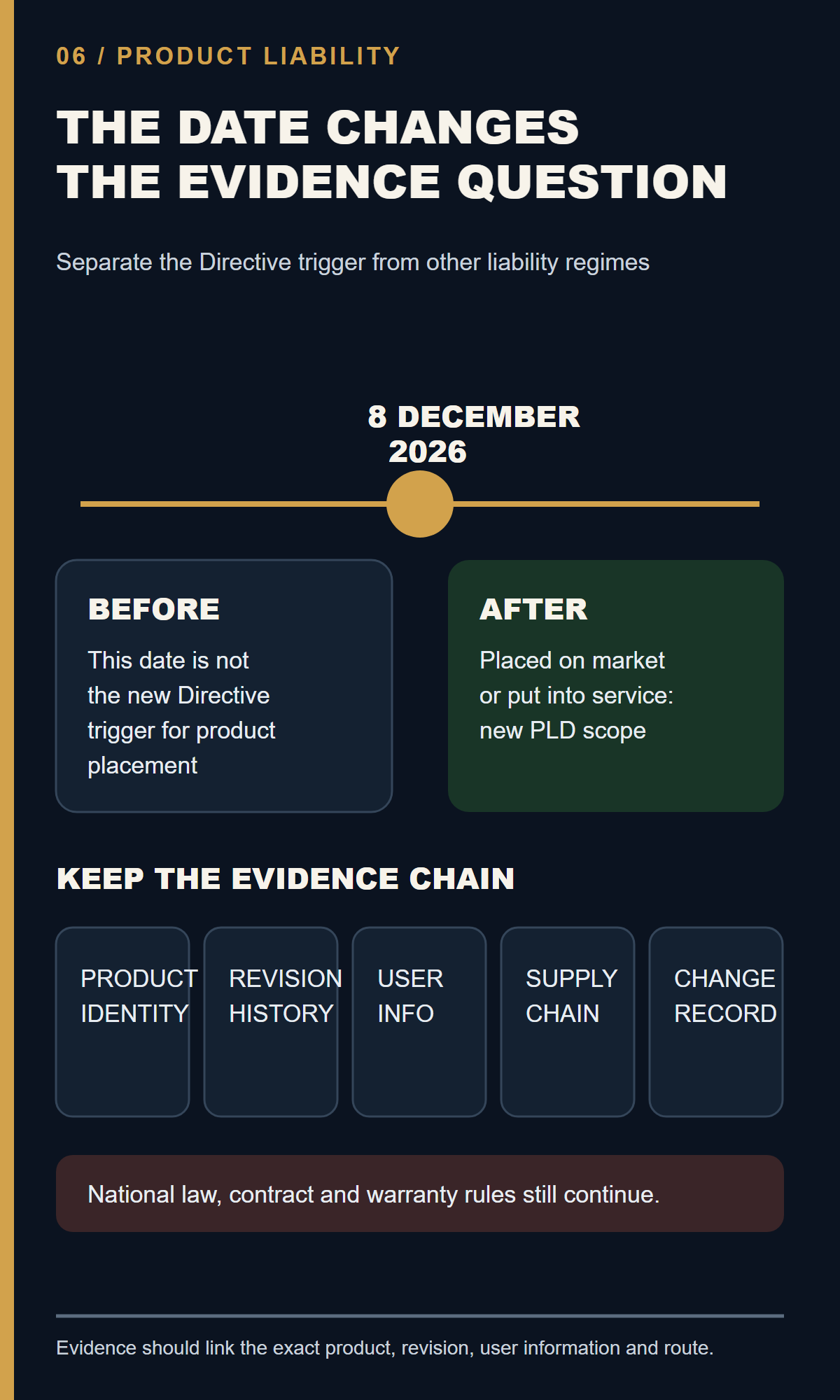
Directive (EU) 2024/2853 applies to products placed on the market or put into service after 8 December 2026.
The older directive continues to govern products placed on the market before that cut-off.
Record the product, component, operator and date that establish which regime applies.
Instructions, safety expectations, foreseeable use and later modifications can matter to defect analysis.
Evidence disclosure and rebuttable presumptions make disciplined product records more important.
The directive does not replace warranties, contracts or national liability procedure.
The December 2026 change isn't a reason to rewrite every warranty. We manufacture completed outdoor saunas in Lithuania, so the useful preparation for us and our partners is a clean, traceable record from product identity to handover and later modification. That's evidence you can retrieve, not a promise you have to reconstruct.
Which EU Liability Rules Apply to Your Sauna After 8 December 2026?
Directive (EU) 2024/2853 applies to products placed on the market or put into service after 8 December 2026, meaning from 9 December. Products placed on the market before 9 December remain under Directive 85/374/EEC. The new directive operates through each Member State's transposing law. It creates a product-liability framework for defective products, but doesn't replace contractual warranties, other national liability claims or existing safety duties.
A 7 May 2026 corrigendum changed Article 2(1) from “after 9 December” to “after 8 December”. Use the corrected cut-off, even if an older summary or uncorrected page still shows the original wording.
Fix the cut-off with evidence, not memory
For each cabin, heater, control system and safety-relevant component, record the product identifier and the date it was placed on the market or put into service. Those terms have legal definitions. They should not be replaced with an informal reference to invoice date, installation date or the day the customer first heated the sauna without checking the facts.
A delivery crossing the cut-off deserves a written classification. Identify the product, the relevant operator, the transaction or first use, and the supporting record. If the facts are unclear, obtain legal advice in the Member State concerned rather than choosing the more convenient date.
Map the responsible economic-operator chain
The new directive identifies potentially liable economic operators within the Union. Depending on the facts, this can include the manufacturer of the defective product, a manufacturer of a defective component, and certain importers, authorised representatives or fulfilment service providers where the manufacturer is outside the Union.
A distributor can also face liability where the claimant asks it to identify the relevant operator and the statutory identification conditions are not met. The practical answer is not to add broad disclaimers. Keep the manufacturer, importer, authorised representative, component and distributor identities traceable for the product actually supplied.
Understand what the claimant still has to prove
The directive keeps the core requirement that a claimant proves damage, defectiveness and the causal link between them. It also introduces rules that can ease proof in defined situations. A court may order disclosure of relevant evidence after the claimant presents sufficient facts supporting the plausibility of the claim. Disclosure must remain necessary and proportionate, with measures available to protect confidential information and trade secrets.
Rebuttable presumptions can apply in circumstances including failure to disclose ordered evidence, non-compliance with mandatory product-safety requirements intended to protect against the relevant damage, or an obvious malfunction during reasonably foreseeable use. Technical complexity can also affect proof where the claimant demonstrates a likelihood of defect or causation. Records need to be understandable, controlled and retrievable, not merely abundant.
Evidence point | Record to preserve | Why it matters |
|---|---|---|
Market or service cut-off | Product ID, operator, date, transaction and commissioning evidence | Supports which liability regime applies |
Product and component identity | Model, serial or batch, bill of materials and supplier identity | Connects an event to the correct economic operator |
Expected safety | Risk assessment, applicable safety requirements, instructions and warnings | Shows the safety context considered when supplied |
Installation and handover | Approved configuration, installer record, tests and documents supplied | Separates product configuration from site work and later changes |
Modification or update | Who changed what, when, why and with whose approval | Helps assess whether a substantial later modification created a new exposure |
Post-market information | Complaints, incidents, corrective actions, notices and recall decisions | Demonstrates controlled response to emerging safety information |
Review safety communication and foreseeable use
Under the new directive, defectiveness is assessed by reference to the safety a person is entitled to expect or that is required by Union or national law. The assessment can include product presentation, instructions and warnings, reasonably foreseeable use, interactions with other products, applicable safety requirements and recall or other intervention by a competent authority.
For a sauna system, check that the handover information matches the actual heater, controls, guards, clearances and ventilation arrangement. Record approved combinations and explain prohibited substitutions clearly. Do not use a warning to excuse a design that should be safer. Do not leave the user to reconcile conflicting manuals.
Treat later changes as their own decision gate
The directive addresses substantial modification of a product outside the original manufacturer’s control. A person who makes such a modification and then makes the product available or puts it into service can be treated as a manufacturer of the modified product for liability purposes.
That does not mean every repair or replacement is substantial. It means changes to heaters, controls, software, protective clearances or other safety functions need a recorded assessment. Define who may approve a change, which evidence must be updated and whether the resulting configuration remains the product originally assessed.
Keep liability, warranty and national procedure separate
The directive is about compensation for damage caused by defective products. It does not replace a commercial warranty or a customer’s contractual rights. It also does not create one identical court process for every Member State. National transposition and procedural law remain essential.
The directive provides a three-year limitation period linked to the claimant’s knowledge of the damage, defectiveness and relevant economic operator, subject to national rules on suspension or interruption. It also uses a general ten-year expiry period, with special provisions for substantial modifications and latent personal injuries. Seek country-specific advice before turning those periods into a document-destruction rule.
Use the official text of Directive (EU) 2024/2853 and the Commission’s product liability policy page as primary references. For an operational perspective after handover, read what sauna manufacturers owe buyers in year three.
Copyable December 2026 readiness checklist
PRODUCT LIABILITY CUT-OFF RECORD
Product and variant:
Serial, batch or other identifier:
Manufacturer:
Component manufacturers:
EU importer or other relevant operator:
Placed-on-market date and evidence:
Put-into-service date and evidence:
Applicable regime conclusion and reviewer:
Safety requirements applied:
Risk assessment version:
Instructions and warnings supplied:
Approved system configuration:
Installation and commissioning record:
Later modifications or software updates:
Complaint and corrective-action file location:
Record-retention decision and national legal advice:
Frequently Asked Questions
What happens to a sauna placed on the market before 9 December 2026?
The new directive does not apply to products placed on the market before its cut-off. Directive 85/374/EEC continues to govern those products. Record the relevant market event and evidence carefully. An installation or complaint occurring later does not by itself move an older product into the new regime.
Does the new directive replace the product warranty?
No. Product liability for damage caused by a defective product is distinct from a commercial warranty and contractual remedies. The directive also preserves other national contractual and non-contractual liability rights within its limits. Warranty wording should therefore be reviewed separately, under the law governing the sale and customer relationship.
Can an EU importer be liable for an imported sauna?
Potentially. Where the product manufacturer is established outside the Union, the directive can place liability on specified Union-based operators, including the importer and, in defined circumstances, an authorised representative or fulfilment service provider. Map the actual supply chain and obtain advice rather than relying on a generic Incoterm label.
Can a distributor be liable if it did not manufacture the sauna?
Potentially. The directive contains identification rules for distributors. A distributor asked to identify the relevant liable economic operator should respond with accurate, traceable information within the legal conditions and deadline. Maintaining current supplier and operator records is therefore a practical control, even where the distributor did not design the product.
How long should product evidence be retained?
The directive’s limitation and expiry periods make long-term retrievability important, but they are not a universal record-retention schedule. The general expiry period can be ten years, with special rules for substantial modification and latent personal injury. Set retention with national legal, tax, safety and data-protection requirements considered together.
1reading now
Get an email when Giedrius publishes