The Shadow Side of the Expertise Altar

A couple of years ago, I delivered a mental health wellbeing-related* talk. In that talk, I shared the then-recent – about two months old – story about my own personal experience of, despite my extended training and my professional/occupational experience, failing to recognise what was happening with me until a trivial almost non-event that prompted my realisation. A realisation that what was happening to me was ‘something to do with mental health.’ The story I then shared isn’t really relevant to what I wish to talk about in this piece, but, for reasons of completeness and fairness to any potential reader’s curiosity, here’s a brief summary:
It was a late Thursday night, and I had a university assignment, of which I had done exactly zero per cent, due at 12pm on Monday. So I cleared my diary, both work and personal, to just get on with it for the roughly 80 hours I had left. For the next 3 days, I would get up around 6-7am, fire up my laptop, open up all the files and folders, and spend the rest of the day scrolling on social media watching resistance to rising oppression videos. Then, come 1-2am, I’d turn everything off, go to bed and then repeat exactly the same sequence the next day. At around 3-4am on Monday morning, with something like 8 hours left until the deadline, I still had zero of the assignment done, so I logged onto my student portal to request an extension. It’s an automated system where one can get a three-day ‘no-real-questions-asked’ extension; the only thing one has to do is give a ‘rough and thereabouts’ reason by choosing from a dropdown menu of potential reasons. It was only when faced with ‘mental health’ among the potential reasons that it dawned on me what has happened to me.
(*I choose this somewhat clumsy, strange and, probably, vague-sounding term – ‘mental health wellbeing-related’ – because ‘on’ or ‘about’ mental health just doesn’t feel right. ‘On’ or ‘about’, to me, sounds as if I’m on the outside of it. An observer; an outsider. When I am not. None of us are.)
Now, going back to the story with which I started, i.e., the talk I delivered. It was received as I intended it to be received; people related and found themselves in quiet thought.
A little later, though, during the informal part of the gathering, someone who I know only wishes well for me whispered in my ear that maybe I shouldn’t share/have shared such a recent story of my own experience. Reason given was that, while lived experience makes the strongest and most relatable stories and that in and of itself my tale was very suitable for my purpose, it was too recent because I couldn’t YET have possibly learnt whatever lessons the experience and overcoming it was meant to teach me to turn them into learning points for others. The person who whispered that to me was a lot more experienced in the ‘speaking industry’ and I knew then and continue to know that, by sharing their feedback, the meant the very best. Not only that, but for the same reasons this person mentioned, I was, myself, unsure about sharing the story all the way up until I shared it on stage. So I took the gently delivered and well-intentioned feedback as learning material.
However, as days went on and I allowed the feedback to sink in, both in intentionally directed ways and subtly, running in the background, I found myself growing vary of it. Not because I didn’t trust the person’s intentions – after all, I was questioning my own decision to use it right until the very end – but because, as I began to recognise, it was in misalignment with my core belief of what helps people become better. Not ‘better at’, but better. As in, what helps people to move closer to the spectrum-line where one end is ‘unwell’ and the other is ‘well’.
In the so-called West, we created the world where ‘expertise’ is THE goal. It’s all very well in some fields. I absolutely want my car to be looked after by an expert mechanic. Ideally, by the very engineers who designed it and built it.
I want my boiler to be installed and maintained by an expert in their field.
My land (if I had land) to be assessed by an expert surveyor before I start building my house designed by expert architects.
An expert lawyer if their respective area of law, if I ever needed one. However, here, with what I am to ponder on soon, I feel I need to add a clause of ‘expert lawyer within their jurisdiction’, given that law is far from universal and can be very different within states/countries/jurisdictions.
I cannot overstate how much I value and admire expertise.
However…
Expertise has its shadow side. Maybe not in and of itself, but the public narrative around it does.
Most of us grew up in societies where expertise is talked about in such a way that it becomes revered and an ‘ultimate goal’ to strive towards. It is an admirable goal to have (similarly, to have DIFFERENT goals that do no harm is equally admirable).
It is the reverence part that I believe to be the shadow of ‘expertise’.
Somewhere somehow along the journey of our ‘socialisation into’ the cultures, societies and systems in which we are born and grow up where expertise is mostly unconditionally revered, we give away our own power to it. As cheesy and as woo as ‘our power’ may read, in the end, it is that very thing. We can choose to call it by different names. In fact, I, too, prefer to call it ‘trusting ourselves’.
We lose balance.
And by losing the sight of balance – a part of me wants to say ‘when balance is taken from us’, but I don’t think a blame-game would be of any use – we lose our innate ability to trust our own experience and to interpret and analyse our experiences within our subjective historical and concurrent circumstances.
It slowly erodes.
It slowly fades.
Wellbeing spaces are among those where this becomes apparent.
A friend of mine once said to me that the reason why they pulled out of psychotherapy was because, ‘Well, it was good to offload and talk and all that, but they didn’t really give me any advice.’ It was interesting to observe how differently we – I and my friend – perceived the role of the therapist. As someone who’s been in the wellbeing space for nearly two decades, I’ve known for a long time that most of the modern schools of thought on therapeutic approaches share this very principle, i.e., not to give advice. Because how can we give advice? We aren’t experts of the person’s life circumstances? Might be a simplified example, but what if I advised someone to take an hour a day to meditate because it ‘will do good for them’ (and it might if the circumstances were conducive to it) while they are a single parent to three young children and working 60 hours a week to keep the roof above their head? What if I advised someone how to respond to their toxic-sounding boss who is not receptive of critique, even if it’s constructive and delivered in an appropriate way, and then the person I advised loses their job? What if I advised someone to look at their grief through a different metaphysical lens which may be alien to them? Apart from the fact that advice, however well intentioned, may lead to further harm, it also undermines and underestimates person’s own resourcefulness and power to arrive at a place where they begin to trust themselves again. It may end up disempowering the person yet further. Furthermore, steering someone in the direction, intentionally or not, to become dependent on the therapist/coach/helper, etc.
I, too, had clients who would ask, ‘What should I do?’, and me reminding them that I am not an expert of their life’s circumstances doesn’t always go down well. Some would not return. Those who would, though, after a while would begin to notice their own confidence and trust in themselves grow.
Similar relationship between reliance on ‘expertise’ and (dis)trusting in the Self can also be observed in many other spaces, from physical health to spiritual quests.
Many years ago, I worked as a support worker in community care, and I would see so many people who would take numerous tablets without knowing what they were for. Without being aware of potential side effects. Without knowing if they’re helping. In my view, it is a complete surrender of one’s own agency to someone and/or something external; someone that aren’t ourselves. And by saying that, I am not dissing the medical approach. Many of my loved ones would either not be here or would be living a considerably worse quality of life, if not for the advances in medicine.
What I am arguing against is our complete surrender and sacrifice of our own agency on the shadowy side of the expertise altar.
*
I am often guilty of forgetting to tie things up, so I best return to the story with which I began, so not to leave it hanging the with no purpose.
I considered the well-intentioned advice not to use stories of my own experiences that are too recent, if I wanted to position myself as an expert in the field. I ended up rejecting it. But I am not any less grateful for it. I am grateful for the well-meaning intention, and I am grateful for the food for thought that is lasting me as long as to prompt this very reflection all these years on.
I rejected it because I do not want to ‘position myself as an expert.’
In the space in which I find my calling, there are no experts. There are equals that hold different knowledge.
I hold the knowledge of my ‘tools of the trade’ and the skill to really listen and notice, and the person in front of me hold the knowledge of how, if at all, the tools I have to offer fit in their life’s circumstances at any given time.
It is a collaboration of equals, not a dynamic of expert-recipient of expertise.
I strongly believe that that is the only sustainable way to help people to unlearn learnt helplessness and reacquaint with their own power and trust in themselves without developing further dependencies.
And to make sure people feel equals, I will continue to tell recent stories of my own imperfect humanity.
Because by projecting an expert vibe will not build safe and empowering spaces where people can regain their trust in their own agency.
Because I am no expert of another’s life. The only thing I have is tools and practiced skills that another may not have currently have. Same as another has tools and skills in some other area of life which I don’t have.
To end, I wish to share an extract from the late Tav Sparks’ book ‘The Power Within’:
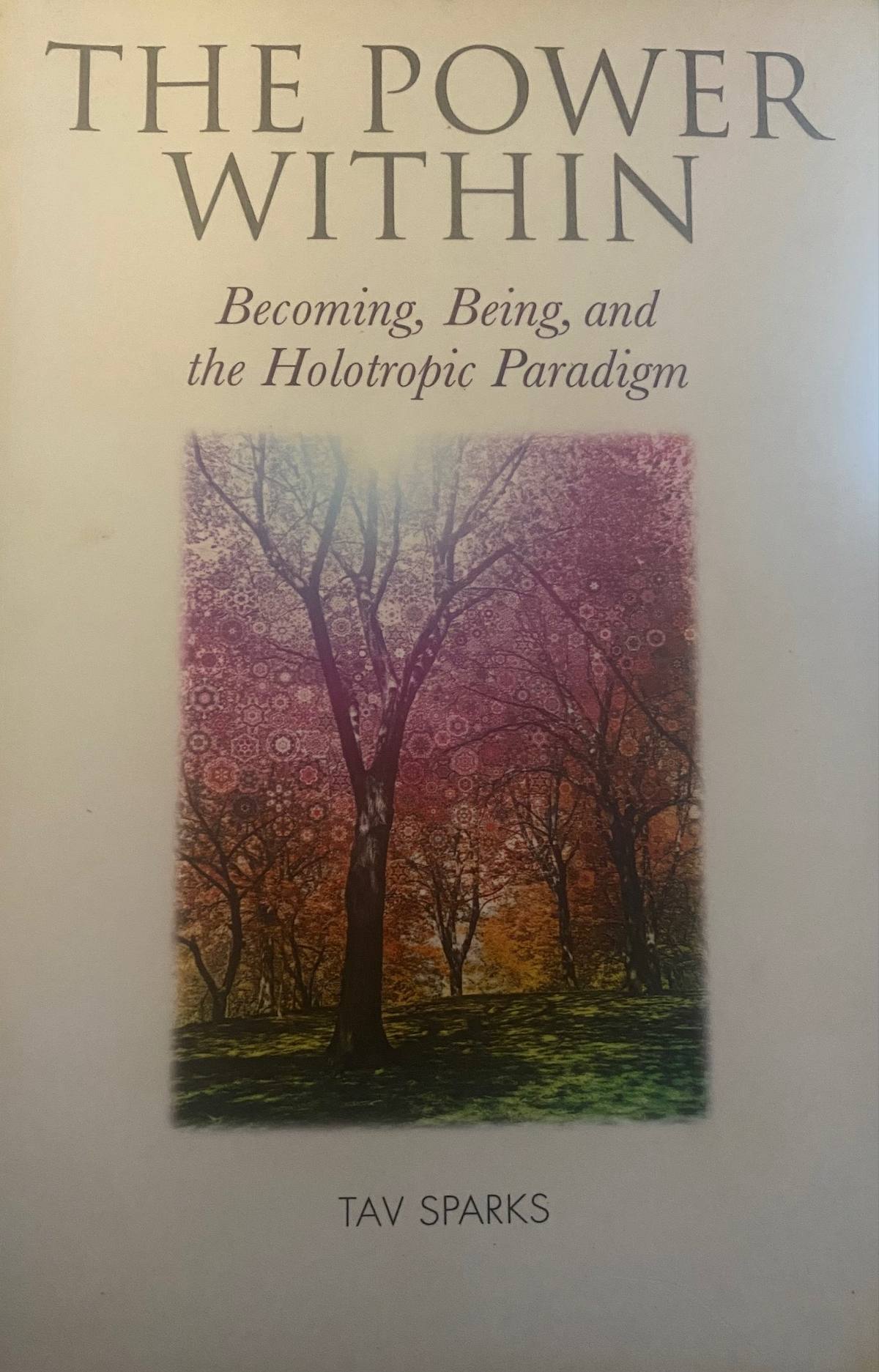
‘There may be millions who are ‘on the fence’ or ‘on the cusp’ of powerful internal change. For these seekers, it may be that research is the critical jump-start they needed to begin the inner journey. People will often read or hear about the so-called ‘groundbreaking’ research, ‘proving’ that a certain theory is the final word of truth. Unfortunately, for many, theories can actually attain a false aura of irrefutable validity. These ‘facts’, which almost always turn out to be, in truth, nothing more than metaphysical assumptions, can tragically create a disempowering reliance on co-called external experts.’ (pg. 15)
I invite readers to not give your agency away too easily.
*
Subscribe using the bell button under the cover picture for an occasional digest sent straight to your inbox.
1reading now
Watch & subscribe
Lina Jan also publishes on YouTube
18 subscribers
One click subscribes you on YouTube - you stay here on PUBlish.
Get an email when Lina publishes