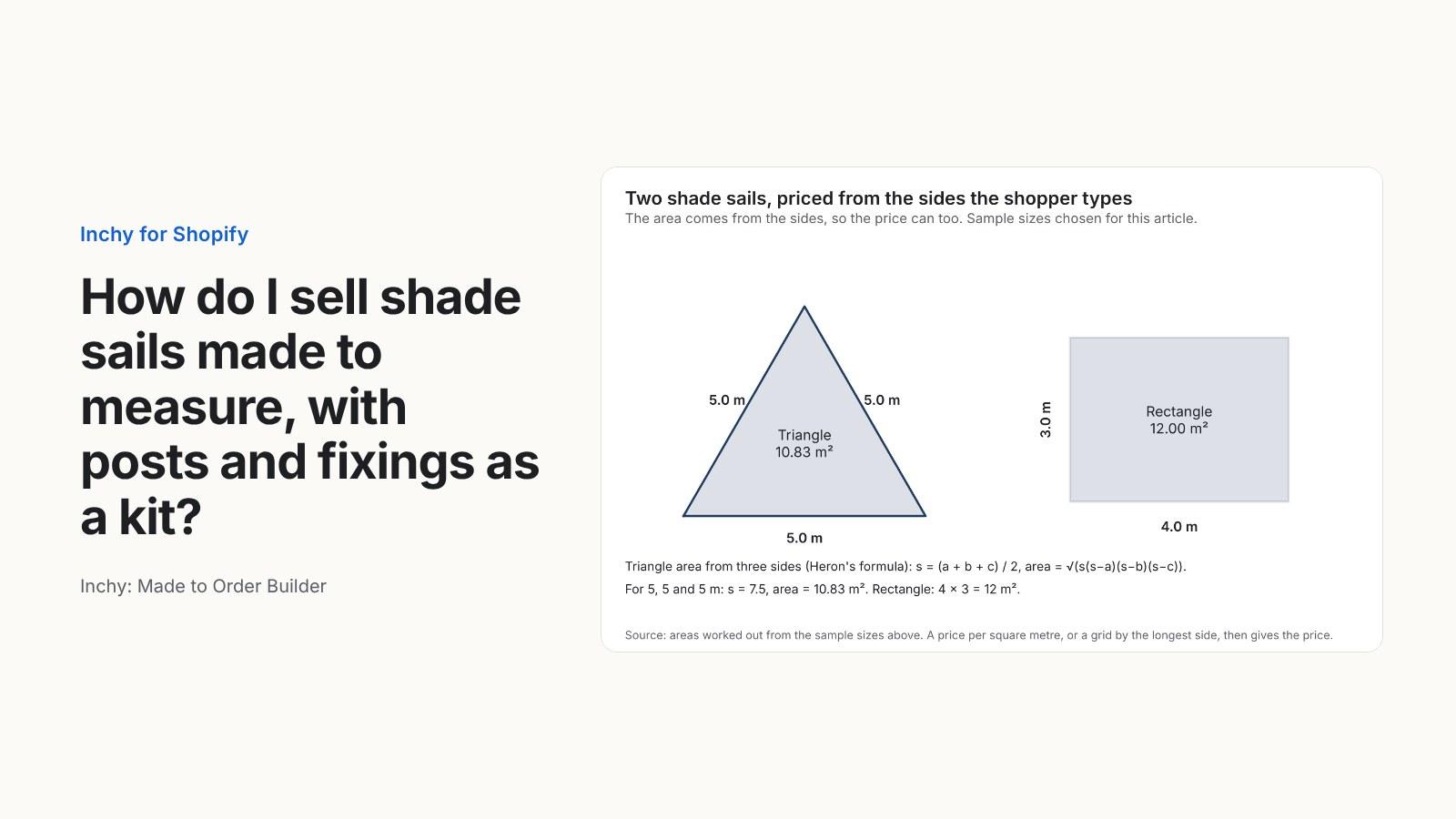
How do I sell shade sails made to measure on Shopify, triangles and rectangles priced by their sides, with posts and fixings as a kit?
A shade sail is sold by its sides. A triangle has three, a rectangle has four, and the customer measures them on their own patio. Global Market Insights valued the shade sails market at USD 1.84 billion in 2023 and expects USD 3.51 billion by 2032, yet most shops still sell sails as a short list of stock sizes and send everyone else to an email address.
How do I sell shade sails made to measure on Shopify, triangles and rectangles priced by their sides, with posts and fixings as a kit?
Make one product for each shape. Let the shopper type the sides, work the area out from them, and price the sail from your own list, either by the square metre or from a grid by the longest side. Set the smallest and largest sides you will make, so odd sizes go to a quote. Then sell the posts, fixings and turnbuckles with the sail as one kit at one price. Inchy, a Shopify app for made to measure outdoor shade, does this on the product page and charges the same price at checkout.
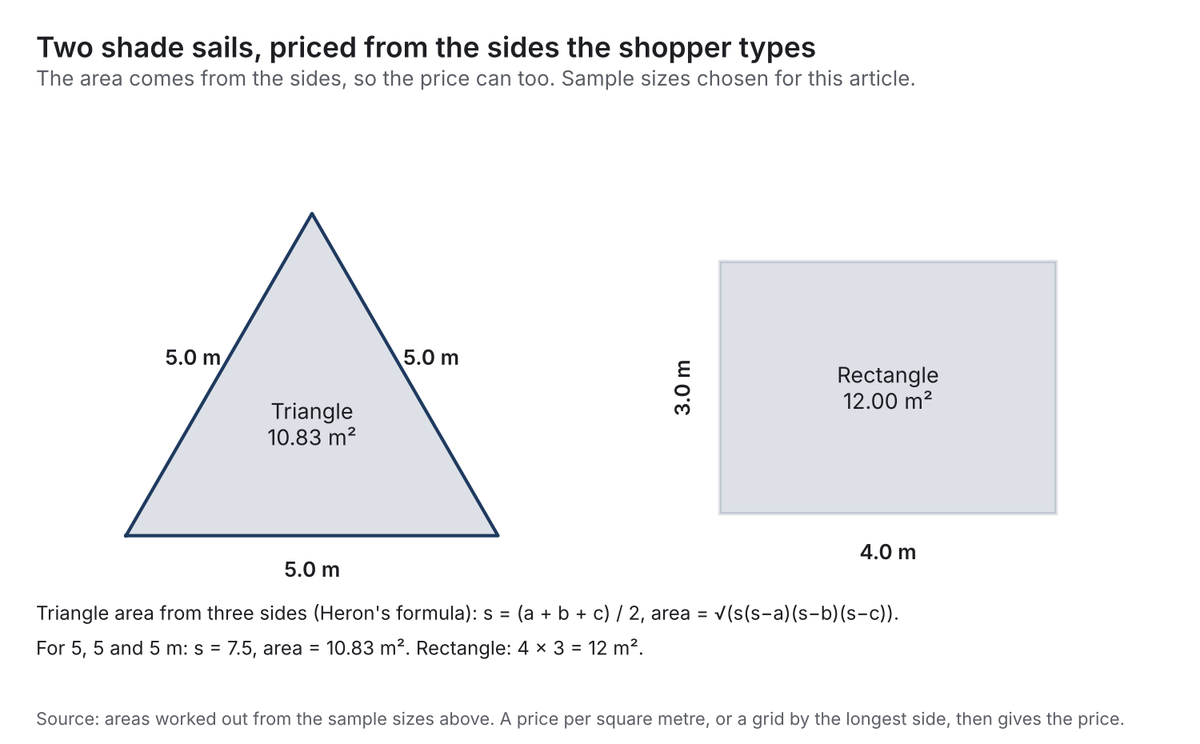
The area comes from the sides the shopper types. Sample sizes chosen for this article.
Why are shade sails harder to list than awnings?
An awning has two numbers, width and projection, and a price grid handles it, as explained in how to sell made to measure awnings and charge the exact price for each size. A sail has three or four numbers, and they do not have to match. A triangle of 5, 5 and 5 metres and a triangle of 3, 4 and 6 metres are both real orders, and they need different amounts of cloth, different edge lengths and different corner hardware.
Shopify variants cannot carry that. Shopify's Help Center says a product can have up to 2,048 variants and up to three options. Three sides in half metre steps from 2 to 7 metres is 11 values each, or 1,331 triangles before a colour is chosen. Four sides on a rectangle, plus colour, plus the kit, and you are past both limits with nothing to show for it.
How do I price a sail from its sides?
Use the way you already price in the workshop. Most sail makers do one of two things.
- Price per square metre. The area of a rectangle is width times depth. The area of a triangle comes from its three sides with Heron's formula: add the sides, halve the total, and take the square root of that half times its difference from each side. For 5, 5 and 5 metres that is 10.83 square metres. For 4 by 3 metres it is 12 square metres. A price per square metre, with a minimum charge for small sails, then gives the price.
- Price by the longest side. A grid with the longest side across the top and the shape down the side. The customer's longest side goes up to the next column, the same way an awning width goes up to the next column.
Inchy takes both. You paste a grid from a spreadsheet, or set a price per square metre or per metre, and set the smallest and largest sizes. The shopper types the sides in centimetres, millimetres or inches, and the price updates as they type. Which price rule fits which product is a question for each shop, and the grid is usually the one the workshop already trusts.
What goes in the kit?
A sail on its own is not an installation. The customer needs something to fix each corner to. Depending on the garden that is a wall plate, a post, or both, and each corner wants a turnbuckle or a strap to tension it. Sold as separate products, the customer has to work out how many of each to add, and gets it wrong. Sold as a kit, they do not have to think.
A kit is the main product plus its add-ons, sold as one thing at one price. For a triangle sail that could be the sail, three fixing points, three turnbuckles and the stainless screws. For a rectangle, four of each. A post is an add-on with its own price, chosen by number: one post, two posts, three. The price of the kit is the total of the parts, less whatever saving you want to give, and the shopper sees the kit price next to what the parts would cost on their own.
In the Inchy demo the same idea is shown on an awning. The "Evening comfort pack" is LED lights at £149.00 plus a winter cover cut to the chosen width, 15% off the pair. At 420 cm wide the pair would be £241.40 separately and the kit is £205.19.
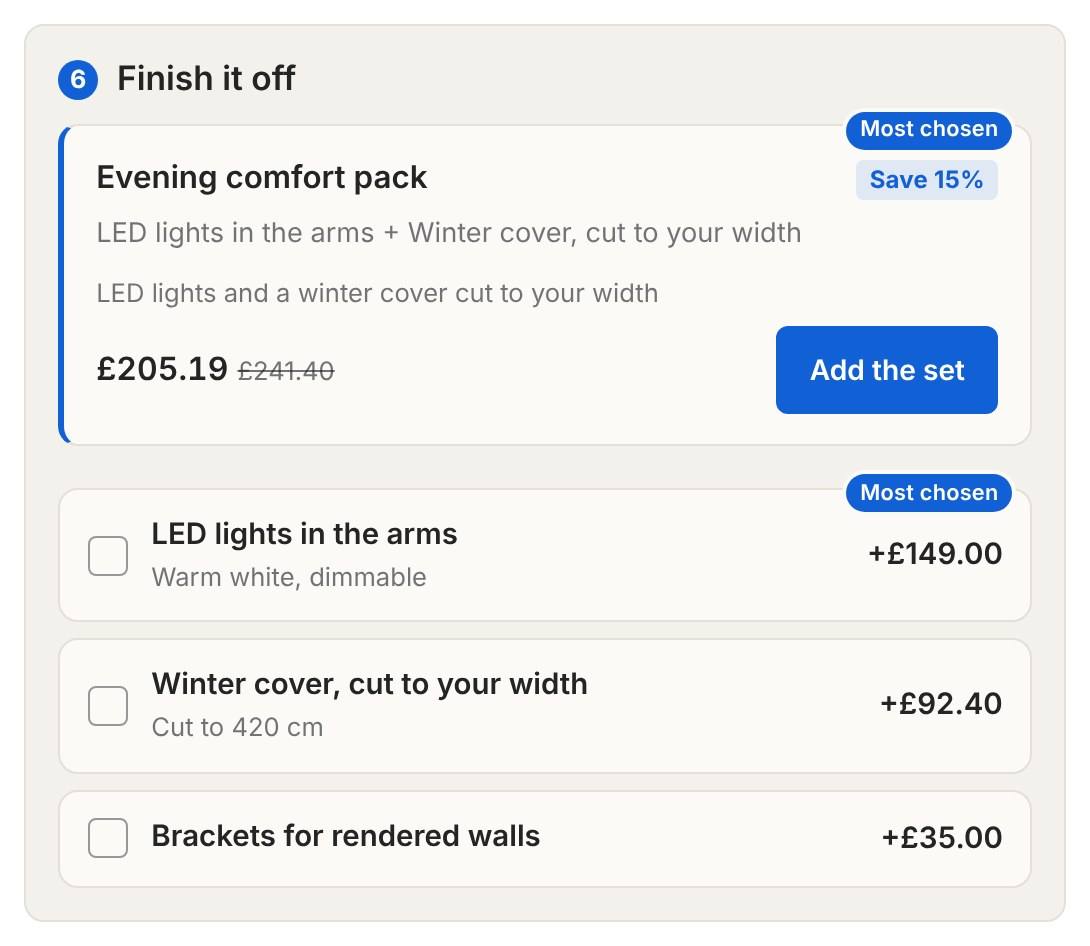
Note what the winter cover does. It is cut to the awning's width, so its price moves with the size, and the kit price moves with it. A sail kit works the same way: the sail is priced by its sides, the hardware is a fixed price per corner, and the kit adds them up for that exact sail. How to price add-ons like a motor or a winter cover explains the add-on rules in detail.
What about sizes you do not make?
Set a smallest and a largest side for each shape. Inside those limits the shopper buys. Outside them the builder shows the limit under the field, clears the total and will not add the product to the basket. In the demo awning, typing 700 cm shows "Width can be up to 600 cm" and the note "This size is made to order. Send us the details and we will quote you."
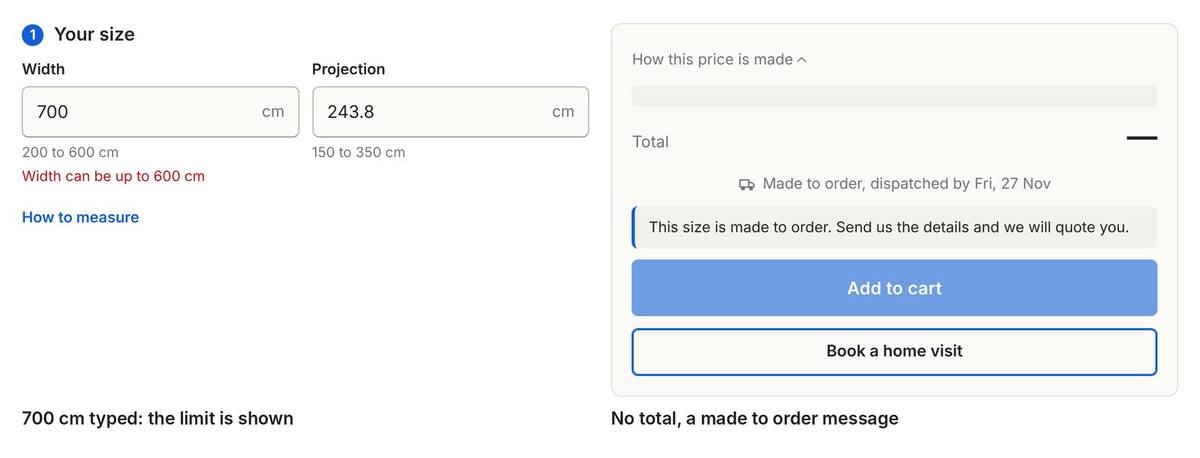
For sails this matters more than for awnings, because a 9 metre side may need a different cloth, a different hem and an engineer's opinion on the posts. Orders above an amount you set can go to a quote form instead of the basket, and the request reaches you with every side in it. How to handle quote requests for big made to measure jobs covers that flow.
What should the product page show?
Keep it to what a buyer on a patio needs.
- One field per side, with the smallest and largest size printed under it.
- A "How to measure" note: measure from fixing point to fixing point, and allow room for the tensioning hardware at each corner.
- Cloth colour as swatches, with a sample button.
- The kit shown with its parts and its price, and the posts as a numbered add-on.
- A price breakdown, so the customer sees the sail, the hardware and the posts as separate lines before they pay.
Inchy draws awnings and t-shirts. For sails it shows your own photo for each colour and option instead of a drawing, and everything else, the fields, the limits, the kit and the breakdown, works the same way.
What happens after the order?
Every side, the colour, the kit and the number of posts land on the Shopify order as line item details, so nobody copies them into a cutting sheet by hand. Inchy adds a production sheet to Shopify's Print menu with the sides listed and boxes to tick, and a daily work list of every sail still to make. The checkout works the price out again from your rules, so the customer pays what the page showed.
Questions and answers
Can the shopper type the sides in feet and inches?
In inches, yes. Sizes can be set in centimetres, millimetres or inches, and the demo awning lets the shopper switch between centimetres and inches on the page.
Can I charge more for a larger triangle than the area suggests?
Yes. Use a grid by the longest side instead of a flat price per square metre, or add a percentage above a certain size. Options can add a fixed amount, an amount per metre or square metre, or a percentage.
Can posts be priced by height?
Yes. A post can be its own made to measure product priced by the metre, or a set of fixed options such as 2.5 metre and 3 metre posts at set prices.
Do I need the Made to measure plan?
Yes. Anything priced by a size the shopper types is on the Made to measure plan at $99 a month, which includes every look and style and Bundle kits, with unlimited products. There is a 7-day free trial.
Who makes Inchy?
InterioApp. We have priced and sold made to measure products since 2011, in our own shop first, and our quoting software and calculators are used by made to measure businesses in the UK, Europe, Australia and New Zealand.
If you make shade sails, set up one triangle with your own price per square metre and your corner kit, and try it on your own product page. See Inchy and try the live builder. Start the 7-day free trial on the Shopify App Store.
Sources
- Global Market Insights, Shade sails market: USD 1.84 billion in 2023, USD 3.51 billion forecast for 2032.
- Shopify Help Center, Adding variants: up to 2,048 variants and up to three options per product.
- Inchy live demo: size limits, messages, the Evening comfort pack and sample UK prices at 420 cm, read on 1 November 2026. Sail areas (10.83 and 12 square metres) and the count of 1,331 triangles worked out from the sample sizes in this article.
Written with AI. Every figure is checked against the sources listed above.
1reading now
Written by
 Inchy: Made to Order Builder for ShopifyShopify app21 pieces · 6 followers
Follow Inchy: to see new posts in your feed, on your phone or by email.
- views