What if 'magic doesn't exist' was never true?

I find myself using the word ‘magic’ to describe how some things feel for me more and more. It probably sounds trivial to some and goes right over their head, and exaggerated to others, potentially jarring them somewhat.
However, despite my anticipated (or maybe projected, I don’t know) effects on other people of me using this word, I feel I must stay faithful to myself and, when the experience is such that I lack words that would do justice to what I feel, I will continue using it.
I do not use it lightly. When I say ‘magic’, to me, something really FEELS* like what I have learnt magic to FEEL* like.
Do you remember that feeling you’d get when, as a child, you’d read – or have read to you – stories where magical things were happening? Or descriptions of places where fairies would hang out? Or some supposedly supernatural happening would take place?
Do you remember that feeling? That quite literally felt lightness in your head, expansion of the chest when you hold your breath? The somewhat visceral pull towards it? The almost-impossible-to-contain all-body desire to experience and witness those things?
These are the feelings and sensations that cause me to use the word ‘magic’ to describe something I experience or witness.
I suppose, it is the word I reach for when I feel a pleasant overwhelm by what I am experiencing. When my body is trying to contain all those sensations and feelings, and feels like it’s approaching a bursting open point.
It’s a beautiful experience to behold.
*Note that I stress the word 'feels'. Because, I'd argue, magic lives less in the happenings and more in how our relationship with whatever is happening or whatever we are observing FEELS like to us. Hence, we can choose to FEEL it.
Magic is a relational phenomena.
*
I guess the closest feeling of that which I refer to as 'magic' but which is generally more accepted as 'legit' is the feeling/emotion of AWE.
Below, are a few dictionary definitions of awe:
'a feeling of great respect sometimes mixed with fear or surprise' (Cambridge Dictionary)
'an emotion variously combining dread, veneration, and wonder that is inspired by overwhelming greatness (as in beauty, power, or size)' (Merriam-Webster Dictionary)
'the feeling of respect and amazement that you have when you are faced with something wonderful and often rather frightening' (Collins Dictionary)
The one that speaks to me the most and feels the richest and, therefore, the closest to the feeling of magic, is the definition by Merriam-Webster.
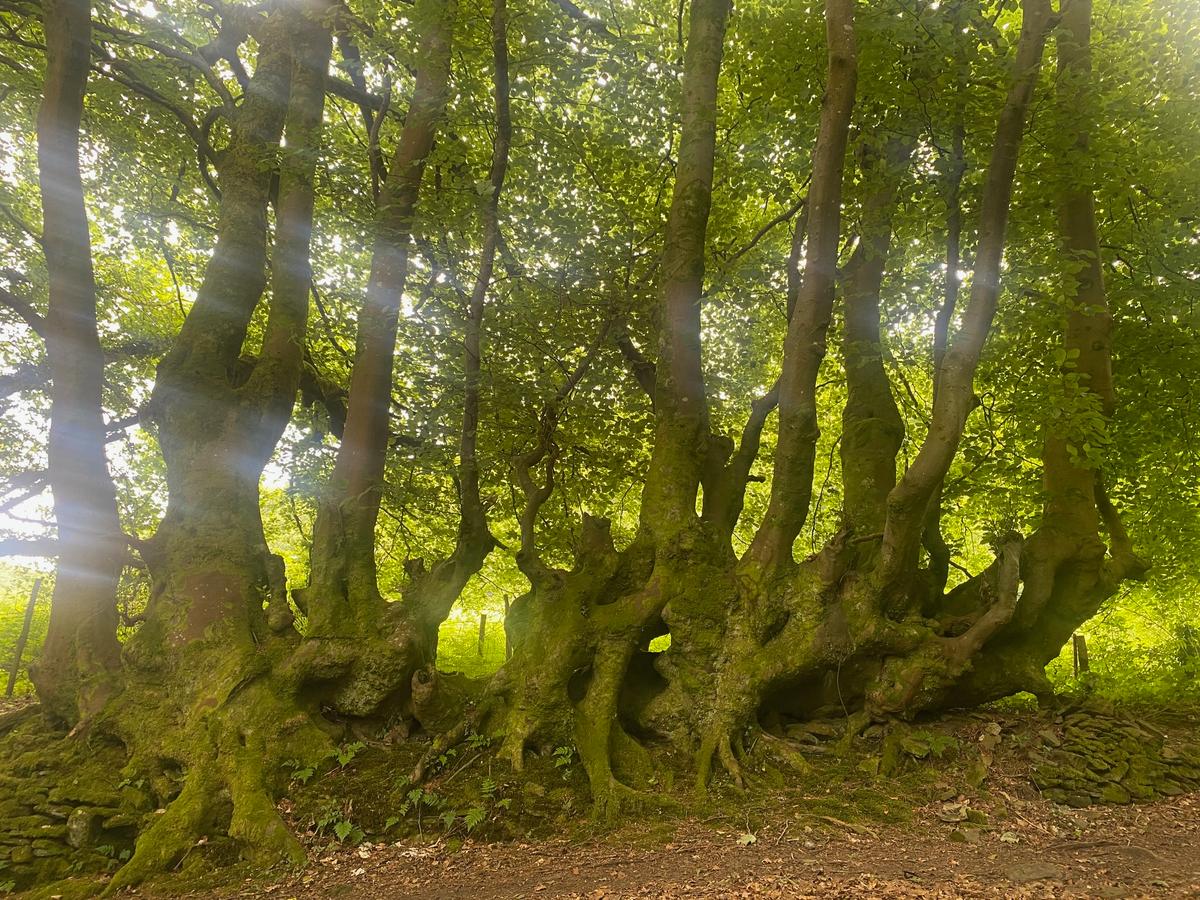
It's that feeling we get when we are encounter something - a view from a mountain top when it finally opens up, the incredibly beauty and craftsmanship of a chapel's ceiling, the few hundred years old tree breaking the sunrays with their canopy illuminating the ground underneath with all sorts of mosaic shapes and sparkles; the list is endless and subjective - that is bigger than us. That feeling that temporarily pulls us out of our head that is full of seemingly relentless and unforgiving worries and anxieties, and reminds us just how little and insignificant we are in the big scheme of things. That feeling that sometimes suspends us in a position of craned neck, open mouth and forgetting to breath in.
That feeling that, most likely, led to the word 'breathtaking' being coined in the first place.
*
The necessary prerequisite for experiencing awe is that we encounter whatever has the potential to give us this beautiful feeling by surprise. Therefore, setting off to find the feeling of ‘awe’ is often futile. Because, by implication, getting too hung up on looking for that something that would give us that feeling is futile and even counterintuitive as the fact that we planned for it makes us somewhat less capable of encountering a surprise. Not fully incapable – the possibility is never zero – but makes it a hell of a lot harder. One mechanism that pops to mind – although, this is just me entertaining ideas rather than claiming to know universal truths – is that planning and actively scanning for something is a cognitively heavy task that narrows our view. When our view is rigidly narrowed, we rarely register what’s in the periphery. And it is in the periphery that surprise often lives.
I’d argue that the same mechanism is at play when it comes to our capacity to experience the feeling of magic.
Therefore, the only conclusion I can come to is that capacity that we may wish to develop is that for openness and for becoming comfortable with uncertainty. With orderly, yet uncontrolled, chaos.
Not to mention how lighter the feeling and capacity for noticing then starts to accompany our daily lives.
It’s precious.
*
I will continue using the word ‘magic’ because it’s the closest I’ve got to try and convey the experience.
I can only hope that, instead of feeling jarred, next time an opportunity presents itself , you remember to choose to notice magic that is always all around us.
*
Subscribe using the bell button under the cover picture for the weekly digest sent straight to your inbox.
1reading now
Watch & subscribe
Lina Jan also publishes on YouTube
18 subscribers
One click subscribes you on YouTube - you stay here on PUBlish.
Get an email when Lina publishes