Must Your Supplier Disclose the Treatment Used on Sauna Timber?

Key Takeaways
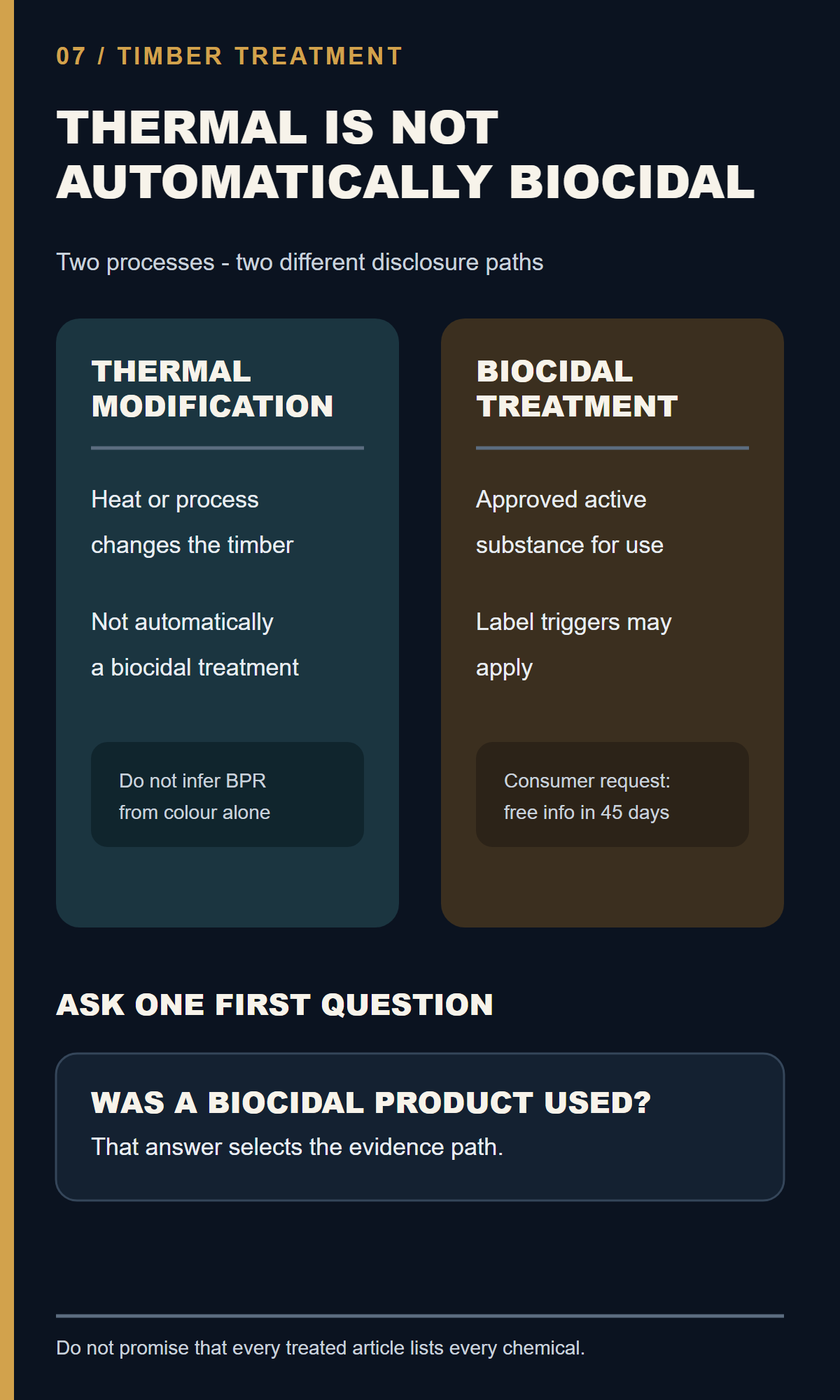
First identify whether the timber was treated with or incorporates a biocidal product.
A biocidal claim or an approval condition can trigger treated-article labelling.
The label is conditional, not a universal list of every chemical used.
An EU consumer may request information on the biocidal treatment free of charge within 45 days.
Thermal modification is not automatically a biocidal treatment.
Ask for the process, purpose, active substance and evidence separately.
“Treated timber” can describe heat, a coating, a preservative or several processes combined. Those routes do not create the same disclosure duties. At Wood Architects, we manufacture outdoor saunas in Lithuania, so I start by separating what physically happened to the timber from what the Biocidal Products Regulation requires a supplier to disclose.
Must Your Supplier Disclose the Treatment Used on Sauna Timber?
Sometimes, but not through one universal chemical list. Under the EU Biocidal Products Regulation, timber treated with or incorporating a biocidal product may require a label when a biocidal property is claimed, when the active-substance approval requires one, or when information is needed to protect health or the environment. An EU consumer may also request information about the biocidal treatment, free of charge, within 45 days. First establish whether the process was actually biocidal.
Start with the treatment mechanism
The decisive question is not whether a sales page calls the wood “treated”. It is whether the article was treated with, or intentionally incorporates, one or more biocidal products. The European Chemicals Agency's treated-articles guidance uses that regulatory definition and places responsibility on manufacturers and importers that put such articles on the EU market.
A preservative applied to control fungi or insects can bring the timber within that framework. Heat treatment without an intentionally applied biocidal product is a different mechanism. Therefore, thermally modified timber is not automatically a treated article under the biocides rules. Do not infer the legal category from colour, odour or the word “Thermowood”. Ask what was done and for what purpose.
Our separate Thermowood comparison for outdoor saunas deals with material selection. The present check is narrower: what treatment information should accompany a particular timber component?
When does the EU label need treatment details?
The European Commission's treated-articles page explains that a label is required when the manufacturer makes a claim about biocidal properties, when the approval of the active substance requires labelling, or when protection of humans, animals and the environment makes precautions necessary. That is why “every treated board must list every chemical” is too broad.
Supplier statement | Next question | Evidence to obtain |
|---|---|---|
“Thermally modified” | Was any biocidal product also applied? | Process declaration and finish schedule |
“Preservative treated” | Which biocidal product and active substance were used, and for which purpose? | Product identity, use description and applicable label |
“Mould resistant” | Is this a biocidal property claim? | Claim wording, supporting treatment record and label decision |
“Protected for exterior use” | Is protection achieved by design, coating, modification or a biocide? | Layer-by-layer treatment specification |
No treatment disclosed | Has the supplier confirmed untreated status in writing? | Signed material and process statement |
What information must a triggered treated-article label provide?
Article 58 of Regulation (EU) No 528/2012 sets the legal frame. Where labelling is triggered, the label must provide a statement that biocidal products were incorporated, the attributed biocidal property, the names of active substances, any relevant nanomaterials followed by “nano” in brackets, and any relevant instructions for use including precautions.
Read that list conditionally. It does not mean each piece of treated timber always carries an exhaustive chemistry dossier. The correct label content depends on the trigger and the treatment. Other EU regimes may create separate duties, including REACH communication for Candidate List substances. Keep those assessments separate rather than merging every 45-day rule into one promise.
The consumer right under the Biocidal Products Regulation is specific. On request, a supplier must provide an EU consumer with information on the biocidal treatment of the treated article within 45 days and free of charge. It is not a general business-to-business deadline for every technical document.
Use one copy-ready information request
Send the request before the timber schedule is frozen. It should ask for facts without assuming that a preservative, safety data sheet or label is mandatory in every case.
Copy-ready treated timber request
Project and component: [PROJECT / TIMBER PART].
Please state whether this timber is untreated, thermally modified, coated, treated with a biocidal product, or subject to more than one process.
For each process, provide its commercial name, purpose, application stage and responsible supplier.
If a biocidal product was used, identify the product and active substance, the intended protective function, and the relevant product type or use.
Confirm whether Article 58 labelling is triggered by a biocidal claim, an approval condition or a necessary precaution.
Provide the final label and safe-use instructions where applicable.
Confirm the contact route for a consumer information request under the Biocidal Products Regulation.
This request creates an auditable answer without dictating the legal result. A supplier can answer “thermally modified, no biocidal product used” and support that statement. Another can identify a preservative and provide the information that follows from its actual status.
Check the claim against the supplied evidence
Compare the purchase description, finish schedule, label and installation instructions. A claim such as “antibacterial”, “insect resistant” or “protected against blue stain” deserves a clear explanation of how the property is achieved. If the evidence describes only heat and moisture control, do not invent a biocidal active substance. If a preservative is named, check whether its active substance is permitted for the relevant product type and use.
The label must be clear, easily legible and appropriately durable. It should be in the official language or languages required by the Member State where the treated article is made available, unless that country provides otherwise. For a sauna kit, also decide where the information remains accessible after individual boards leave the outer packaging.
That is the practical answer to Must Your Supplier Disclose the Treatment Used on Sauna Timber? Identify the mechanism, test the label trigger and preserve the final evidence. Do not turn a conditional rule into a generic materials claim.
Your next step is small. Pick one exterior cladding line from the timber schedule and send the copy-ready request today. A specific written response is more useful than another brochure saying only “natural protection”.
Frequently Asked Questions
Does every treated timber article need a chemical list?
No. Biocidal treated-article labelling depends on specific triggers, including a claim about biocidal properties, a condition in the active-substance approval or precautions needed for protection. The required fields are conditional. First confirm that a biocidal product was used, then check the applicable label duty.
Is thermally modified timber automatically biocidally treated?
No. Thermal modification can be a heat-based process without an intentionally applied biocidal product. The commercial description alone does not decide the BPR status. Ask whether any preservative or other biocidal product was also incorporated or applied, and keep the process declaration with the timber specification.
Who has the 45-day information right?
Under Article 58 of the Biocidal Products Regulation, an EU consumer may ask the supplier for information on the biocidal treatment of a treated article. The supplier must provide it within 45 days and free of charge. This is not a universal deadline for every business procurement document.
Does a biocidal claim change the label decision?
Yes. If the manufacturer claims that a treated article has biocidal properties, Article 58 can trigger labelling. Record the exact claim, not a paraphrase, and ask which treatment supports it. General statements about durability may still need clarification, but they should not automatically be recast as biocidal claims.
Must the label name the active substance?
Where Article 58 labelling applies, the Regulation includes the name of all active substances contained in the biocidal products among the label particulars. The duty still depends on the relevant trigger. Do not assume that every thermally modified or coated timber component requires such a label.
Can a brochure replace the treatment record?
A brochure can support identification, but it rarely fixes the component, batch, process and final label together. Ask for a project-specific material statement, applicable label and safe-use instructions. Retain the version and date so the architect can connect the evidence to the timber actually specified and supplied.
1reading now
Get an email when Giedrius publishes