If European countries were stocks, which ones would you actually buy right now?
I've been looking at EU economic data this week and ended up falling to a rabbit hole.
Here's my question I was having as myself beeign from EU - if European countries were stocks, which ones would you actually buy right now? (my questiosn to AI, no one searches on Google anymore) LOL
Turns out the answer is pretty interesting - and not what most people expect.
The old logic is flipping
For decades, the "safe" play in Europe was Germany, France, the big Western economies. Stable, established, dependable. But look at the last 20 years of actual GDP growth data and a different picture emerges.
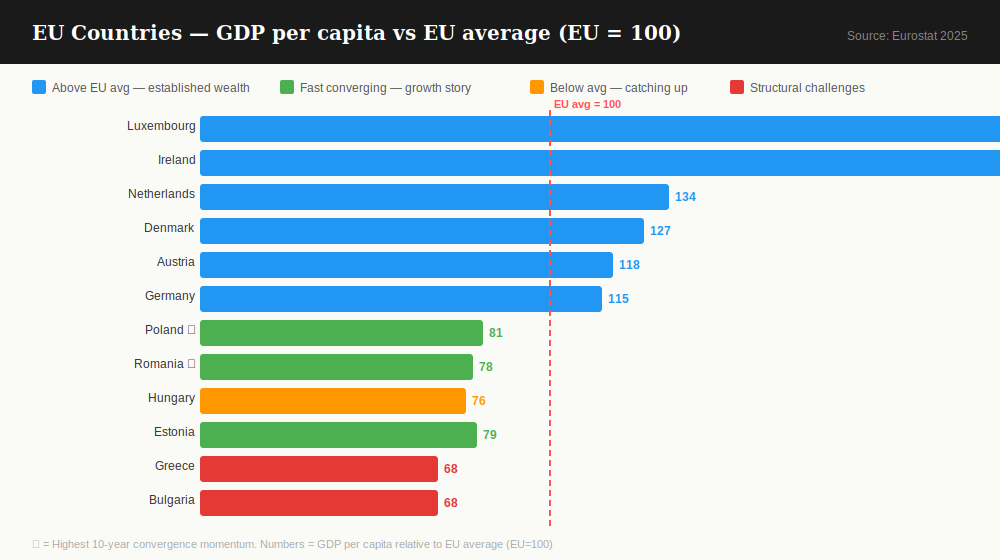
Poland has had 28 consecutive years of economic growth - an EU record. Their GDP is 7 times larger than it was in 1990. Romania was at 26% of the EU average in 2000. By 2024 it was at 78%. Estonia, Lithuania, Latvia - the Baltic Tigers - consistently outpaced Western Europe for most of the 2000s.
The pattern: every Eastern European country that joined the EU, kept taxes low, built export-focused industries, and let the private sector run - quietly beat the big legacy economies over the long term.
If these were stocks
Poland right now is what growth investors look for. Solid fundamentals, momentum, relatively undervalued against its trajectory. Defence spending up, tech sector growing, young-ish workforce. Strong buy.
Spain surprised everyone in 2024 - fastest GDP growth among large EU economies at 3.2%. Tourism, green energy, immigration filling labour gaps. Buy.
Romania is the speculative play. Enormous upside (still converging toward EU average), a real IT sector, automotive manufacturing - but an 8.6% fiscal deficit and brain drain are the risk factors. High risk, high potential.
Germany is the hold that makes you nervous. The largest EU economy, 30 companies in the Fortune 500, but its industrial model - built around cheap Russian energy and Chinese export demand - lost both supports at once. The question isn't whether Germany is important. It's whether it can reinvent fast enough.
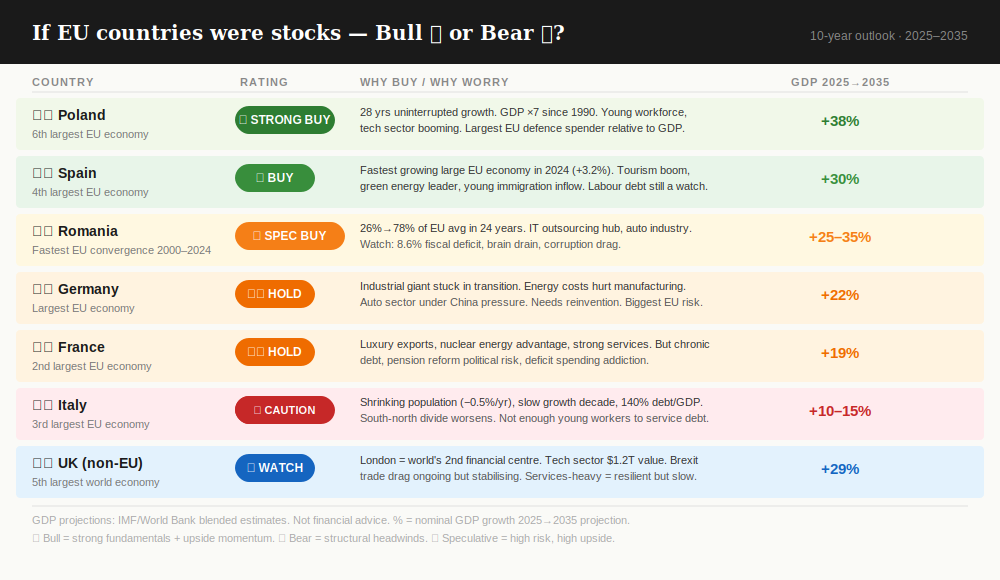
Italy is the one that keeps analysts up at night. Population shrinking at -0.5% per year naturally. 140% debt to GDP. The south-north divide widening. Not a collapse - but structurally, the hardest decade ahead of any major EU economy.
France sits somewhere in the middle. Luxury exports, nuclear energy advantage, strong services. But chronic deficit spending and pension reform politics that never quite resolve.
What about the UK?
Outside the EU but impossible to ignore. London is still the world's second largest financial centre. The UK tech sector has a $1.2 trillion enterprise value - fintech, health tech, semiconductors doing the heavy lifting. The Brexit trade drag is real and ongoing but starting to stabilise.
The honest read: the UK gave up frictionless trade access and got... regulatory independence it hasn't fully used yet. Over 10 years it probably ends up as a slightly slower grower than it would have been, but still a top-5 global economy. Not a disaster, not a triumph.
The thing worth watching
The EU fertility rate is 1.6 children per woman - well below replacement. Germany's population shrinks naturally by -0.4% a year. Italy by -0.5%. The countries holding up better demographically are the ones with immigration inflows or younger populations - Ireland, France, Sweden, and ironically the Eastern European countries that were losing population to emigration but are now reversing that trend as wages catch up.
Demographics is slow. But it's the variable that makes a 10-year economic outlook very different from a 3-year one.
East is where the growth story is. Poland, Romania, the Baltics - they did the boring thing (reform, export, private sector) and it compounded. The big legacy Western economies face harder questions about what they're actually building next.
The UK is a separate bet - services-heavy, London-anchored, post-Brexit finding its footing.
None of this is financial advice. But it is interesting.
1reading now
Get an email when Amy publishes