
Does Your Prefabricated Sauna Need a Declaration of Performance?

Key Takeaways
A prefabricated sauna is not automatically within the Construction Products Regulation.
Start with the exact product or kit being placed on the EU market, not the completed garden project.
Ask whether that product is intended for permanent incorporation into construction works.
If it is, check for an applicable harmonised technical specification in the Official Journal.
Where no such specification applies, a manufacturer may use a European Technical Assessment route.
A Declaration of Performance covers declared product performance. It does not approve the whole project.
A buyer may call the whole delivery “the sauna”, while product law sees a cabin kit, windows, cladding, a heater and controls—a difference that matters. We manufacture completed outdoor saunas in Lithuania, but that doesn't make one document cover every item. The Declaration of Performance question should be answered product by product, before anyone asks for a document that may not legally exist.
Does Your Prefabricated Sauna Need a Declaration of Performance?
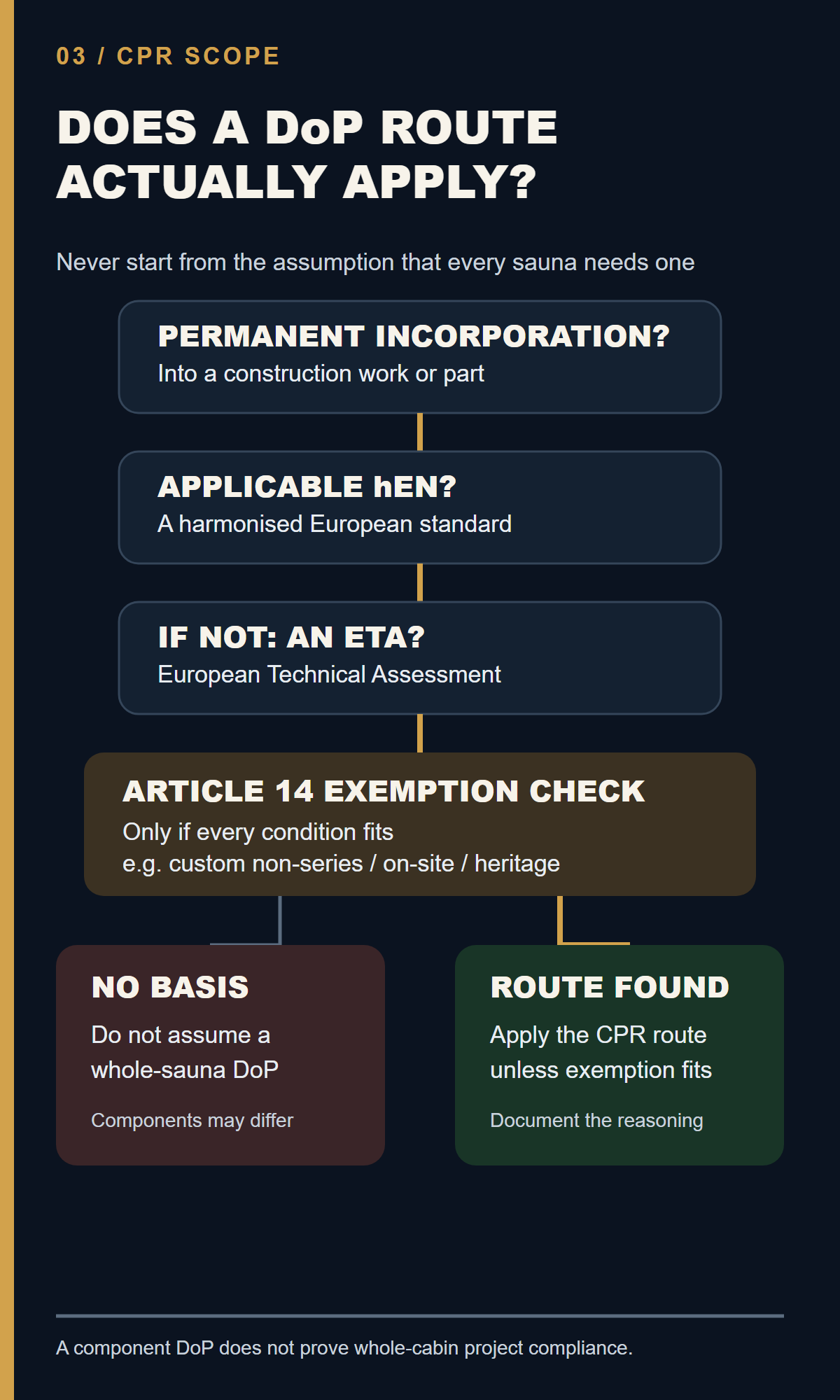
Possibly, but not simply because it is a prefabricated sauna. First define the item or kit being placed on the market. Then ask whether it is intended for permanent incorporation into construction works. Check for an applicable harmonised technical specification or European Technical Assessment. If a declaration route exists, test the narrow Article 14 exemptions before concluding that a declaration is required. Those gates determine the Construction Products Regulation route. Other EU or national rules may still apply.
Start with the product, not the project name
“Sauna” is a useful commercial description, but it is not a legal classification. A factory-built cabin might be sold as one kit. A project might instead combine several separately supplied construction products and electrical products. The scope analysis should identify the manufacturer, the product type and what is actually placed on the market.
Keep this analysis separate from planning permission, foundations, electrical installation and local fire requirements. Those questions may be important, but they do not decide whether a particular product needs a Declaration of Performance under the Construction Products Regulation.
Gate one: is it intended to remain in the works?
Regulation (EU) 2024/3110 defines a construction product as a physical item or kit placed on the market for permanent incorporation into construction works or parts of them. “Permanent” means intended to remain after construction or renovation is completed.
This is an intention and use question, not a shape test. A movable-looking cabin is not automatically outside scope. A cabin fixed to a prepared base is not automatically inside every harmonised product route either. Record how the product is installed, whether it is intended to remain, and which part of the building or civil engineering work it affects.
Gate two: does an applicable harmonised specification cover it?
If the product falls within construction-product scope, identify the exact product family and intended use. Then check the harmonised technical specification that legally applies. Under the transitional system, harmonised standards cited under the previous Construction Products Regulation can remain relevant until they are withdrawn or replaced through the new framework.
Do not treat any EN standard found in a search as a harmonised standard. Check the official citation, version, scope and coexistence dates. The European Commission explains that harmonised standards provide the common assessment methods used for a Declaration of Performance and CE marking. Its published lists and the Official Journal are the right starting points.
Gate three: is there a European Technical Assessment?
A construction product not covered by an applicable harmonised specification may have a relevant European Assessment Document. The manufacturer can request a European Technical Assessment on that basis. This route is voluntary, but once the manufacturer obtains the assessment and places the product on the market under it, the resulting declaration and CE marking duties follow.
If there is no applicable harmonised route and no European Technical Assessment, don't invent a Declaration of Performance. National product requirements, mutual recognition and other EU legislation may still affect the sale. The answer is a documented scope conclusion, not an empty template carrying a CE mark.
Gate four: does a narrow Article 14 exemption apply?
Even where Article 13 would otherwise require a declaration, Article 14 permits a manufacturer to use an exemption only when every condition in the relevant route is met. For an individually manufactured or custom-made product, that means a non-series process, a specific order, installation in one identified construction work by the manufacturer, responsibility for safe incorporation, and compliance under the required national supervision.
A separate heritage route covers non-series products made exclusively for qualifying conservation work. A product isn't exempt merely because a buyer calls it bespoke or selects a finish. Record every condition and the identified construction work. Article 61 also offers a simplified-documentation alternative for qualifying custom-made non-series products.
Decision gate | Evidence to check | Likely CPR outcome |
|---|---|---|
Permanent incorporation? | Intended installation, fixing method, declared use and whether the product remains after completion | If no, the construction-product route may not apply. Check other legislation. |
Applicable harmonised specification? | Official Journal citation, correct version, scope and intended use | If yes, assessment, declaration and CE duties normally follow for that product. |
Relevant assessment document and ETA? | European Assessment Document, issued ETA and matching product identity | If the manufacturer uses this route, declaration and CE duties follow. |
Article 14 exemption? | Every custom/non-series or heritage condition, identified works and national supervision | If every condition is met, the manufacturer may decide not to draw up the declaration. |
No harmonised route? | Written scope note and destination-country requirements | No CPR declaration should be fabricated. National and other EU rules still need review. |
What a positive answer actually means
Where the applicable route requires a Declaration of Performance and Conformity, the manufacturer assesses the product under the relevant technical basis, declares the covered performance and applies CE marking as required. The declaration is tied to a clearly identified product type, intended use and technical reference.
That declaration is not a universal quality certificate. It does not select the right product for a project, approve the site layout or confirm compliance with every national building rule. The designer or buyer still has to compare the declared performance with the project specification. The same distinction matters when discussing private-label CE responsibilities.
Use the transition period carefully
The new Construction Products Regulation entered into force in 2025, while many operative provisions and product-family rules phase in over time. Regulation (EU) No 305/2011 remains relevant for existing harmonised standards during transition. A document check in 2026 should therefore record the legal basis and technical specification used, rather than assuming every product has already moved to the new form.
The authoritative starting points are the official text of Regulation (EU) 2024/3110, the Commission’s Declaration of Performance and CE marking guidance, and its harmonised standards page.
Copyable CPR scope checklist
CPR SCOPE NOTE
Product or kit placed on market:
Manufacturer and product type:
Declared intended use:
Intended to remain after completion: YES / NO / UNCLEAR
Reason and installation evidence:
Product family checked:
Official Journal harmonised reference and version:
Does its scope match the product and intended use: YES / NO / UNCLEAR
Relevant European Assessment Document:
European Technical Assessment number and date:
Article 14 exemption route checked: YES / NO
Every exemption condition and identified construction work:
Result: MANDATORY ROUTE / VOLUNTARY ETA ROUTE / NO CPR ROUTE CONFIRMED
Other EU rules to check:
Destination-country rules to check:
Reviewer, source links and review date:
Frequently Asked Questions
Is every prefabricated sauna a construction product?
No. Classification depends on the exact product or kit, its intended use and whether it is intended for permanent incorporation into construction works. A commercial name does not settle the question. Record the configuration and installation intention, then test it against the legal definition and relevant technical scope.
Does a freestanding sauna automatically fall outside the CPR?
No. “Freestanding” can describe appearance rather than intended permanence. Check whether the cabin is intended to remain after the site work is complete, how it is connected and what the manufacturer declares. The conclusion should rest on evidence, not on whether a crane could move it later.
Is every custom-made sauna exempt from a declaration?
No. Article 14 requires every condition in the relevant exemption route to be met. A custom-made product must also use a non-series process, answer a specific order, be installed by the manufacturer in one identified construction work, and meet safe-incorporation and national-supervision conditions. “Bespoke” alone isn't enough.
Does any EN standard create a Declaration of Performance duty?
No. A standard number alone is insufficient. Confirm that the correct version is cited for the relevant product family, that its scope covers the product and intended use, and that transitional dates have been checked. Other voluntary standards can be useful without creating a CPR declaration route.
Can a manufacturer choose the ETA route?
Where no applicable harmonised technical specification covers the product, a manufacturer may seek a European Technical Assessment using a relevant European Assessment Document. It is a voluntary route. Once used for placing that product on the market, it brings the associated declaration and CE marking responsibilities.
Does CE marking settle the sauna project approval?
No. CPR CE marking relates to the product’s declared performance and the applicable assessment route. It does not replace project design, planning permission, structural checks, electrical installation or local fire requirements. Those decisions belong to the project actors and the rules of the destination country.
1reading now
Get an email when Giedrius publishes