Can ChatGPT design a blind calculator for my website?

Can ChatGPT design a blind calculator for my website?
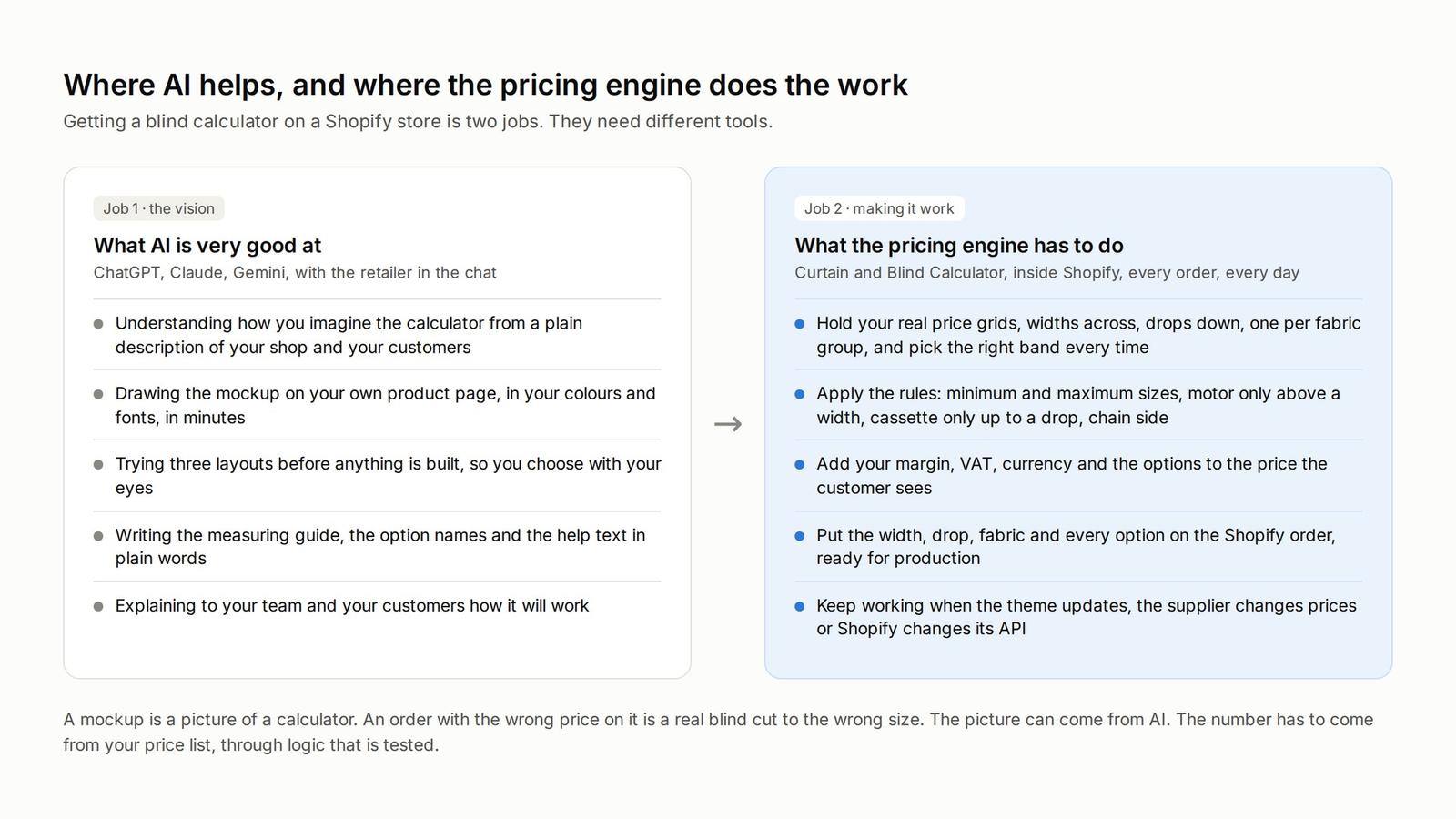
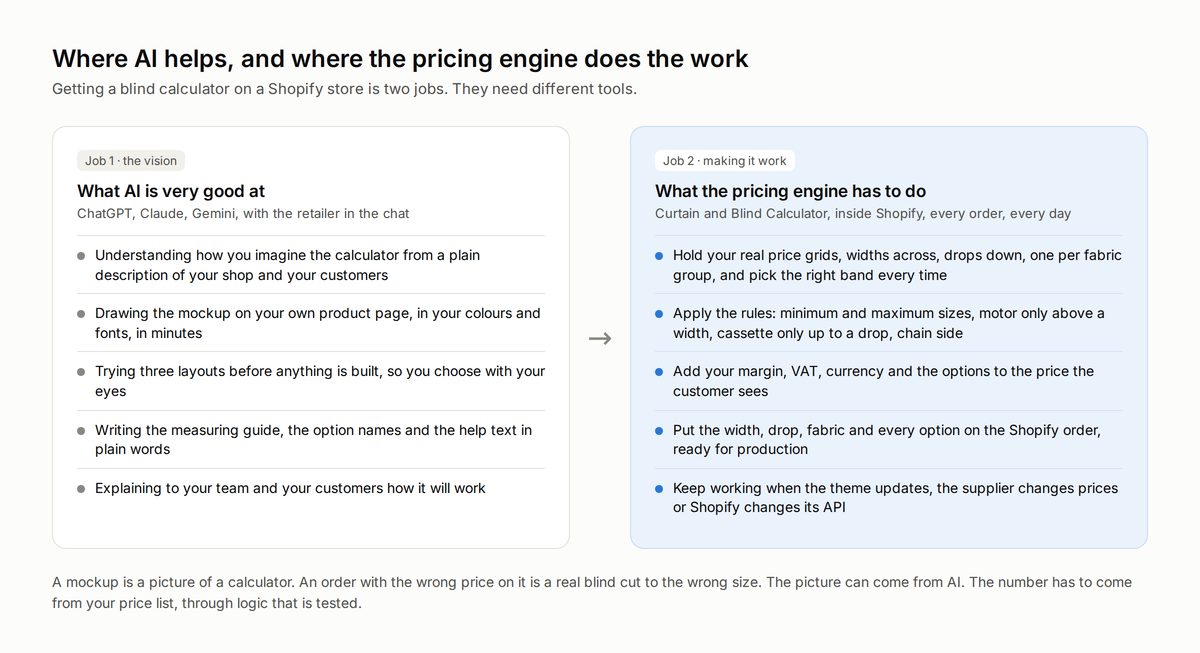
Yes, and it is the best way we know to find out what you actually want. Describe your shop, your customers and your products to ChatGPT, Claude or Gemini, ask for a calculator on your own product page, and in ten minutes you have a mockup that looks right, in your colours, with your words. What AI cannot do on its own is make that mockup sell a blind: hold your price grids, apply your rules, put the measurements on the Shopify order and keep doing it correctly every day. That part needs pricing logic in the back end, tested, and that is what the Curtain and Blind Calculator app is. We now use AI for the first job and the app for the second, on every store we set up, and this piece explains why the split matters.
Why is AI so good at the first job?
Because the hardest part of any calculator project used to be understanding the retailer's vision, and AI has made that almost free. For years the conversation went like this. The retailer says "I want it to look modern and simple". The developer builds something. The retailer says "no, not like that". Three weeks and one invoice later they try again. Nobody was wrong, they just had no shared picture.
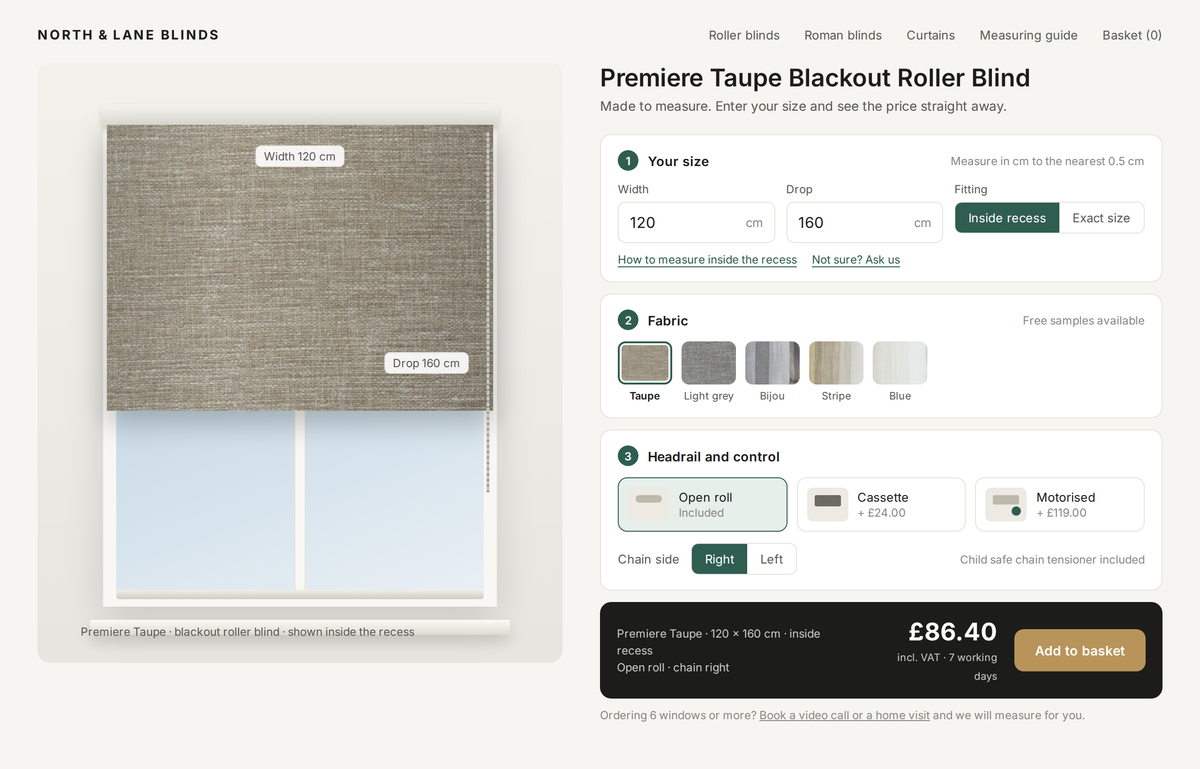
Now the retailer sits with an AI, or with us and an AI, and says: my customers are women between 35 and 60, they buy on their phone in the evening, they are scared of measuring, I sell roller blinds and Romans and I want the colour swatches to look like my fabric wall. The AI draws it. The retailer says "the swatches bigger, the price at the bottom, and I want the measuring help next to the size box". The AI redraws it. In an hour you have three layouts and a clear opinion about which one is yours, and only then does anybody build anything. We described that process in our piece on what a calculator should look like on a product page, and every mockup in it was drawn that way.
So why not let the AI build the whole thing?
Because a mockup is a picture of a calculator and an order is a real blind cut to a real size for real money. Between the two sits a list of things that have to be exactly right, every time, and that list is longer than it looks from the outside.
The price grid. A roller blind price is not a formula, it is a table from your supplier with widths across the top and drops down the side, and the rule is that a 142 cm wide blind is priced in the 150 cm band, never the 120 cm band below it. One fabric group has one grid, a shop has twenty or fifty of them, and they change when the supplier changes them.
The rules. Motor only above 60 cm wide. Cassette only up to 250 cm drop. This fabric is 200 cm wide so no blind wider than 200 cm in it. Chain length depends on the drop. Minimum charge below a certain size. Every retailer has twenty of these and most of them live in the fitter's head.
The margin, the tax and the currency. Your margin on top of the grid, VAT in the UK, sales tax in the US, pounds or dollars, and the price the customer sees must be the same price that reaches your accounts.
The order. The width, the drop, the fabric, the control side, the fitting type and the bracket type have to arrive on the Shopify order attached to the line item, in a form your workroom can cut from without retyping, and the confirmation email has to repeat every number to the customer.
The years. The theme gets updated, Shopify changes its checkout, the supplier sends a new price list. Something that was generated once and never maintained breaks quietly, and you find out when a customer receives a blind priced at £0.
An AI can write code for some of this. The problem is not writing it, the problem is being right about all of it and staying right, and the cost of being wrong is not a bug report, it is a blind you cannot resell. That is why we keep the pricing logic in an app that has been running inside Shopify stores since February 2023, and let the AI do the part it is good at.
How does the process work in practice?
First the vision. You tell us about your shop, or you have already played with ChatGPT and have a picture you like. We put a mockup of the calculator on your own product page, in your theme, and we do a second and a third version, because a retailer who sees three layouts chooses better than one who sees one. This takes days, not weeks, and it is the part where AI does most of the drawing.
Then the logic. You send us the product list and the price lists for the blinds and for the hardware, because tracks, poles and headrails are cut to length and priced by size too. We load the grids into the app, set the rules and the margin, and connect the options to the prices. This is the part that takes the time, and it is the same work whatever software you end up using.
Then the layout goes on top of the logic. The design you chose becomes the skin over the pricing engine, on your live store, and because the two are separate you can change the design later without touching a single price.
What does it mean for a retailer talking to an agency?
It means you should ask two questions. Who is drawing the design, and where does the price come from. If the answer to the second question is "the AI generated it" or "a spreadsheet the developer wrote", ask who updates it when the supplier changes prices in January, and what happens when it is wrong. If the answer is a pricing engine with your grids in it, that a real person maintains, then let the AI draw all the pictures it likes. The picture is the cheap part now. The number is still the expensive part.
Frequently asked questions
Can I use my own ChatGPT mockup as the design?
Yes. Bring it. If it is what your customers will understand, we build the layout to match it and put the pricing engine behind it.
Does the AI decide any prices?
No. Every price comes from your grids and your rules in the app. AI is used for the design, the help text and the explanations, never for a number a customer pays.
Can the calculator be redesigned later?
Yes. The layout is a skin over the pricing engine, so the design can change without touching the prices, and two layouts can run side by side to see which converts better.
What do I need to send to get started?
Your product list and your price lists for the blinds and the hardware. The design can start from a description of your shop and your customers, or from a mockup you already have.
How long does it take?
Mockups within days. The build depends on how many price grids you have and how clean they are. For most stores the first product is live within two weeks of the price lists arriving.
Which Shopify app does this is covered in the first piece on this page, and how the price grid itself works is tomorrow's piece.
If you asked ChatGPT to draw your calculator tonight, what would you tell it about your customers first?
1reading now
Watch & subscribe
Curtain & Blind Calculator also publishes on YouTube
1.24K subscribers
One click subscribes you on YouTube - you stay here on PUBlish.
Get an email when Curtain publishes