The Eventual Cost of Suppressing

We’ve all been there.
We are all in there almost every day.
Breathing in, shaking it off and bracing ourselves before we walk into the room with a great big smile and oozing pretend-confidence.
Feeling the flood and the pressure of tears behind our eyes only to put a great big effort into redirecting our attention until the tears behind our eyes retrieve and ease the pressure. Sometimes the effort achieves what we set out to do, and soon, we’ve forgotten it was even there. It’s good, because it allows us to carry on.
It allows us to meet the often-unwritten demands and the expectations attached to the situation we are in at any given time.
Feeling that huge pressure on our chests and frenzy somewhere – everywhere – in our bodies where we just feel a NEED to scream. To walk out into the middle of the woods and let out a resounding, full-breath howl out into the world around us. So that the tears we delayed could finally come and let the built-up pressure out, finally.
But we can’t.
We’re not in a forest in a middle of nowhere.
We’re in the middle of a great big building in a great big city full of the worldly expectations and norms where such expression has been pathologised and stigmatised.
So we don’t. Again. And again.
Until the intentional, self-inflicted – because of the ‘norms’ and expectations – suppression and delay in expressing what our bodies need to express in real time, leads to the constriction in our throats becoming habituated; stuck.
Until we can no longer scream at the top of our lungs even when we find ourselves in circumstances where we could.
Because the natural essence of brain is potential, not a rigid set, and so we shape that potential into relative rigidness through experience and association.
Like the Pavlov’s dog. Quite literally.
*
When we force ourselves to suppress when our body is desperate to express, that’s what wires in our brains; the association between what it is experiencing in itself and the response of not letting the natural come.
And so it soon starts taking upon itself to impose the response of suppression in association with particular things it’s experiencing.
Have you ever felt in your body a need to cry but the tears just wouldn’t come, even when you wanted them to? IT’S THAT.
And, as time goes on, that learnt response wreaks havoc on our health. And our relationships.
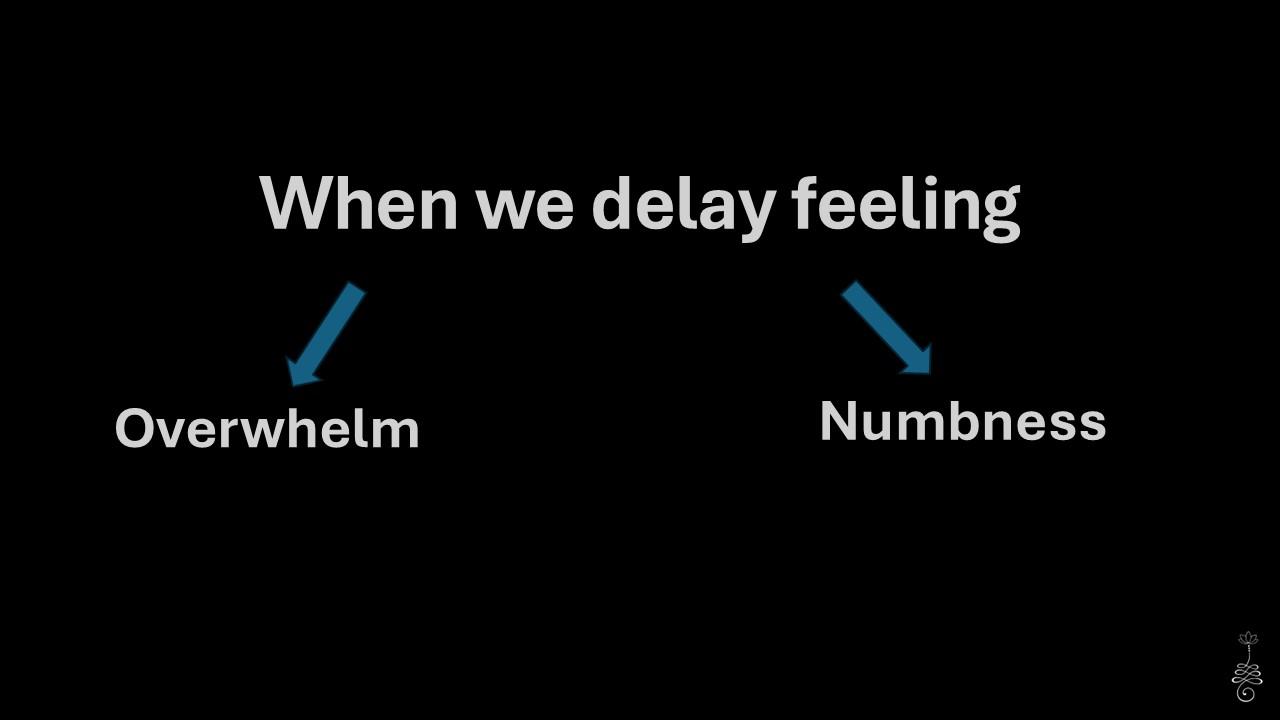
Because it most often leads to one of the two things – numbness or the accumulation of stuff that turns into overwhelm that manifests itself in an outburst of everything that’s been suppressed.
And that rarely is pretty.
Something that could’ve been expressed in real time when it needed to be expressed eventually accumulates such explosive force that it becomes destructive.
*
All of those are adaptive strategies we often have little choice but to employ.
Life’s like that.
The world’s like that. It requires that of us.
It pathologised the healthy, evolutionary-built expression of what is happening for us at any given moment and, instead, built a very narrow, unrealistic notion of ‘normality’ within which we have to bend over backwards we are expected to mould ourselves.
‘Don’t cry; you’ll look weak.’ And so we never learnt to be with someone else’s tears; we learnt discomfort instead.
‘Don’t dance that way; it looks stupid.’ And so we never learnt to read what our bodies need. And, instead, we took on a job of policing how others dance further perpetuating our own invisible shackling.
‘Don’t raise your voice; it’ll make you look unstable.’ And so learnt that our views are wrong and feelings are abnormal. We learnt to sugarcoat or suppress instead. And then perpetuate the same restrictions on another.
‘Don’t express joy like that; express it like this.’ And so we learnt to supress the aliveness in our veins in favour of subdued kind of expression.
‘Don’t laugh like this; it looks ridiculous and inappropriate.’ And so we unlearnt laughing from the heart and forced ourselves to laugh from the head, in an ‘acceptable manner.’ And lost the ability to laugh from the heart.
It didn’t have to be that way.
We didn’t have to build the world where human expression became pathologised, ridiculed and socially penalised.
We accepted a manmade imposition of the notion of ‘normality’ as if it’s natural and universal, when it is anything but.
But who were those that defined what is normal and what isn’t? Who did they think they were to impose their own version of ‘normality’ on the rest of the world?
The choice to suppress is often a trade-off between being today and ensuring our basic needs are met tomorrow.
And sometimes it’s not a choice; sometimes it’s ‘become natural’ because the brain wires itself through experiential and associative input and learning of the immediate effects of a particular act.
But brain wiring is a potential, not a rigid set.
Therefore, NOW THAT WE KNOW, we can use the same potential that led to it wiring itself the way it did before we knew we could affect it, and use that potential intentionally, deliberately and the way it serves us.
And challenge the manmade, UNNATURAL narrow notion of ‘normality’ in the process.
*
If your body picks up a rhythm and wants to move a particular way, let it move the way it wants to, don’t curate it to some standard that someone else has set.
If tears are pooling at the back of your eyes – of sorrow or of joy – let them out. That way, we re-learn to give our bodies what they need and, slowly but surely, give others permission to give themselves permission to do the same. Imagine the world where we all learnt how to not be uncomfortable in the presence of human emotions?!
If your heart wants to sing out loud, let it sing out loud! The permission-to-self is the best investment in your future wellbeing you could ever make. And, again, by doing so, we give permission to others to do the same. Imagine the world were no one suppressed their heart’s song! Where everyone sang when the fancy took them and then burst into laughter of joy!
We can gift ourselves permission to return to what comes natural to us and begin redefining the rules of engagement in the process.
1reading now
Watch & subscribe
Lina Jan also publishes on YouTube
18 subscribers
One click subscribes you on YouTube - you stay here on PUBlish.
Get an email when Lina publishes