What You Actually Need to Publish an App on the Play Store and App Store (2026)

Most launch delays aren't technical — they're paperwork. Here's the short list of what you need before your app can go live on either store.
1. A developer account — go with Organization, not Personal
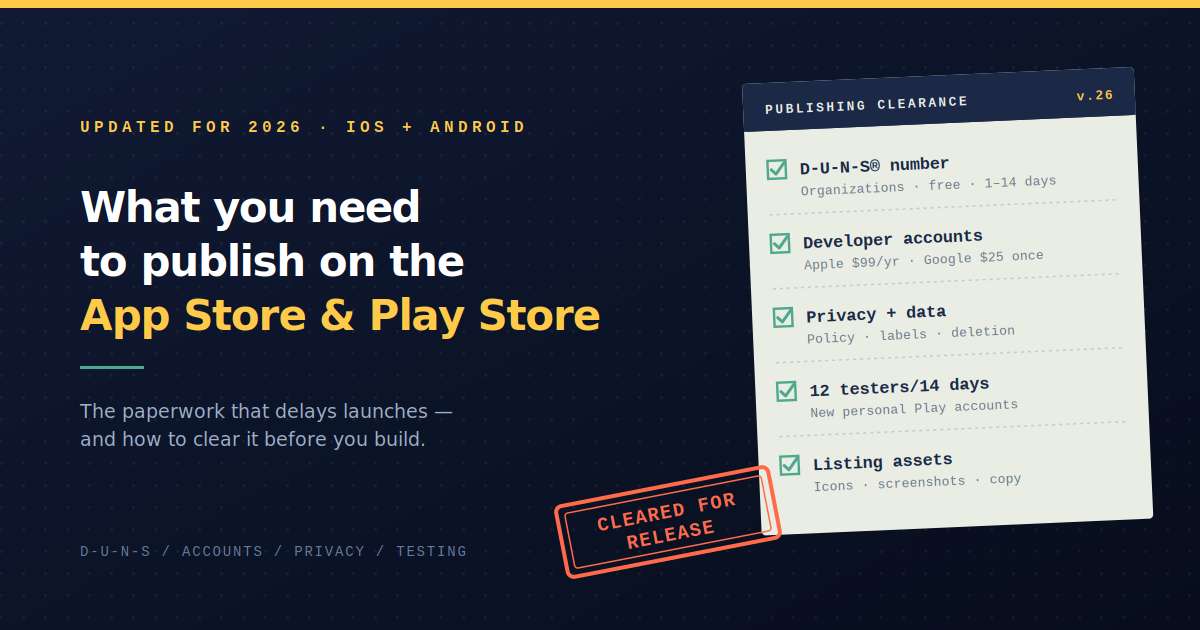
Google Play: $25, one-time, unlimited apps. You'll be asked to choose Personal or Organization at signup — and you can't switch later, so this decision matters.
Apple: $99/year. Lapses take your live apps down within ~24 hours, so turn on auto-renewal.
Organization is almost always the better choice, even for solo developers. A personal account publishes under your own name and home address (both go public on your listing), locks you into Google's mandatory 12-tester closed-testing gate, and can't be transferred to a company later without rebuilding your presence from scratch. An organization account publishes under your business name, skips the testing gate entirely, supports multiple team members, and looks more credible to users and reviewers alike. The only extra step is a D-U-N-S number — and it's free.
2. Get your D-U-N-S number early
Both stores require a D-U-N-S number — a free, nine-digit business ID from Dun & Bradstreet — for organization accounts.
It's free. Apply directly with D&B; don't pay a third party for it.
Takes anywhere from a few days to two weeks — apply before your app is finished, not after.
Your legal name and address must match your incorporation documents exactly, or verification stalls.
3. Business documents you'll need for an organization account
Certificate of incorporation / government registration
Proof of a real physical business address
ID of the person legally authorized to sign for the company
A company-domain email (Apple expects this eventually)
4. Technical must-haves
Android: App Bundle (.aab), Play App Signing, target API level 36 (Android 16, mandatory from 31 Aug 2026). iOS: Built with Xcode 26 / iOS 26 SDK, valid certificates and provisioning profiles.
5. Store listing basics
App icon, screenshots, short + full description, category, and content rating — all required, no placeholders accepted.
6. Compliance you can't skip
A live, public privacy policy URL that matches your data declarations
In-app account deletion if your app has accounts
EU trader status in App Store Connect — apps get silently pulled from all 27 EU storefronts without it
Data safety / privacy nutrition labels on both stores
7. Google's 12-testers rule — another reason to skip Personal
New personal Play accounts (created after 13 Nov 2023) must run a closed test with 12 testers opted in continuously for 14 days before they can even apply for production access. That's a hard two-week floor added to your launch timeline for no reason other than account type.
Organization accounts are fully exempt from this rule. It's one of the clearest, most concrete reasons to register as a business from day one, even if you're a solo developer — the D-U-N-S paperwork takes less time than the testing window it lets you skip.
Realistic timeline
D-U-N-S and account verification: 1–2 weeks. Review: 24–48 hours on Apple, up to 7 days on Google. Go the organization route and that's your entire runway — no 14-day testing window tacked on. Start the paperwork the same week you start building — none of it requires a finished app.
How I can help you get there
Getting an app "launch-ready" is rarely the bottleneck — clearing this checklist is. If you're planning a launch, I can help with:
D-U-N-S number and business document prep — getting the application right the first time so it doesn't bounce back
Developer account setup for Apple and Google, personal or organization
Privacy policy, data safety forms, and EU trader status — so nothing gets your app pulled after launch
Store listing copy and assets written for both compliance and app store SEO
Managing Google's closed testing window so the 14 days actually count
If you're a few weeks from launch and want this handled instead of chased, [get in touch] and I'll walk you through what applies to your app specifically.
1reading now
Get an email when Akash publishes