Better Wallpaper Ecommerce Starts with Confidence

Choosing wallpaper is personal. Customers imagine how a room could feel, compare colours against furniture and look for a pattern they will enjoy living with. A good product photograph can start that process. Completing the purchase takes a little more.
Even when someone has found a design they love, practical questions remain. How much should they order? How will they know whether it suits the space? Can they get help before committing to a whole room?
For wallpaper retailers, those questions are part of the sale. How well your store answers them can shape what happens next.
Help customers move from interest to a decision
In a showroom, an experienced salesperson recognises hesitation. They bring out a sample book, explain the product and ask about the room. They help the customer work towards a decision at a comfortable pace.
Your online store needs to offer that same sense of support.
Start with the information someone needs to make a sensible choice: clear product dimensions, how the wallpaper is sold, installation guidance, delivery details and the option to order a sample where available. Put important answers alongside the product, where customers are already considering their purchase.
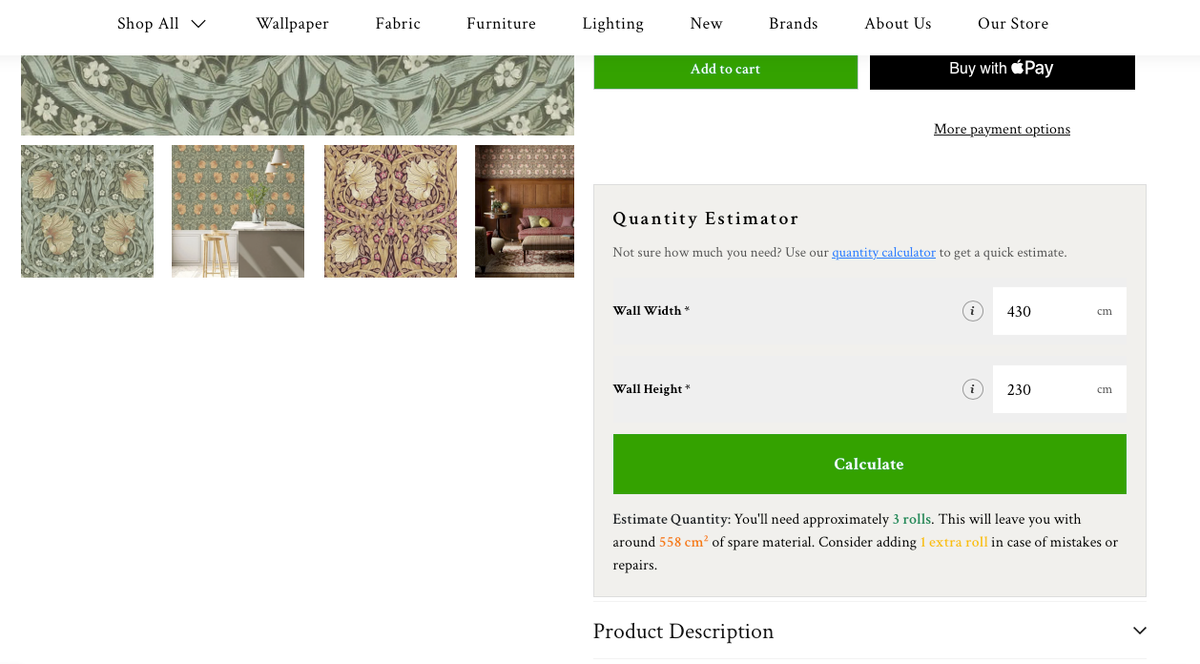
Quantity deserves particular attention. A price per roll tells someone what one roll costs. It does not tell them what they need for their room.
WallpaperCalc, our wallpaper calculator for Shopify, helps bridge that gap. Customers enter their wall dimensions to estimate the quantity required for wallpaper or wall panels, with support for calculations per roll or unit and for metric and imperial measurements.
That gives them a practical starting point. Retailers should also make the estimate’s assumptions clear, including how any pattern matching or installation allowances are handled and when the customer should ask for advice.
The value is in making the purchase easier to understand. When a customer can connect their chosen product with their own project, they have a better basis for deciding what to do next.
Make the next step feel natural
Different projects need different kinds of support. Someone decorating a single wall may be ready to order. Someone considering wallpaper throughout a home may need samples and a conversation. A commercial project may require a detailed quotation.
A useful product page recognises those differences without overwhelming the customer.
Give the ready buyer a clear route to purchase. Make sample ordering easy for someone still choosing. Offer a project enquiry for customers who need more help, and explain what information your team needs to prepare a useful response.
The wording matters. “Request a quote for your project” gives someone a reason to get in touch. Explaining that they can share their measurements and selected wallpaper makes that invitation more useful.
Where your systems allow it, carry those details into the enquiry. The customer has already done some work. Your team should be able to pick up the conversation from there.
Bring showroom expertise into the online experience
For interiors businesses, the relationship between a showroom and an online store can be a real strength.
Customers may discover a collection online, visit to see the texture and finish, then complete their decision at home. Others may begin with a showroom conversation and return to the website to review products with their partner.
Designing for that movement makes the whole experience more helpful. Product information should be consistent. Advice should be easy to find again. Customers should know how to continue a conversation once they leave the shop.
For retailers also selling made-to-measure blinds and curtains, InterioApp supports the wider process through online selling, project quoting and client management across showroom and online enquiries.
The principle behind both products is the same: give customers useful guidance and give the business a clear way to turn that interest into an order or a project.
Make your products easier to discover and understand
This work matters before a customer reaches your website, too.
People can now use ChatGPT to explore shopping options and compare products. OpenAI says its shopping results consider the customer’s intent alongside product information and other sources. Shopify product data is also integrated through Shopify Catalog, although individual products are not guaranteed to appear.
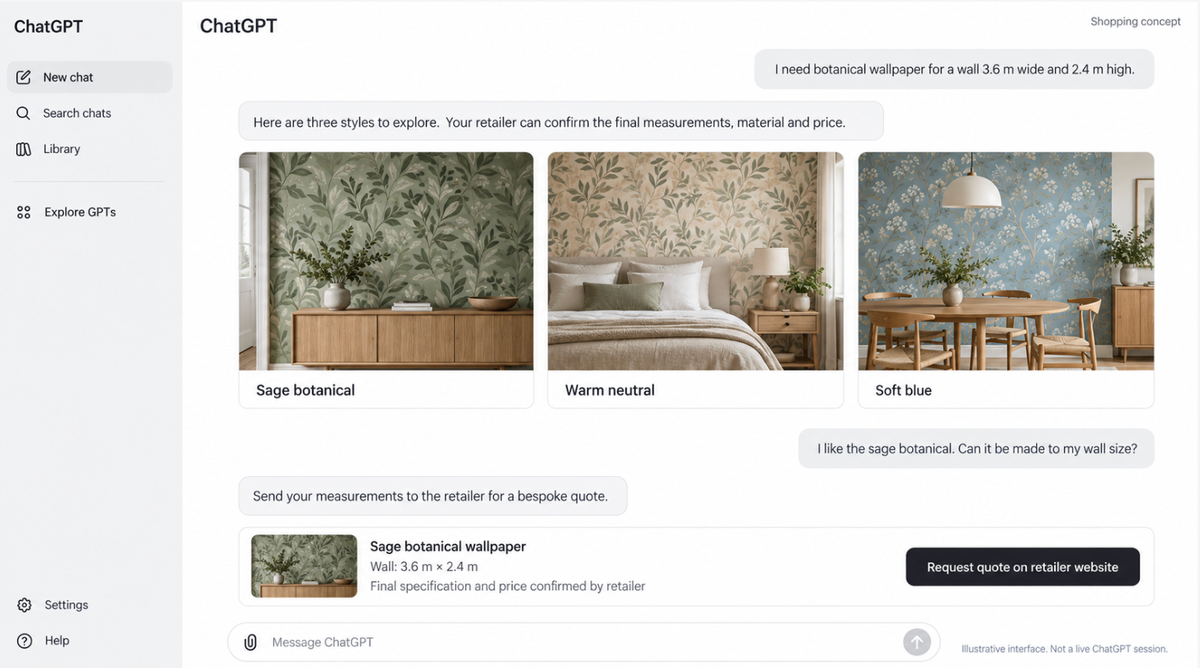
For retailers, that makes accurate, descriptive product information worth sustained attention. A collection name and a photograph leave many questions unanswered. Details about material, colour, dimensions, application and availability help explain what a product actually offers.
Useful editorial content adds another layer. A guide to measuring a feature wall, an explanation of wallpaper pattern matching or advice on choosing samples can answer the questions customers ask before they are ready to buy.
Google’s guidance for its AI search experiences emphasises helpful, original content and accessible websites. These foundations support eligibility for discovery; they do not guarantee rankings or recommendations.
The opportunity is to make your product knowledge available in a form that people can find and use.
Improve the moments where customers hesitate
A good place to begin is with one product page.
Ask someone unfamiliar with your store to choose wallpaper for a room. Watch how they find the measurements, work out a quantity and look for help. Pay attention to the moment they pause. That pause may tell you more than another design review.
Use what you learn to make a specific improvement, then check whether it helped. Look at completed purchases, sample requests, useful enquiries and the questions your team still receives.
Better ecommerce grows through this kind of attention. Each clear answer removes a little uncertainty. Each useful tool makes the next step easier.
If your customers are unsure how much wallpaper to order, explore WallpaperCalc for Shopify. For businesses managing made-to-measure curtain and blind projects, discover Interio App.
Help customers understand the purchase, and give them somewhere useful to go next.
Common questions
What does a wallpaper calculator do for an online store?
It helps customers estimate the quantity they need from their wall measurements. This provides a starting point for purchasing or requesting a quotation. The store should explain what the calculation includes and when additional advice is needed.
Should wallpaper retailers offer online checkout and project enquiries?
Both can be useful. Checkout serves customers who are ready to order, while project enquiries support purchases that need a quotation or specialist guidance. Make each route clear and relevant to the product.
Does adding a calculator improve AI search visibility?
A calculator primarily helps customers make decisions on your website. Search visibility also depends on accessible content, accurate product information and the search platform’s selection process. Installing a calculator does not guarantee an AI recommendation.
1reading now
Get an email when WallpaperCalc publishes