Could certain breathing techniques help with body inflammation and, by extension, our felt sense of emotional and psychological wellbeing?

A few months ago, I attended the first ‘Studying the Human Brain’ symposium initiated and organised by Dr Emily Clements and Dr Sonia Medina Hernandez at the University of Exeter. While I chose to go there for a very specific reason - to learn what’s new in brain imaging tech world as I foresee very specific need for when I get around to doing my PhD in a year or 20 - I learnt a lot of other VERY interesting stuff, even if not directly currently relevant to me (stressing ‘not directly currently’, NOT ‘irrelevant’).
The talk that sent me down an unexpected rabbit hole was that of Dr Julia Schubert who presented on Imaging Brain-Body Communication with PET. It confirmed something I intuitively knew. While I didn’t feel I needed a confirmation, I appreciate and accept that many people feel they do. Actually, now that I typed this, I feel that I, too, feel good about having had my intuition confirmed.
Among many things, Dr Schubert talked about the findings that show the association between elevated inflammation and depression. So this morning I went down this rabbit hole. There is a vast body of research showing the association between elevated inflammation and poorer mental health and social experience (I highly recommend reading Eisenberger and Moeini (2020) publication, full reference at the bottom of this article).
While I couldn’t find any studies (of ‘naturally occurring’; there are plenty of 'intentionally induced') I would deem to show causal relationship between elevated inflammation and poor mental health, I’d argue that, when we seek to help ourselves out of a deep dark place, it is less important (of course, it is highly important in prevention work, but that’s a different topic). I am a subscriber to Gabor Maté’s school of thought a large chunk of which dedicates to highlighting how environmental - relational, subjective sense of safety and security, lack of ability to meet basic needs due to systemic factors, etc. - stressors increase inflammation. Can we be sure yet that elevated inflammation increases emotional and psychological struggle? Or is it the other way around, i. e., emotional and psychological suffering increases the likelihood of elevated bodily inflammation? Amasi-Hartoonian (2022) makes a point that increase in cortisol - the 'stress hormone' - can actually be the cause of depression. While the science isn't clear or unanimous yet as to the causal relationship, the correlation seems to be well established.
Bottom line, it is likely that, if we’re in a state of emotional and psychological stress - acute or subtle but sustained - our bodies are also likely to be harbouring elevated inflammation which then perpetuates the cycle.
While there are many ways - none a panacea - to attempt reduce the inflammation, one that I rely on the longest and one that is relevant to me both personally (as someone who lives with stress-induced rheumatoid arthritis (RA) and psoriasis and manages both conditions through non-pharmaceutical interventions) and professionally is breathwork.
When I first started - well before training as a breathwork facilitator - using breathing techniques to reduce the acute stress that I was experiencing, it was just that, a 'quick fix.' I learnt about the approximate mechanics of longer outbreath all the way back when I was conducting my undergrad research of the potential links between the practice of yoga and emotional intelligence (breathing techniques, called pranayama in yogic tradition, is a major part of yoga practice) and started using these breathing techniques, coupled with visualisation of said 'mechanics' (to help my need-to-understand-before-I-entertain brain 'buy into it') during the periods of elevated stress. I'd do it for however many minutes in bed before turning over, while cooking dinner, at the supermarket while queuing; whenever I felt the rise of anxiety that would show itself through the acid eating away at my food pipe resulting in the whole digestive system getting out of whack. It was a 'quick fix' (to my knowledge) strategy to alleviate the symptoms.
What I did not intentionally set out to do was to experience the long-term alleviation of my RA. But when I finally observed the long-term impact of these 'quick fix' practices, suddenly, intuitively it made sense. With those breathing techniques, I'd physiologically interrupt the otherwise self-perpetuating stress cycles, which, whether over time or immediately, would reduce the inflammation in my body (for those unfamiliar with RA, it is an autoimmune inflammatory condition). That 'breaking of the cycle' would give my body some temporary rest and an opportunity to restore some balance before life's stressors would inevitably cause more stress.
Owing to my own experience and this surprise observation, I became a believer before I caught up with the science that is also 'catching up'. Science did not invent these practices; science usually 'discovers' what already is. And while it may seem that we know a lot about stress and its workings in and on the body and, by extension, on how we experience and live our lives, we actually know very little and have to draw inferences; the kind I engage in the next paragraph before returning to breathwork.
Jung et. al. (2019) found that 'the pro-inflammatory cytokines TNF-alpha and IL-6 had negative effects, whereas the anti-inflammatory cytokines (e.g., IL-10 and IFN-gamma) showed beneficial effects, on stress levels, and multiple dimensions of emotional and cognitive intelligence'. Pro-inflammatory cytokines are something that show up in our blood work and indicate inflammation (say, when we catch a cold). They show that the body is fighting something that is harmful to it. In some conditions, it gets 'stuck' in that mode of fighting, hence, the chronic inflammation conditions. There is also a growing body of evidence - slowly shifting the paradigm - that speaks to elevated cytokine levels (read, inflammation in the body) in major depression, such as below referenced Schiepers et. al. (2005) (couple it with the afore-mentioned Amasi-Hartoonian et. al. (2022) publication if you're inclined to entertain the 'causation' argument). Furthermore, there is a vast body of evidence showing consistent correlation between reduced heart variability rate (HRV) and depression disorders (Sgoifo et. al., 2015; Bassett, 2016; Koch et. al., 2019) and anxiety disorders (Pittig et al., 2013; Cheng, et. al., 2022). Relationship so consistent that there is a growing number of voices suggesting that HRV should be used as a biomarker in the diagnostic assessment. Furthermore yet, it has been observed that inflammatory conditions correlate with reduced HRV (Lampert, et. al., 2008; Williams, et. al., 2019). Again, while the causation-correlation hasn’t yet been settled, it is safe to suggest that, since reduced HRV seems to accompany depression-related and anxiety-related disorders most of the time, it is worth entertaining the idea that reduced HRV at least perpetuates these emotional and psychological health states.
I can feel myself getting tangled zooming into the deeper and deeper levels of our biology, so I'll stop here and sum up. While much of the 'inflammation in mental health' theory gets discussed and explored using the scientific method in the context of depression, I'd argue – feel free to challenge me, but take a moment to feel into what your intuition is indicating before you do – that such relationship extends way beyond depression; I'd argue that, whether by causation or correlation, it's relevant to how we feel and show up every day in our lives.
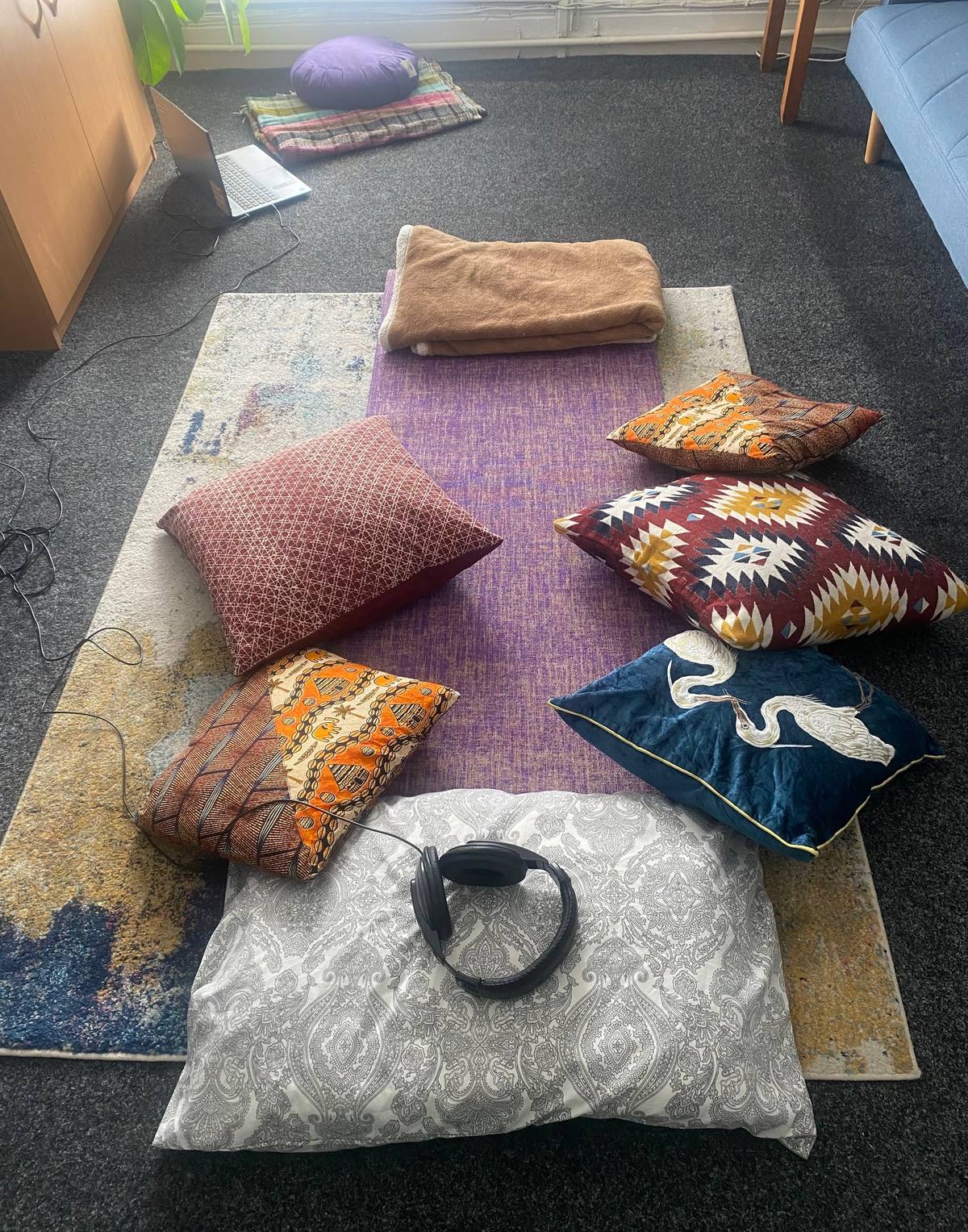
Which is where I come back to breathwork. I already recanted my personal experience with breathwork for stress relief and incidentally-observed reduction in my inflammatory condition symptoms which turned me into a believer. However, I'd lie if I said that observing science 'catching up' with what I intuitively knew did not give me a great deal of satisfaction. In fact, not only satisfaction, but it helps me sustain this practice, both personally and professionally, as the scientific evidence helps my brain to get fully onboard. While I couldn't locate any studies that would've looked directly into the effects of breathwork on pro-inflammatory cytokines, there is an ever-growing body of studies using measurements like Heart Rate Variability (HRV) which is indicative of the optimality of our physiological functioning (that is inextricably related to our emotional and psychological functioning and, ultimately, HOW WE FEEL in the day to day). While research into the effects of various breathwork techniques and their therapeutic – both physiologically and for subjective sense of emotional and psychological wellbeing – impact only just started accelerating in the last few years, it is already showing that both slow diaphragmic (Lomas, 2025) and connected hyperventilation (Cervantes and Puente, 2014). I also recommend following Guy Fincham (to my knowledge, he’s most active on LinkedIn) and his leading work in breathwork and mental health wellbeing research. I include a reference to one of his publications below. Or studies looking into the kind of breathwork that induces altered states of consciousness (often referred to as ASC) and its positive effects on mental health related things (see Jungarbele reference below).
But whatever the technique and for whatever purposes – temporary respite to restore some balance in our nervous systems or for deeper healing or anything in between – breath, in addition to keeping us alive, is proving to be very powerful tool/strategy (I actually highly dislike reducing breath to that, but for the sake of functionality in this context...) to have power over own wellbeing and, by extension, how we feel and how we show up in this world. In the words of Siebieszuk (2025):
'We argue that most breathwork techniques share core neurophysiological mechanisms that benefit well-being, regardless of the theoretical differences between specific techniques. Accumulating evidence suggests breathwork may serve as both a preventive and adjunctive therapy for chronic stress, anxiety, and depression, given its potential to target key risk factors and produce clinically relevant outcomes.'
*
I'm glad that gone are the days when breathwork was 'woo'. Not because I have anything against 'woo'; in fact, 'woo' is something that interests me a lot as it is often driven by intuition and the only thing that's 'missing' is science 'catching up' with it.
The reason why I'm glad is that, by virtue of being shown as 'scientifically viable', it will become better accessible to more people hopefully benefitting not only the said people but also everything else we come into contact with: other people and the natural environment for the sole reason that we are nicer people when we feel well.
*
Subscribe using the bell button under the cover picture for the weekly digest sent straight to your inbox.
*
References:
Amasi-Hartoonian, N., Sforzini, L., Cattaneo, A., & Pariante, C. M. (2022). Cause or consequence? Understanding the role of cortisol in the increased inflammation observed in depression. Current opinion in endocrine and metabolic research, 24, 100356.
Bassett, D. (2016). A literature review of heart rate variability in depressive and bipolar disorders. Australian & New Zealand Journal of Psychiatry, 50(6), 511-519.
Cervantes, J., & Puente, I. (2014). Effects of Holorenic Breathwork on anxiety and heart rate variability: Preliminary results. Journal of Transpersonal Research, 6(1), 134-142.
Cheng, Y. C., Su, M. I., Liu, C. W., Huang, Y. C., & Huang, W. L. (2022). Heart rate variability in patients with anxiety disorders: A systematic review and meta‐analysis. Psychiatry and clinical neurosciences, 76(7), 292-302.
Eisenberger, N. I., & Moieni, M. (2020). Inflammation affects social experience: Implications for mental health. World Psychiatry, 19(1), 109.
Fincham, G. W., Epel, E., Colasanti, A., Strauss, C., & Cavanagh, K. (2024). Effects of brief remote high ventilation breathwork with retention on mental health and wellbeing: a randomised placebo-controlled trial. Scientific Reports, 14(1), 16893.
Jung, Y. H., Shin, N. Y., Jang, J. H., Lee, W. J., Lee, D., Choi, Y., ... & Kang, D. H. (2019). Relationships among stress, emotional intelligence, cognitive intelligence, and cytokines. Medicine, 98(18), e15345.
Jungaberle, A. J. Decreased CO2 saturation during circular breathwork supports emergence of altered states of consciousness.
Koch, C., Wilhelm, M., Salzmann, S., Rief, W., & Euteneuer, F. (2019). A meta-analysis of heart rate variability in major depression. Psychological medicine, 49(12), 1948-1957.
Lampert, R., Bremner, J. D., Su, S., Miller, A., Lee, F., Cheema, F., ... & Vaccarino, V. (2008). Decreased heart rate variability is associated with higher levels of inflammation in middle-aged men. American heart journal, 156(4), 759-e1.
Lomas, C. (2026). Breathwork in embodied psychotherapies: a systematic review and meta-analysis. Body, Movement and Dance in Psychotherapy, 1-22.
Pittig, A., Arch, J. J., Lam, C. W., & Craske, M. G. (2013). Heart rate and heart rate variability in panic, social anxiety, obsessive–compulsive, and generalized anxiety disorders at baseline and in response to relaxation and hyperventilation. International journal of psychophysiology, 87(1), 19-27.
Schiepers, O. J., Wichers, M. C., & Maes, M. (2005). Cytokines and major depression. Progress in Neuro-Psychopharmacology and Biological Psychiatry, 29(2), 201-217.
Sgoifo, A., Carnevali, L., Pico Alfonso, M. D. L. A., & Amore, M. (2015). Autonomic dysfunction and heart rate variability in depression. Stress, 18(3), 343-352.
Siebieszuk, A., Płoński, A. F., & Baranowski, M. (2025). Breathwork for Chronic Stress and Mental Health: Does Choosing a Specific Technique Matter?. Medical Sciences, 13(3), 127.
Williams, D. P., Koenig, J., Carnevali, L., Sgoifo, A., Jarczok, M. N., Sternberg, E. M., & Thayer, J. F. (2019). Heart rate variability and inflammation: A meta-analysis of human studies. Brain, behavior, and immunity, 80, 219-226.
1reading now
Watch & subscribe
Lina Jan also publishes on YouTube
18 subscribers
One click subscribes you on YouTube - you stay here on PUBlish.
Get an email when Lina publishes