What Has Your Wellbeing to Do with Nature-Connectedness?

Wellbeing, Resilience and Nature-Connectedness
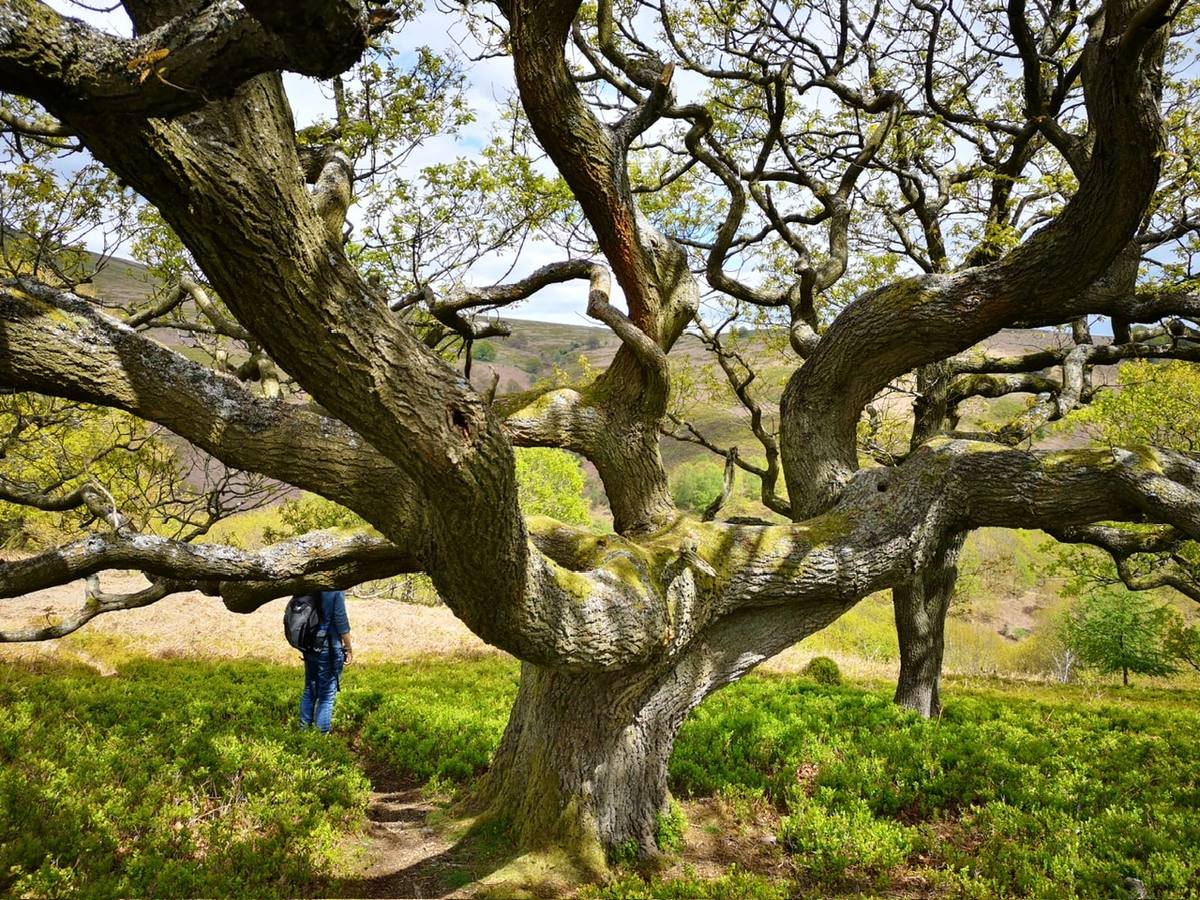
There’s something fundamentally peaceful about feeling small whilst being surrounded by giants.
There’s something fundamentally comforting about feeling as one with the tree you are resting against.
*
Usually, I invite my readers to engage in some little exercises at the end of my articles, but, today, I want to invite you for one at the beginning, before we enter intellectual ponderings.
When we are weighed down by the worldly demands, when the bills need paying, the car needs MOT’ing, emails need responding to, laundry needs doing, our headspaces are ill-equipped to appreciate topics like the subject of this piece. There is no fault within us; our brains have naturally and biologically built-in limited capacity, and so the very things that ensure our survival within whatever systems we are a part of must take priority.
But if you find yourself here, reading this, I want you to have the best chance of making the most of the time spent reading what’s coming, and I believe that you may find yourself being able to connect to the things I’ll be talking about better if you are given a chance to experience something that would temporarily give your brain some rest first. It should also help you to closer relate to the concept of ‘Nature-connectedness’ rather than approach it from a somewhat abstract, detached position.
INVITATION. Close your eyes for a minute (after you finish reading the instruction). Sit back comfortably; if you can, lean into whatever you are resting against. Basically, do whatever you need to do to give your body an opportunity to relax, where it doesn’t have to exert effort to keep you upright, supporting yourself. Where it can slump into relaxation. Then, take yourself back to the time when you intentionally and deliberately went out into Nature; whether it’s a park, a forest, seaside, riverside, etc. Or a time when you found yourself walking through a city park, with things-to-do keeping your head buzzing and feeling full and suddenly being pulled out of your head and into the present moment by either the sight of a beautiful flower or a sound of a bird song or a sound of crashing wave or trickle of the river. Of anything that made you notice where you are and what’s around you and temporarily silenced that buzz in your head. Once you’ve taken yourself back to that moment, stay in it for a little while. The memory of it will most likely have started in your head; of sights or of sounds. But if you relax into it for a little bit longer, you’ll be able to start feeling it in your body, too. That feeling when you slowed down for long enough to deliberately and intentionally breath in the sea or forest air. That feeling of your chest expanding and that feeling of slight awe and calm. Or when you were pulled, as if by some force outside of you, to touch the leaf or the bark of the tree that unexpectedly pulled you out of your busy head. The sources and opportunities of these moments are endless, and we all have our own memories of such experiences.
When the memory of your chosen moment travels down from your head and into your body and you start FEELING it, not just observing, this is when you anchor it. The feeling. Stay with it for a little while. A minute or two or however long you wish to bathe in it.
That’s the feeling of Nature-connection I am talking about. We’ve all felt it, however infrequently and however long ago.
Hang on to it.
*
It’s been a long time since the suggestion that nature is good for us has been accepted as a fact.
Some time ago, I had the pleasure and privilege to listen in to a webinar so kindly offered for free by Psychedelics Today where, among other things, it was discussed how psychedelic experiences have the power to enhance our sense of connectedness to nature and the ripple effect this sense of connectedness might have in terms of individual wellbeing, community wellbeing and the wellbeing of our mother Earth.
Whilst I am absolutely fascinated by all the new developments in Psychedelic-Assisted therapy research and application that I monitor as closely as I can, it is often discussed in the context of the Western science-making paradigms: very clinical, very protocoled, very much disconnected from the source. Again, whilst fascinated and hopeful, simultaneously, I feel fear that the ancient practices stand to be perverted and yet another natural resource will soon be commodified, as a result of which further damage to the indigenous communities and their native ecosystems will be caused.
Commodity does not know reciprocity.
Commodity does not care for a true sense of well-being; it only cares to get return on investment while patching you up so to maintain your productive and purchasing power on both of which it depends.
I mean, of course, I love the sound and premise of neuroplastogenesis (the brain’s ability to form new connections) – especially now that I’m long past my spring-chicken stage of life – that seems to be becoming a bit of a buzz word in today’s clinical-as-we-know-it setting; regardless, it was truly refreshing to be privy to a discussion that focused on a genuinely holistic, rather than the prevailing reductionist, view of what we are, on what is good for us and how this ‘good’ can be achieved.
Among all the weird and wonderful things that I heard on that webinar, there was one that made a mark on the core of me: there is no substitution for the nourishment that feeling connected, RELATED to the nature around us gives us.
It is time to change the ‘health=absence of disease’ paradigm that still dominates Western medicine.
Absence of a disease is not wellbeing.
It is time to adopt a ‘health=abundance’ of true, holistic wellbeing paradigm.
Actually, the best time was yesterday. The second best is today.
*
While this is being spoken quite a bit in the psychedelics field – because the psychedelic experiences, the origin of this medicine and the historic stewardship of the environments they inhabit demand that Nature and all She entails remain a part of the conversation – the premise – or, rather, the truth of it – of the importance of feeling connected to our natural environment is in and of itself stretches way outside of this field.
It is something that engulfs and envelopes our very existence.
If you ever felt isolated and alone, no matter the circumstances, you will know what disconnection feels like. It’s the worst and the most health-damaging thing that can happen to us, feeling the lack of connection.
The only way to feel connected in this world we created for ourselves that imposes on us more and more disconnection and to hang on to the connection is to cultivate it mindfully and intentionally.
The reason to practice it is to reclaim our own power in making ourselves well, without allowing ourselves to depend on the world that has its own vested interests that do not always serve our interests.
And wellbeing is not a nice-to-have.
Our wellbeing all we've got.
*
Subscribe using the bell button under the cover picture for an occasional digest sent straight to your inbox.
1reading now
Watch & subscribe
Lina Jan also publishes on YouTube
18 subscribers
One click subscribes you on YouTube - you stay here on PUBlish.
Get an email when Lina publishes